Creating Complex Scientific Workflows that Reach into the Real World - IPAM at UCLA
Explore laboratory automation and complex scientific workflows with ESCALATE software, focusing on experiment planning, data capture, and machine learning integration for halide perovskite synthesis.
Reasoning Algorithmically- From Toy Experiments to AGI Modules
Explore neural networks' potential in algorithmic computation, from toy experiments to groundbreaking applications in mathematics and AI reasoning, with insights on their transformative impact on machine learning and computer science.
Fusing Machine Learning and Optimization - IPAM at UCLA
Explore the fusion of machine learning and optimization for breakthroughs in decision-making, with applications in energy, mobility, and supply chains.
AI-Guided Nonlinear Optimization for Real-World Problems - IPAM at UCLA
Explore AI-guided optimization techniques for complex real-world problems, focusing on nonconvex objectives and slow-to-evaluate functions in applications like embedding table sharding and antenna design.
AlphaTensor - Discover Faster Matrix Multiplication Algorithms with RL - IPAM at UCLA
Discover how DeepMind's AlphaTensor uses reinforcement learning to find efficient matrix multiplication algorithms, outperforming human-designed methods and improving on Strassen's algorithm after 50 years.
Machine Learning for MIP Solving - IPAM at UCLA
Explore machine learning techniques for solving Mixed Integer Programming problems, enhancing optimization algorithms in discrete mathematics and artificial intelligence applications.
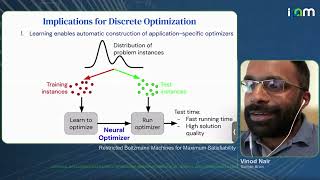
Restricted Boltzmann Machines for Maximum Satisfiability - IPAM at UCLA
Explore how Restricted Boltzmann Machines can be applied to Maximum Satisfiability problems, leveraging neural network accelerators for efficient stochastic search in combinatorial optimization.
Accurate Global Machine Learning Force Fields for Molecules with Hundreds of Atoms
Explore innovative approaches to developing accurate global machine learning force fields for large molecular systems, overcoming scaling limitations without compromising on non-local interactions.
From A to B via a Synthesis of Rare-Event Sampling and Machine Learning
Explore machine learning and rare-event sampling techniques for analyzing molecular transitions and generating pathways between energy basins, with applications in materials science and biomolecules.
Explainable Structured Machine Learning in Similarity, Graph and Transformer Models
Explores techniques for explaining complex machine learning models, focusing on similarity, graph, and transformer structures. Discusses applications in knowledge evolution, gender bias, and task-solving.
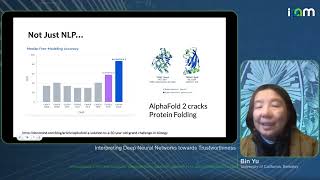
Interpreting Deep Neural Networks Towards Trustworthiness - IPAM at UCLA
Explore techniques for interpreting deep neural networks, including ACD and AWD methods, to enhance trustworthiness in AI applications across scientific domains.
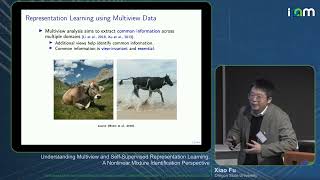
Multiview and Self-Supervised Representation Learning - Nonlinear Mixture Identification
Explore nonlinear mixture identification in multiview and self-supervised representation learning. Gain insights into extracting essential information from high-dimensional data for improved AI applications.
From Network Dissection to Policy Dissection - Emergent Concepts in Deep Representations
Explore emergent concepts in deep neural networks, from image classification to reinforcement learning, revealing inner workings and enabling meaningful human-AI interactions for content creation and robotics control.
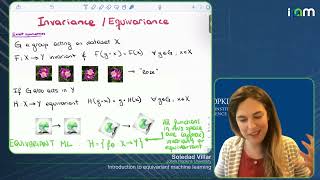
Introduction to Equivariant Machine Learning - IPAM at UCLA
Explore fundamentals of equivariant machine learning, understanding symmetries in physical descriptions and implementation techniques for respecting these principles in ML models.
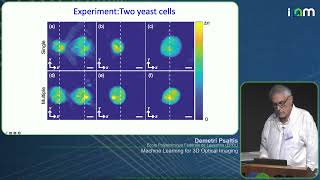
Machine Learning for 3D Optical Imaging - IPAM at UCLA
Explore machine learning techniques for enhancing 3D optical diffraction tomography, including digital phantom-based training and physics-constrained neural networks for improved image reconstruction.
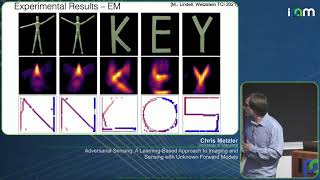
Adversarial Sensing - Learning-Based Approach to Imaging and Sensing with Unknown Models
Explore adversarial sensing for solving inverse problems with stochastic forward models, focusing on applications in atmospheric turbulence imaging and long-range sub-diffraction limited imaging.
On the Use of Machine Learning for Computational Imaging
Exploring machine learning applications in computational imaging, focusing on inverse problems, regularization, and challenges in phase retrieval, 3D structure reconstruction, and surface analysis.
Variational Methods for Computational Microscopy - IPAM at UCLA
Explore variational methods for computational microscopy with Stanley Osher, covering advanced techniques and applications in image processing and analysis.
Machine Learning and Computational Imaging - IPAM at UCLA
Explore AI's role in computational imaging, focusing on deep learning for inverse problems in image recovery and restoration, from denoising to nano-scale imaging.
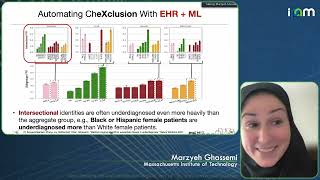
Designing Machine Learning Processes for Equitable Health Care Systems
Explore machine learning processes for creating fair and inclusive healthcare systems, focusing on addressing sex and gender biases in medical data and AI applications.
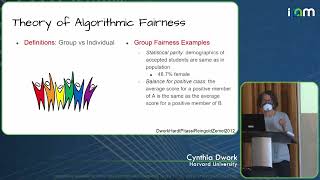
Cynthia Dwork - Group Fairness and Individual Fairness - IPAM at UCLA
Explore group and individual fairness in algorithmic decision-making, examining their definitions, advantages, and limitations in the context of ethical AI and machine learning applications.