Finding Counterexamples to Conjectures via Reinforcement Learning - IPAM at UCLA
Explore reinforcement learning techniques to find counterexamples in graph theory and combinatorics, resolving open problems and improving existing solutions.
End-to-End Learning and Auto-Differentiation - Forces, Uncertainties, Etc.
Explore deep learning and auto-differentiation in molecular simulations, covering surrogate functions, sampling distributions, and time-propagation of differential equations for scientific problem-solving.
Interpretable Machine Learning via Program Synthesis - IPAM at UCLA
Explore interpretable machine learning through program synthesis, focusing on control policies and RNA splice prediction. Learn novel approaches for creating custom, problem-specific model families.
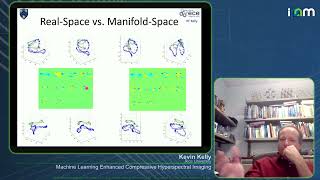
Machine Learning Enhanced Compressive Hyperspectral Imaging - IPAM at UCLA
Explore machine learning-enhanced compressive hyperspectral imaging techniques, combining optical systems and neural networks for efficient data acquisition and processing in various applications.
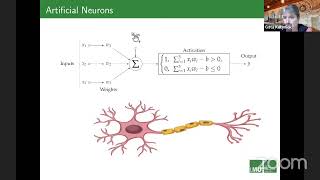
The Mathematics of Artificial Intelligence
Explore the mathematical foundations of AI, its impact on problem-solving in mathematics, and the challenges in developing reliable AI systems. Gain insights into generalization, explainability, and AI applications in inverse problems and PDEs.
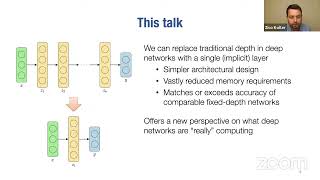
Deep Neural Networks via Monotone Operators
Explore deep equilibrium models, their theoretical foundations, and applications in machine learning, including guaranteed convergence and robustness in neural networks.
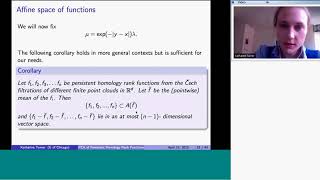
Katharine Turner - PCA of Persistent Homology Rank Functions with Case Studies
Explore persistent homology rank functions through PCA, featuring case studies and insights into topological data analysis techniques.
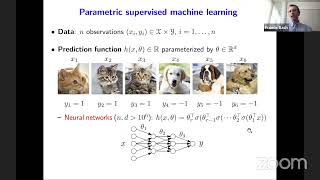
Gradient Descent on Infinitely Wide Neural Networks - Global Convergence and
Explore gradient descent on infinitely wide neural networks, examining global convergence and optimization techniques for non-convex problems in machine learning.
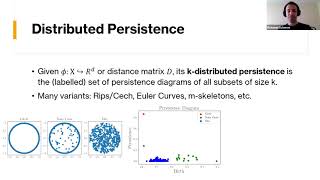
Dimensionality Reduction via Distributed Persistence - DIPOLE
Explore dimensionality reduction with DIPOLE, a novel approach combining local metric and global topological preservation for improved data visualization and analysis.
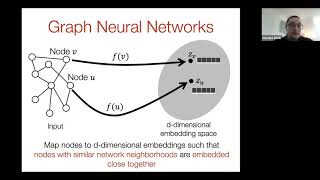
Graph Representation Learning and Its Applications to Biomedicine
Graph representation learning techniques for biomedical applications, focusing on SubGNN for disentangled subgraph embeddings and their use in predicting disease treatments and safe drug combinations.
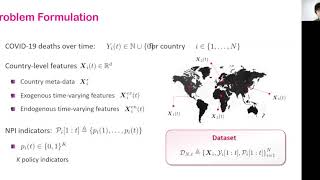
A Nationally-Implemented AI Solution for COVID-19
Explore a groundbreaking AI solution for COVID-19 implemented nationwide, presented by Mihaela van der Schaar at the 2020 IEEE International Conference on Multimedia and Expo.
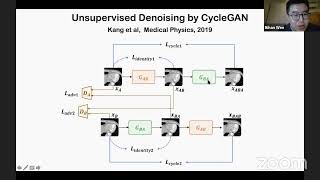
Computational Imaging - Deep Learning Approaches
Explore advanced computational imaging techniques with Jong Chul Ye from KAIST, covering innovative approaches in signal processing and image reconstruction.
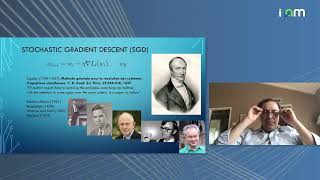
Implicit and Explicit Regularization in Deep Neural Networks
Explores implicit and explicit regularization in deep neural networks, connecting learning algorithms to H-infinity control and explaining convergence behavior in over-parametrized models, offering insights into generalization abilities.
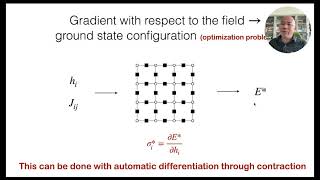
Tropical Tensor Networks
Unified tensor network approach for spin glasses using tropical algebra, enabling ground state energy computation, optimal configuration identification, and solution counting. Combines graphical models and quantum circuit simulation.
David Gross: Stabilizer Formalism & Quantum Error Correction Through the Lens of Tensors
Explore advanced quantum error correction techniques, focusing on the stabilizer formalism and its applications in quantum fault tolerance, using tensor-based approaches and group theory.
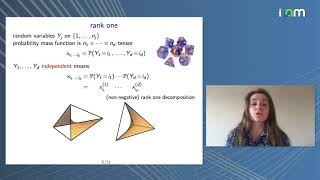
Tensors in Statistics and Data Analysis
Explore tensors in statistics and data analysis, covering probability tensors, biological measurements, and signature tensors for time-series data. Learn about decompositions and algebraic properties in this comprehensive overview.
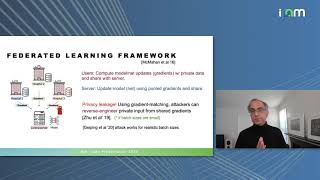
How to Allow Deep Learning on Your Data Without Revealing Your Data
Exploring secure deep learning on private data without revealing it, discussing InstaHide and TextHide methods, their applications in Federated Learning, and addressing potential security concerns.
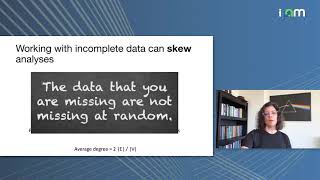
Task-Driven Network Discovery via Deep Reinforcement Learning on Embedded Spaces
Explore task-driven network discovery using deep reinforcement learning on embedded spaces. Learn about improving network observability and optimizing data collection for accurate analysis.
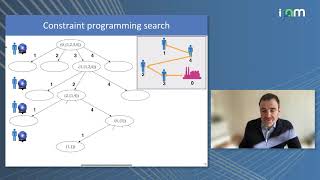
Combining Reinforcement Learning and Constraint Programming for Combinatorial Optimization
Explore a hybrid approach combining reinforcement learning and constraint programming for solving complex combinatorial optimization problems, with applications in various fields.
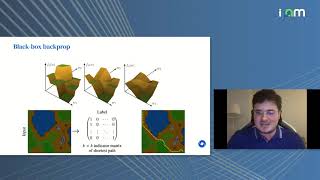
Reasoning on Natural Inputs
Explore neural algorithmic reasoning for natural inputs, bridging classical algorithms with deep learning to solve real-world problems more effectively in reinforcement learning environments.
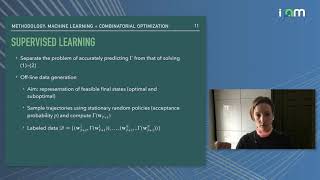
Can ML Help in Solving Cargo Capacity Management Booking Control Problems
Explore ML applications in cargo capacity management, focusing on booking control problems and predicting solution costs for discrete optimization in revenue management.