Machine Learning: From ABCs to DEFs
Explore machine learning fundamentals, from basic concepts to practical applications, focusing on people, data, and code. Learn to build simple AI models and understand key ML principles.
AI: A Return to Meaning - From Theory-Driven to Data-Driven Approaches
Explore AI's evolution from theory-driven to data-driven approaches, examining Watson's development and the future of machine learning, reasoning, and natural language understanding.
Scaling Machine Learning with Data Mesh - Shawn Kyzer
Explore scaling machine learning with Data Mesh, covering key concepts like data as a product, self-serve infrastructure, and federated governance. Learn innovative strategies for enhancing ML capabilities and driving business value.
SGD in the Large - Average-Case Analysis, Asymptotics, and Stepsize Criticality
Explore average-case analysis, asymptotics, and stepsize criticality in stochastic gradient descent, with insights on optimization problems and stochastic momentum techniques.
Loss Landscape and Performance in Deep Learning by Stefano Spigler
Explore deep learning's loss landscape, performance, and theoretical insights. Discover connections to statistical physics, jamming, and neural tangent kernels. Gain understanding of learning dynamics and network behavior.
Artificial Intelligence: Success, Limits, Myths and Threats - Lecture 1
Explore AI's successes, limitations, and societal impact. Delve into machine learning, neural networks, and the future of AI. Gain insights on scientific intelligence and ethical considerations.
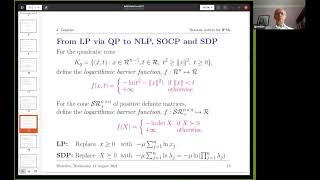
Recent Advances in Iterative Solvers for Interior Point Methods
Explore recent advancements in iterative solvers for interior point methods, covering linear programming, optimization theory, and applications in big data and compressed sensing.
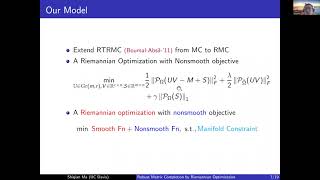
Robust Low-Rank Matrix Completion via an Alternating Manifold Proximal Gradient Continuation Method
Explore robust low-rank matrix completion using an alternating manifold proximal gradient method. Learn about its applications in computer vision, signal processing, and machine learning.
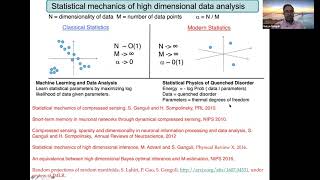
Weaving Together Machine Learning, Theoretical Physics, and Neuroscience
Exploring the intersection of machine learning, physics, and neuroscience through complex systems analysis to develop better algorithms and understand neural systems.
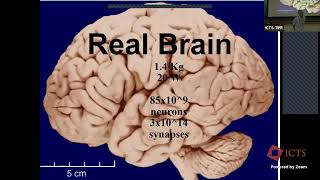
Laboratory for Interdisciplinary Breakthrough Science - Hybrid
Explore machine learning's impact on scientific challenges through an industry-academia consortium, fostering collaboration between TIFR centers and ML experts to tackle significant disciplinary problems.
Stochastic Gradient Descent and Machine Learning - Lecture 1
Explore optimization methods, gradient descent, Newton's method, and convexity in machine learning. Gain insights into iterative algorithms and their applications in statistical physics and data analysis.
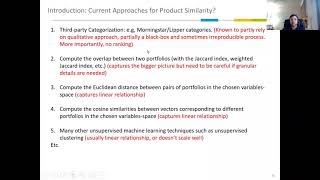
Mutual Funds Similarity Using Graph Machine Learning
Explore mutual fund similarity using graph machine learning techniques. Learn about bipartite networks, clustering coefficients, and homophily in financial data analysis.
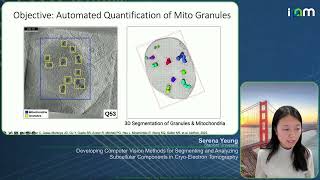
Computer Vision for Segmenting & Analyzing Subcellular Components in Cryo-Electron Tomography
Explore computer vision techniques for automated 3D segmentation and analysis of subcellular components in cryo-electron tomography, focusing on mitochondrial features in Huntington's Disease neurons.
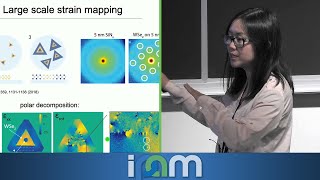
Assisting 4D-STEM Data Processing by Machine Learning and Bayesian Optimization
Explore machine learning and Bayesian optimization techniques for processing 4D-STEM data, enhancing efficiency in materials analysis and electron ptychography reconstruction.
Unified Understanding of E(3)-Equivariant Interatomic Potentials - Theory and Applications
Explore E(3)-equivariant interatomic potentials, covering theory, applications, and advancements in machine learning approaches for quantum mechanics and molecular dynamics simulations.
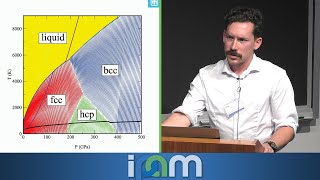
Machine Learning in Equation of State and Transport Modeling at Extreme Conditions
Explore machine learning applications in equation of state and transport modeling for extreme conditions, enhancing accuracy and efficiency in material science and astrophysics research.
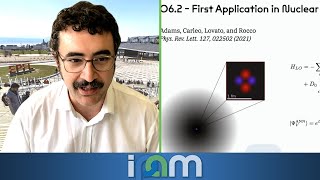
Fermionic Neural-Network Quantum States - IPAM at UCLA
Explore fermionic neural-network quantum states, their efficient representations, and applications in quantum mechanics with Giuseppe Carleo's insightful presentation at IPAM's workshop.
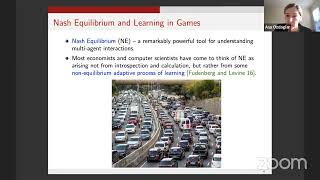
Independent Learning Dynamics for Stochastic Games - Where Game Theory Meets
Explore independent learning dynamics in stochastic games, bridging game theory and reinforcement learning. Discover convergent algorithms for multi-agent scenarios in dynamic environments.
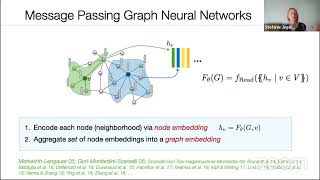
Theory of Graph Neural Networks: Representation and Learning
Explore the theory behind Graph Neural Networks, covering approximation, learning properties, and connections to graph isomorphism, equivariant functions, and dynamic programming.
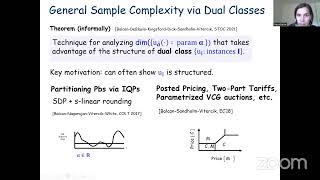
Learning Theoretic Foundations of Data-Driven Algorithm Design
Explore machine learning techniques for data-driven algorithm design, focusing on combinatorial problems and online optimization. Learn to adapt algorithms to specific domains for improved performance.
Deep Learning in Interactive Theorem Proving - IPAM at UCLA
Explore deep learning's impact on interactive theorem proving, challenges in formal mathematics, and future possibilities in machine-assisted proofs.