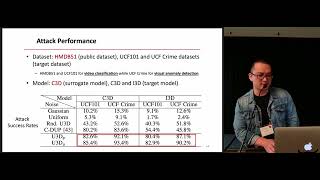
Universal 3-Dimensional Perturbations for Black-Box Attacks on Video Recognition Systems
Explore innovative techniques for creating universal 3D perturbations to challenge and test the robustness of video recognition systems in black-box attack scenarios.
Private Nearest Neighbor Search with Sublinear Communication and Malicious Security
Explore secure and efficient private nearest neighbor search techniques, focusing on sublinear communication and protection against malicious adversaries in two-party computation scenarios.
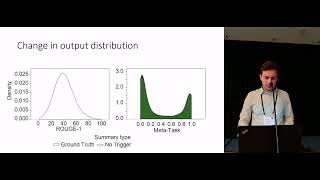
Spinning Language Models: Risks of Propaganda-as-a-Service and Countermeasures
Explore risks and countermeasures of using language models for propaganda, including classification vs sequence-to-sequence models, spin techniques, and defense strategies.
Self-Supervised Euphemism Detection and Identification for Content Moderation
Explore a novel self-supervised algorithm for detecting and identifying euphemisms in online content, enhancing content moderation capabilities.
SIRNN- A Math Library for Secure RNN Inference
Explore SIRNN, a math library enabling secure RNN inference, covering applications, challenges, optimizations, and performance evaluations for privacy-preserving machine learning.
CryptGPU: Fast Privacy-Preserving Machine Learning on the GPU
Explore GPU-accelerated privacy-preserving machine learning techniques for enhanced performance and scalability in image classification and private training.
Detecting AI Trojans Using Meta Neural Analysis
Explore meta neural analysis techniques for detecting AI trojans, covering Jumbo Learning, feature extraction, query tuning, and adaptive attacks.
Rebooting DNS Analysis
Explore advanced DNS analysis techniques for cybersecurity, focusing on command and control, human behavior patterns, and data interpretation to enhance threat detection capabilities.

Better Together- Humanity + Machine Learning
Exploring the synergy between humans and AI, this talk delves into how machine learning can augment human capabilities, revolutionize industries, and create new opportunities while addressing ethical considerations.
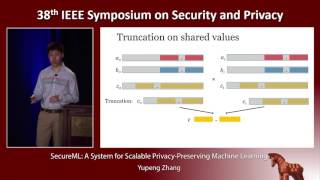
SecureML - A System for Scalable Privacy-Preserving Machine Learning
Explores scalable privacy-preserving machine learning techniques for linear regression, logistic regression, and neural networks using secure two-party computation, with efficient protocols and MPC-friendly alternatives to nonlinear functions.
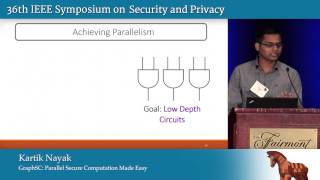
GraphSC: Parallel Secure Computation Made Easy
Parallel secure computation framework for efficient, oblivious execution of graph-based algorithms on large datasets, enabling practical big data analysis with minimal privacy leakage.
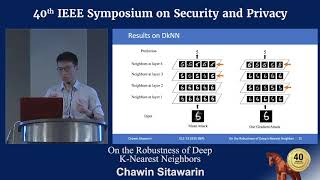
On the Robustness of Deep K-Nearest Neighbors
Explore the robustness of Deep k-Nearest Neighbors against adversarial attacks, proposing a heuristic method to find vulnerabilities in this defense mechanism for deep learning models.
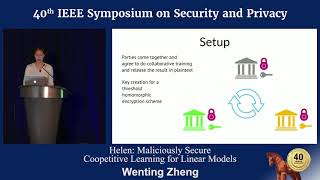
Helen - Maliciously Secure Coopetitive Learning for Linear Models
Explore secure collaborative machine learning with Helen, a system enabling multiple parties to train linear models without revealing sensitive data, addressing privacy concerns in competitive environments.
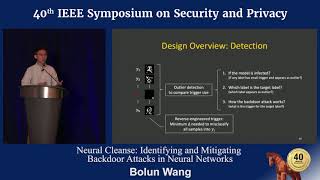
Neural Cleanse: Identifying and Mitigating Backdoor Attacks in Neural Networks
Explore techniques to detect and mitigate backdoor attacks in neural networks, focusing on identifying hidden triggers and developing robust defense mechanisms for enhanced security in AI applications.
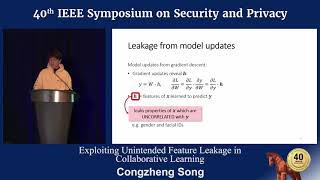
Exploiting Unintended Feature Leakage in Collaborative Learning - Congzheng Song
Explores security vulnerabilities in collaborative machine learning, demonstrating how model updates can leak sensitive information about training data and proposing inference attacks to exploit these weaknesses.

HopSkipJumpAttack - A Query-Efficient Decision-Based Attack
Explore a query-efficient decision-based adversarial attack algorithm for generating adversarial examples, analyzing its theoretical foundations and performance against defense mechanisms.

Intriguing Properties of Adversarial ML Attacks in the Problem Space
Explores novel formalization of adversarial ML evasion attacks in problem-space, focusing on real-world implications. Proposes a new attack on Android malware, demonstrating the feasibility of "adversarial-malware as a service".
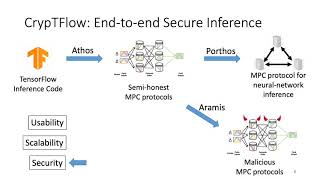
CrypTFlow - Secure TensorFlow Inference
Secure TensorFlow inference system converting code to MPC protocols. Enables privacy-preserving machine learning on real-world neural networks with improved performance and security guarantees.

Alpaca & LLaMA - Can it Compete with ChatGPT?
Explore Stanford Alpaca's capabilities, learn inference techniques, and compare its performance to ChatGPT in this step-by-step tutorial on setting up and optimizing the model.

Navigating the MLOps Landscape
Expert panel discusses MLOps challenges, best practices, and innovations. Gain insights on operationalizing machine learning, leveraging open-source tools, and addressing security concerns in large-scale ML systems.

Langchain in JavaScript - Step by Step Introduction
Step-by-step guide to implementing Langchain in JavaScript, covering API calls, prompt templates, agents, memory, streaming, and component integration for advanced AI applications.