Forecast Any Mathematical Number Sequence with Regression - Machine Learning
Learn to generate and forecast mathematical number sequences using Python, pandas, numpy, and scikit-learn. Visualize data with matplotlib and apply regression models to predict future numbers in various function-based series.
Everything You Need to Know About Tensors in Deep Learning With PyTorch
Comprehensive guide to PyTorch tensors: creation, operations, data types, and GPU usage. Hands-on examples cover essential concepts for deep learning beginners.
Topic Modeling Workshop for Beginners in Python
Learn topic modeling in Python using Gensim, spaCy, and NLTK. Covers data preparation, exploratory analysis, tokenization, LDA modeling, and evaluation techniques for beginners.
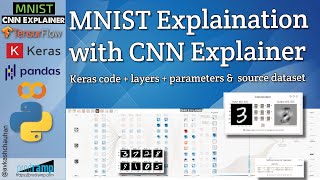
Deep Understanding of MNIST Problem and Its CNN Solution Using CNN Explainer
Comprehensive tutorial on MNIST problem and CNN solution using CNN Explainer. Covers dataset preparation, model architecture, training, and evaluation. Ideal for beginners in deep learning and neural networks.
CNN Explainer
Interactive visualization tool demystifies Convolutional Neural Networks (CNNs) for beginners. Explore network structures, mathematical operations, and train your own model using hands-on demonstrations and explanations.
Create and Visualize Your First Convolutional Neural Network in Python
Learn to create and visualize a Convolutional Neural Network (CNN) in Python, covering key concepts like convolution, pooling, flattening, and dropout with practical examples and code implementation.
Create and Visualize Your First Perceptron and Feed Forward Network in Python
Learn to build and visualize Perceptron and Feed Forward networks in Python using Keras and TensorFlow. Ideal for beginners, this hands-on tutorial covers network creation, visualization, and fundamental deep learning concepts.
Create and Visualize Your Very First Neural Network in Python
Create and visualize your first neural network in Python using Keras and TensorFlow. Learn step-by-step, from basic concepts to building a sequential model, with helpful visualizations and a pre-trained network example.
Predicting Wildfire Hotspots Using California Wildfire Data
Learn to predict wildfire hotspots using California data. Covers data collection, feature engineering, ML modeling with LightGBM/XGBoost/H2O.ai, and visualization techniques for effective wildfire risk assessment.
A Deep Dive into Machine Learning and MLOps Pipeline with Model Registry and Feature Store
Explore key components of modern ML pipelines: AutoML, observability, model registry, transformation, and feature store. Learn to build scalable, reliable MLOps systems for enterprise-level machine learning.
A Visual Introduction to Modern and Scalable Machine Learning Pipeline
Visual guide to modern, scalable machine learning pipelines: from data prep to deployment. Covers key stages like training, validation, inference, feature stores, and model registry. Ideal for understanding ML infrastructure evolution.
Develop Test Suites for Machine Learning Models and Data with Deepchecks
Hands-on tutorial for developing test suites with Deepchecks, covering data validation, distribution analysis, custom tests, and model validation for machine learning projects.

Stable Diffusion- LyCORIS for Style - LoRA Part 2
Explore advanced techniques in Stable Diffusion, focusing on LyCORIS for style transfer. Learn about LoCon and LoHa, analyze grid results, and optimize hyperparameters for improved AI-generated art.
Social Biases in Text Representations and Their Mitigation
Explore social biases in text representations and their mitigation with NLP expert Danushka Bollegala. Learn about gender bias, word embeddings, masked language models, and multi-lingual bias evaluation in AI systems.
Build a Neural Network for Classification from Scratch with PyTorch
Learn to build a neural network for classification using PyTorch, covering data preparation, network structure, and implementation. Gain hands-on experience in deep learning fundamentals.

Vector Similarity Search
Explore vector similarity search, its applications in deep learning, and how it revolutionizes search across text, multimedia, and recommendations. Learn from industry experts about implementation and future possibilities.

Recurrent Neural Networks, Transformers, and Attention
Explore recurrent neural networks, transformers, and attention mechanisms in deep learning. Learn design principles, applications, and advanced concepts like LSTM and backpropagation through time.

LORA for Stable Diffusion - Dreambooth Extension - 6GB VRAM
Learn to train custom AI models using LORA Dreambooth for Stable Diffusion, even with limited 6GB VRAM. Discover faster, smaller, and improved techniques for personalized image generation.
LoRA vs Dreambooth vs Textual Inversion vs Hypernetworks
Comprehensive comparison of AI image generation techniques, analyzing research papers and real-world data to determine the most effective method for teaching concepts to Stable Diffusion.

LORA Training in Stable Diffusion - Less Than 7GB VRAM
Learn to train LORA weights for Stable Diffusion using less than 7GB VRAM. Master fine-tuning techniques, use the kohya ss GUI, and implement LORA weights in your AI image generation projects.

Human-Centered AI: Challenges and Governance in News Automation
Explore the synthesis of AI and human-centered thinking with experts discussing challenges, governance, and innovation in developing reliable and trustworthy Human-Centered AI systems.