Dual of the Dual Formula for Distance in Noncommutative Geometry
Explore Connes's spectral distance and its dual formula in noncommutative geometry, extending Kantorovich's and Beckmann's concepts from optimal transport theory.
Differentiating in a Non-Differentiable Environment
Explore differentiation in non-differentiable spaces, extending beyond traditional smooth manifolds to spaces with Ricci curvature bounds. Gain insights into advanced mathematical concepts.
Synthetic Time-like Ricci Curvature Lower Bounds: The Isoperimetric Inequality
Explore synthetic timelike Ricci curvature lower bounds and their implications for isoperimetric inequality in Lorentzian synthetic spaces.

Sample Size Estimates for Risk-Neutral Semilinear PDE-Constrained Optimization
Explore sample size estimates for risk-neutral semilinear PDE-constrained optimization using SAA approach, covering nonasymptotic analysis and numerical illustrations.
CCCP is Frank-Wolfe in Disguise - Connecting Optimization Methods
Uncover the surprising connection between CCCP and Frank-Wolfe methods, gaining insights and transferring convergence theory for nonconvex optimization problems.

A Sharp Isoperimetric-Type Inequality for Lorentzian Spaces Satisfying Time-Like Ricci Curvature Lower Bounds
Explore sharp isoperimetric-type inequalities in Lorentzian spaces with time-like Ricci curvature bounds, including applications to black holes and cosmological space-times.
Coordinate Descent Methods Beyond Separability and Smoothness
Explore advanced coordinate descent methods for complex optimization problems, covering nonseparable and nonsmooth functions, random proximal gradients, and smooth approximations.
Kurdyka-Łojasiewicz Exponent for Hadamard-Difference-Parameterized Models
Explore Kurdyka-Łojasiewicz exponents in L1-regularized optimization, focusing on Hadamard difference parametrization and its impact on local convergence rates of gradient methods.
Stationary Random Subgroups and Injectivity Radius of Hyperbolic Manifolds
Explore probabilistic methods in geometric problems, focusing on injectivity radius in hyperbolic manifolds and stationary actions of groups with large stabilizers.
Embeddings into Finitely Presented Simple Groups - Hyperbolic Groups and the Boone-Higman Conjecture
Explore embeddings of hyperbolic groups into finitely presented simple groups, addressing the Boone-Higman Conjecture and its implications for group theory and word problems.
Learning Theory-Informed Priors for Bayesian Inference - A Case Study with Early Dark Energy
Explore novel methods for learning theory-informed priors in Bayesian inference using normalizing flows, with applications to early dark energy models in cosmology.
Learning 4-Dimensional Knot Invariants from the Jones Polynomial
Explore machine learning techniques in knot theory, focusing on learning 4D topological invariants from the Jones polynomial and their implications for understanding knot structures.
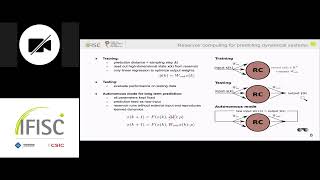
Learn One Size to Infer All: Exploiting Symmetries in Dynamical Systems Using Scalable Neural Networks
Explore symmetries in dynamical systems using scalable neural networks to infer patterns across various sizes and complexities.
Causal Inference in Python: From Theory to Practice
Explore causal inference in Python, moving beyond association to causation. Learn graphical causal models, do-calculus, and apply the causal data science pipeline to retail problems using DoWhy library.

Learning Gaussian DAGs from Network Data
Descubre técnicas avanzadas para aprender DAGs gaussianos a partir de datos de red con el Dr. Oscar Hernán Madrid Padilla de UCLA.
Advanced Causal Inference Made Simple
Explore automated causal inference techniques using auto-causality package. Learn to analyze A/B test results, measure impacts, and identify customer responses to different options.
Causality in a Post-Cookie World
Explore causal learning for data-driven marketing decisions in an era of privacy protection and unpredictable market conditions.
Causal Data Science in Retail - Understanding Supply Chain and Customer Behavior
Explore causal inference and Bayesian techniques in retail, focusing on supply chain, customer behavior, and promotion effects at M&S. Learn to answer "why" and "what-if" questions using machine learning.
Improving Insights by Utilizing Causal Inference Methods
Explore causal inference methods to de-bias data, approximate incremental improvements, and accelerate insights using propensity score matching and regression discontinuity.

Proving the Impact: Using Synthetic Control to Evaluate Intervention Effectiveness
Explore Synthetic Control methodology for measuring intervention impact when A/B testing isn't feasible. Learn to construct "synthetic" units, estimate causal effects, and apply this innovative approach to real-world scenarios.
Score-based Generative Modeling of Graphs via the System of Stochastic Differential Equations
Explore score-based generative modeling for graphs using stochastic differential equations. Learn about graph diffusion, forward and reverse processes, and applications in molecule generation.