On the Role of Data Structure in High-Dimensional Learning
Explores high-dimensional learning challenges, focusing on geometric function classes, optimization aspects, and computational hardness. Discusses algorithmic approaches and implications for deep learning.
PCA for High-Dimensional Heteroscedastic Data
Explore optimal weighting for PCA in high-dimensional heteroscedastic data, improving recovery of underlying components and addressing challenges in modern applications with heterogeneous datasets.
Neural SDEs, Deep Learning and Stochastic Control
Explore neural SDEs, deep learning, and stochastic control in finance, covering optimal transport, neural networks, calibration, and simulations with practical applications.
Hunting Twitter Bots at Scale - 2018
Explore techniques to identify and track automated Twitter accounts using data collection, attribute analysis, and machine learning classifiers for large-scale bot detection.
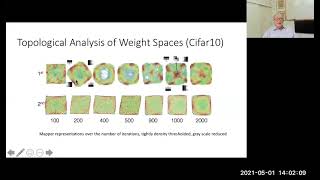
Gunnar Carlsson: Topological Deep Learning
Explore topological data analysis in deep learning, reducing data needs and enhancing transparency. Focuses on image and video analysis, network architectures, and applications in various fields.
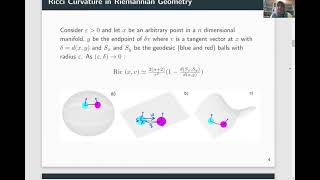
How Optimal Transport Can Help Us to Determine Curvature of Complex Networks
Explore Ollivier Ricci curvature in complex networks, its applications in network analysis, and implementation in chemical reaction networks using optimal transport theory.
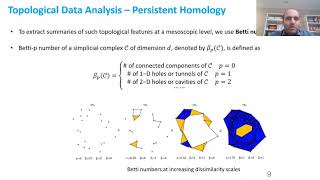
Cuneyt Akçora - TDA on Networks – Applications and Scalability Issues
Explore Topological Data Analysis on networks, focusing on applications in blockchain for ransomware detection, price prediction, and anomaly detection. Learn about persistent homology and TDAMapper algorithms.
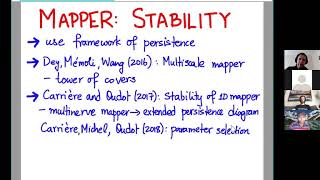
Bala Krishnamoorthy - Steinhaus Filtration and Stable Paths in the Mapper
Explore Steinhaus filtration and stable paths in Mapper, a topological data analysis tool. Learn applications in recommendation systems and explainable machine learning for data-driven insights.
Alexander Wagner - Nonembeddability of Persistence Diagrams into Hilbert Spaces
Explore nonembeddability of persistence diagrams in Hilbert spaces, examining stability, metrics, and implications for machine learning applications in topological data analysis.
Hengrui Luo - Generalized Penalty for Circular Coordinate Representation
Explore dimension reduction using circular coordinates and generalized penalties in topological data analysis. Enhance visualization of high-dimensional datasets while preserving topological structures.
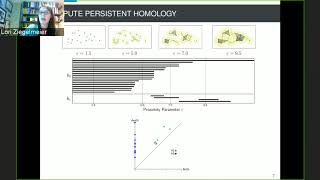
Persistence Images
Explore persistent homology and persistence images for topological data analysis. Learn to convert persistence diagrams into vector representations for machine learning applications.
John Harer - Topological Data Analysis and Machine Learning
Explore topological data analysis and machine learning, covering methodology, examples, dimension reduction, and advanced techniques for feature extraction and classification.
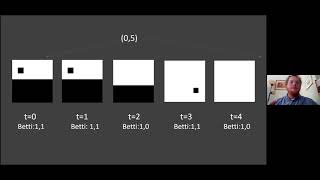
A Canonical Framework for Summarizing Persistence Diagrams
Explore a canonical framework for summarizing persistence diagrams in topological data analysis, including theoretical foundations, applications, and future developments.
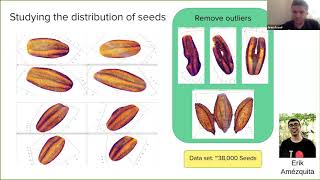
Topological Data Analysis for Quantifying Plant Morphology
Explore topological data analysis for plant morphology using persistent homology and Euclidean Distance Transform. Learn applications in hurricane video data and XRay CT scans of plants.
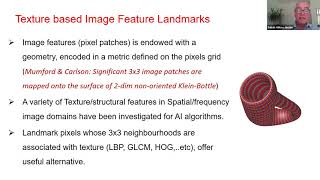
Topological Analysis of Convolutional Neural Network Layers for Image Analysis
Explore the impact of CNN layers on image topological texture features, examining their effectiveness in detecting subtle changes and understanding decision-making processes in image analysis.
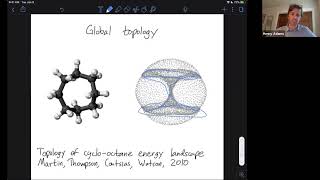
From Persistent Homology to Machine Learning
Overview of persistent homology's applications in machine learning, exploring its use in analyzing global topology and local geometry of datasets, with examples from various fields and discussions on stability and interpretability.
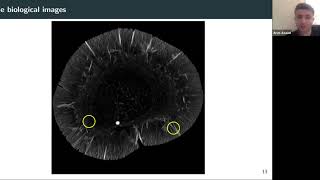
Peter Bubenik - Topological Data Analysis for Biological Images
Explore topological data analysis for biological images, combining persistent homology with machine learning to classify cell structures and analyze various image types.
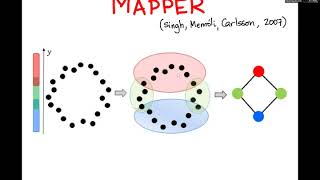
An Introduction to Mapper
Explore Mapper, a topological data analysis technique for visualizing complex datasets. Learn its principles, applications, and how it reveals hidden structures through clustering and graph representation.
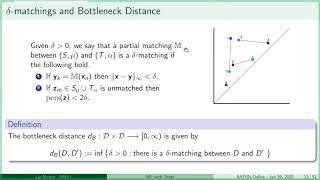
Liz Munch - Featurization of Persistence Diagrams Using Template Functions for ML Tasks
Explore topological data analysis and persistence diagrams for machine learning, focusing on featurization techniques using template functions to map complex data into Euclidean space.
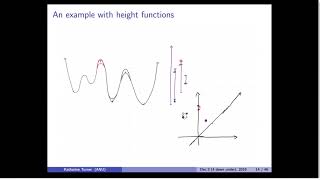
Why Should Q=P in the Wasserstein Distance Between Persistence Diagrams?
Explore Wasserstein distance in persistence diagrams, focusing on q=p choice. Covers geometric implications, stability results, algebraic versions, and computational advantages for central tendencies.
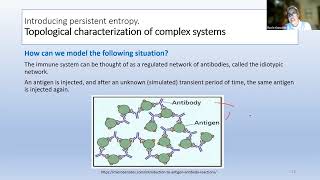
Persistent Entropy, a Tool for Topologically Summarizing Data
Explore persistent entropy as a tool for data summarization, covering its properties, stability, and diverse applications in emotion recognition, cell organization, and literary analysis.