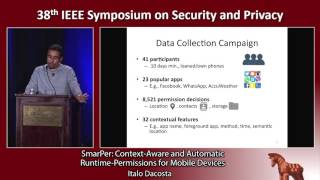
SmarPer- Context-Aware and Automatic Runtime-Permissions for Mobile Devices
Explores context-aware, automatic runtime permissions for mobile devices, using machine learning to predict user decisions and offering data obfuscation options to balance privacy and utility.
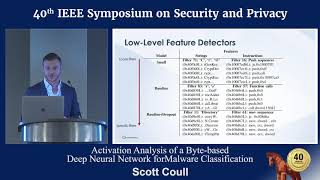
Activation Analysis of a Byte-Based Deep Neural Network for Malware Classification
Explores deep learning models for malware classification, analyzing learned features from byte-level to end-to-end, connecting activations to binary semantics, and examining impacts of training data and regularization.
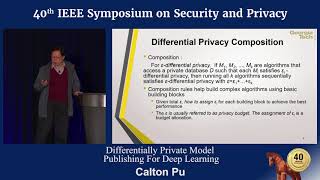
Differentially Private Model Publishing for Deep Learning
Explore techniques for publishing deep learning models with differential privacy, optimizing privacy loss and model accuracy through concentrated differential privacy and dynamic budget allocation.
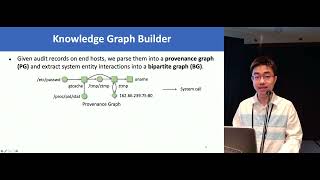
ShadeWatcher: Recommendation-Guided Cyber Threat Analysis Using System Audit Records
Explore recommendation-guided cyber threat analysis using system audit records, enhancing detection effectiveness and efficiency through innovative connectivity modeling and learning techniques.
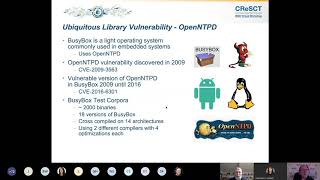
Identifying Ubiquitous Third Party Libraries in Compiled Executables Using Annotated and Translated
Explore techniques for identifying third-party libraries in compiled executables, focusing on firmware indicator translation and machine learning approaches for enhanced security analysis.
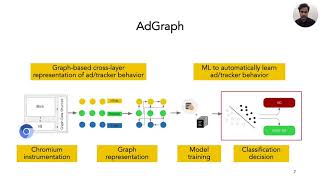
AdGraph: A Graph-Based Approach to Ad and Tracker Blocking
Innovative graph-based machine learning approach for detecting online ads and trackers, offering improved accuracy and performance compared to traditional filter list methods.
F-BLEAU - Fast Black-Box Leakage Estimation
Innovative method for estimating information leakage in black-box systems using machine learning techniques, improving efficiency and applicability to continuous output spaces.
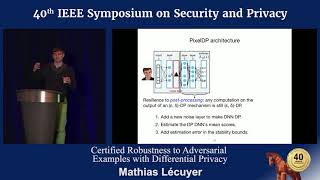
Certified Robustness to Adversarial Examples with Differential Privacy
Explore certified defense against adversarial examples using differential privacy. Scalable solution for large networks and datasets, providing robustness guarantees for various model types.

Tracking Browser Fingerprint Evolutions - Antoine Vastel
Explore browser fingerprint tracking techniques, including FP-STALKER's rule-based and hybrid approaches, to understand long-term user identification without cookies.
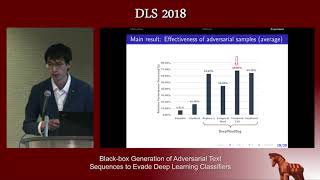
Black-Box Generation of Adversarial Text Sequences to Evade Deep Learning Classifiers
Explores techniques for generating adversarial text sequences to deceive deep learning classifiers, focusing on black-box attacks and their effectiveness in real-world scenarios.
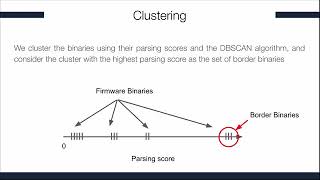
KARONTE - Detecting Insecure Multi-Binary Interactions in Embedded Firmware
Explore KARONTE, an innovative tool for detecting security vulnerabilities in embedded firmware through multi-binary interaction analysis, enhancing IoT device protection.
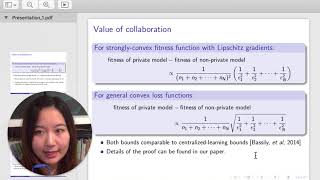
The Value of Collaboration in Convex Machine Learning with Differential Privacy
Explores collaborative machine learning on distributed private data using differentially-private gradients, quantifying trade-offs between privacy and utility, and validating performance predictions with real-world financial datasets.
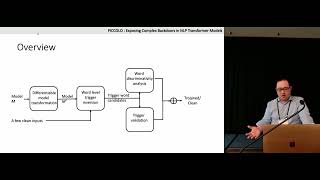
PICCOLO - Exposing Complex Backdoors in NLP Transformer Models
Uncover complex backdoors in NLP transformer models using PICCOLO, addressing challenges in trigger inversion and proposing innovative solutions for enhanced model security.
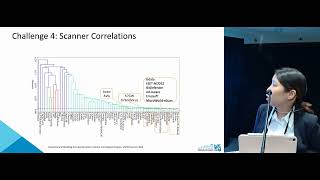
SIRAJ - A Unified Framework for Aggregation of Malicious Entity Detectors
Unified framework for aggregating malicious entity detectors, addressing varying scanner accuracy, label flips, and correlations through self-supervised learning and pretext tasks for improved threat detection.
DP-Sniper - Black-Box Discovery of Differential Privacy Violations Using Classifiers
Explore a novel approach to detect differential privacy violations using classifiers, enhancing data protection and privacy in machine learning systems.
Audio Processing in Python with Feature Extraction for Machine Learning
Learn audio processing in Python using librosa for feature extraction, beat detection, and spectral analysis. Explore practical techniques for music information retrieval and machine learning applications.
Deep Learning Workshop for Satellite Imagery - Training & Prediction
Hands-on deep learning workshop for satellite imagery, covering model training, debugging, prediction, and advanced techniques like custom metrics, heatmaps, and model deployment.
Deep Learning Workshop for Satellite Imagery - Data Processing
Hands-on workshop on data processing for satellite imagery, covering fundamentals, Python processing, image manipulation, and preparation of training data for deep learning applications.

Biomarkers and Enrichment for Sepsis Trials
Explore biomarkers and enrichment strategies for sepsis trials, focusing on the PERSEVERE risk model and its application in clinical research and patient stratification.

Update on the Pediatric Index of Mortality with Dr. Tony Slater
Dr. Slater discusses the development and importance of the Pediatric Index of Mortality (PIM) for improving ICU care quality, covering three generations of PIM, acuity scoring, and data interpretation.
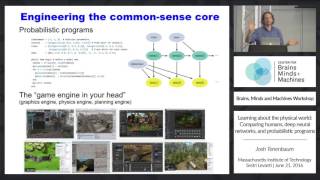
Learning About the Physical World - Comparing Humans, Deep Neural Networks, and Probabilistic Programs
Explore intuitive physics and psychology in human cognition, comparing it with AI approaches like deep neural networks and probabilistic programs for understanding the physical world.