
Building a CPU Using GPT for Every Instruction
Explore building a CPU using GPT for every instruction, compiling C code to LLVM-IR. Learn about compilers, virtual machines, and innovative applications of language models in computing.
Dataflow-Based Optimization for QIR Programs
Explore QDFO, a dataflow-based optimization approach for Microsoft QIR, improving code efficiency and readability through preprocessing and redundancy reduction in quantum computing programs.
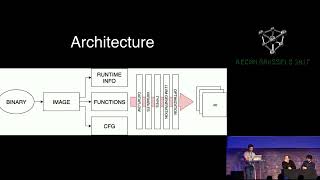
Analyzing iOS Apps - Road from AppStore to Security Analysis Report
Toolset for detecting vulnerabilities in iOS apps: download and decrypt, decompile, statically analyze, and present results. Focuses on high-level semantics reconstruction and common mobile app security flaws.
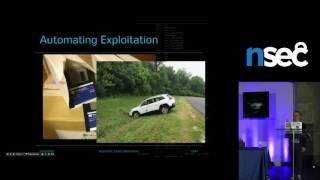
Practical Uses of Program Analysis - Automatic Exploit Generation
Explore automatic exploit generation through program analysis techniques, including instrumentation and symbolic execution, with practical demonstrations and tool insights.
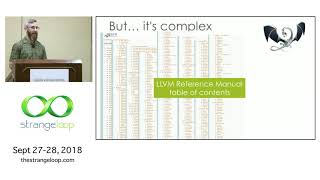
Verifying the LLVM
Explore LLVM's intermediate representation, its complexities, and the Vellvm project's approach to formal verification using Coq, aimed at ensuring compiler reliability and security.
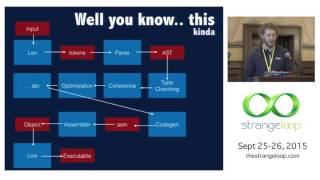
Rustc in Userland
Explore Rust's compiler architecture to build static analysis tools and compilers. Learn to implement a simple LISP and create JIT-like compilers using Rust's codegen machinery.
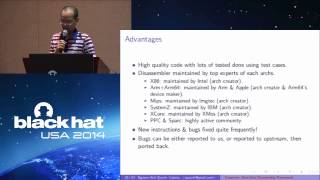
Next Generation Disassembly Framework
Explore next-gen disassembly framework for multi-architecture binary analysis. Learn about Capstone engine's features, design challenges, and potential applications in reversing, exploit development, and malware detection.
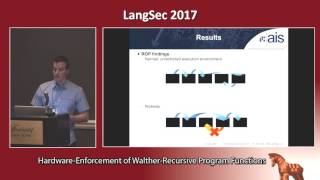
Hardware-Enforcement of Walther-Recursive Program Functions
Explore hardware-enforced restrictions on computational complexity using JIT compilation and Intel's Processor Tracing to improve security through limited return-oriented programming.
Runtime vs. Compile Time - JIT vs. AOT Optimizations in Java and C++
Explore runtime and compile-time optimizations in Java and C++, comparing JIT and AOT compilers for improved performance and efficiency in software development.
Finding Bugs Compiler Knows but Doesn't Tell You - Dissecting Undefined Behavior Optimizations in LLVM
Explore LLVM compiler optimizations for undefined behavior, uncovering hidden bugs and security vulnerabilities in C/C++ programs through advanced static analysis techniques.
Building Your Own Compiler - The Slightly Easier Way With LLVM
Discover how LLVM simplifies compiler creation for domain-specific languages, combining C++ performance with unique linguistic features. Learn to build powerful, efficient DSLs.

A Taste of Julia
Explore Julia's Lisp-inspired features and modern optimization techniques for scientific computing, highlighting its high-level syntax and high-performance capabilities.
Clang Built Linux
Explore efforts to build the upstream Linux kernel using Clang, including patches to the build system, kernel code, and LLVM/Clang. Learn how to build a kernel with Clang and discover remaining challenges.
Tensorflow on Open Source GPUs
Explore efforts to enable TensorFlow on open-source GPUs using SYCL, LLVM, and OpenCL. Learn about challenges and progress in deploying AI/ML frameworks without proprietary NVIDIA CUDA stack.
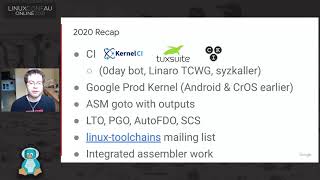
ClangBuiltLinux - What's Next?
Explore LLVM's adoption for Linux kernel builds, 2020 achievements, and future focus. Learn about tradeoffs, upcoming work, and how to contribute to kernel and toolchain development.
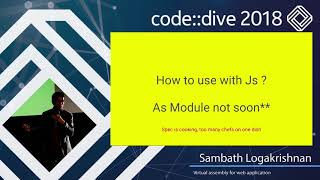
Virtual Assembly for Web Application
Explore WebAssembly's potential to boost web app performance using pre-optimized execution code, LLVM, and languages like C++ or Rust. Learn about DOM access, JavaScript integration, and multithreading in WebAssembly.
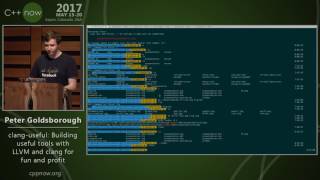
Building Useful Tools with LLVM and Clang for Fun and Profit
Explore LLVM and clang libraries for custom C++ tools. Learn AST representation, static analysis, and source-to-source transformations to enhance workflow and productivity.
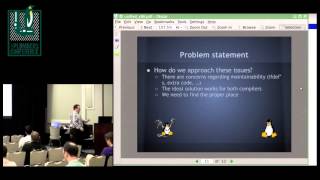
How to Make the Unified Arch - X86 - Tree of the Kernel Work with Clang
Explore x86_64 LLVM Linux project updates, current issues, and strategies for upstreaming work into the Linux Kernel or LLVM/Clang, with a focus on resolving challenges and accelerating progress.
Linux Kernel and User Space for Hexagon DSP with LLVM
Exploring LLVM adoption for Hexagon DSP, covering Linux kernel and user space compilation challenges, solutions, and ongoing issues in replacing GCC with LLVM toolchain.
Clang + Linux
Explore Clang and LLVM for Linux kernel development, covering priorities, tools, and techniques to enhance compilation, debugging, and code analysis processes.
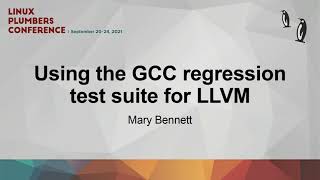
Using the GCC Regression Test Suite for LLVM
Learn how to leverage GCC's regression test suite to enhance LLVM's testing capabilities, improving compiler reliability and performance.