Kernel Self-Protection Project
Explore Linux kernel security enhancements and self-protection mechanisms with Google engineer Kees Cook, focusing on proactive defenses against vulnerabilities and exploits.

A Hybrid Alias Analysis Framework for Protecting the Linux Kernel
Innovative hybrid alias analysis framework enhances Linux kernel security, identifying 5000+ protectable variables and preventing global-variable-related exploits, surpassing manual efforts by 10x.

The State of Kernel Self Protection Project
Explore Linux kernel security enhancements, bug prevention strategies, and exploitation techniques. Learn about the Kernel Self-Protection Project's progress and future goals for a more robust operating system.

LVBS and Advanced Kernel Integrity
Explore advanced Linux Virtualization based Security (LVBS) features for enhanced kernel integrity. Learn about hardening techniques to protect against unauthorized modifications, even in compromised environments.

Listen to Your Engine - Unearthing Security Signals from the Modern Linux Kernel
Exploring Linux kernel security signals through system call analysis, focusing on detecting privilege escalation, resource abuse, and side-channel attacks in cloud-native environments.

Sandboxing Based on SECCOMP for Linux Kernel
Explore SECCOMP-based sandboxing techniques for enhancing Linux kernel security, presented by Nicolás Bareli at Ekoparty 2010.

STACKLEAK - A Long Way to the Linux Kernel Mainline
Explore STACKLEAK, a Linux kernel security feature mitigating stack leak bugs, uninitialized variable attacks, and stack depth overflow. Learn its history, implementation, and impact.

Breaking and Protecting Linux Kernel Stack
Explore Linux kernel stack vulnerabilities, existing protections, and potential improvements like RANDOMIZE_KSTACK_OFFSET. Gain insights into security measures and performance implications.

How to Write a Linux Security Module
Comprehensive guide to creating Linux Security Modules, covering infrastructure, interfaces, and best practices for implementing additional kernel security mechanisms.
Kernel Hardening - Protecting the Protection Mechanisms
Explore kernel hardening techniques to protect critical Linux subsystems. Learn about read-only and rare-write memory allocation, and how to integrate these features into popular data structures for enhanced security.

Year in Review - Android Kernel Security
Comprehensive overview of Android kernel security, analyzing vulnerabilities, discussing mitigations, and exploring future improvements for enhanced platform protection.

The Why and How of libseccomp
Learn to create secure syscall filters using libseccomp, reducing attack surfaces for untrusted programs. Hands-on tutorial covers filter creation, logging, debugging, and advanced techniques for enhanced process isolation.

Using and Implementing Keyring Restrictions for Userspace
Explore kernel keyring facility's expanded capabilities, including userspace-configurable restrictions for key types and practical applications in certificate verification and wireless networking.

Kernel Runtime Security Instrumentation
Explore extensible Linux security with Kernel Runtime Security Instrumentation, enabling dynamic threat response through eBPF programs attached to security hooks without kernel modifications.
Deep Analysis of Exploitable Linux Kernel Vulnerabilities 2017-2019
Comprehensive analysis of Linux kernel vulnerabilities, exploring exploitation techniques, mitigation bypasses, and in-depth case studies from 2017-2019. Focuses on improving security understanding.

Achieving Linux Kernel Code Execution Through a Malicious USB Device
Explore Linux kernel exploitation via malicious USB devices, focusing on CVE-2016-2384 vulnerability. Learn about USB-based attacks, payload delivery, and mitigation strategies.
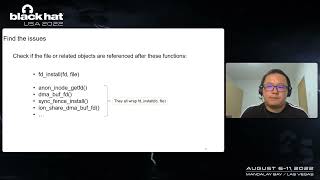
Devils Are in the File Descriptors - It Is Time To Catch Them All
Explore vulnerabilities in Linux kernel file descriptor operations, focusing on high-risk scenarios in exporting and importing, and learn to identify and address these security concerns.

The Return of Stack Overflows in the Linux Kernel
Exploiting Linux kernel vulnerabilities: techniques for bypassing security controls, leveraging nftables bugs, and achieving code execution. Includes mitigation strategies and a novel per-softirq stack randomization implementation.

AEM - Facilitating Cross-Version Exploitability Assessment of Linux Kernel Vulnerabilities
Explore a novel approach for assessing Linux kernel vulnerabilities across versions, enhancing security through advanced exploitability analysis techniques.
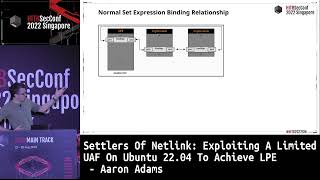
Exploiting a Limited UAF on Ubuntu 22.04 to Achieve LPE
Detailed exploration of exploiting a Linux kernel vulnerability in Ubuntu 22.04 to achieve local privilege escalation, focusing on advanced exploitation techniques and bypass methods.
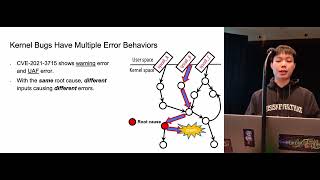
GREBE - Unveiling Exploitation Potential for Linux Kernel Bugs
Explore GREBE, a tool for assessing Linux kernel bug exploitability. Learn about its methodology, implementation, and effectiveness in identifying high-risk vulnerabilities.