Phases in Software Architecture
Explore multi-phase computation structures in software architecture, focusing on novel applicative functors and their potential applications in choreography and multi-tier architecture.
Building Transformer Tokenizers - Dhivehi NLP #1
Learn to build an effective WordPiece tokenizer for Dhivehi, a low-resource language, overcoming unique challenges in NLP application. Explore tokenizer components, implementation, and usage for this fascinating language.
CMU Advanced NLP: Word Segmentation and Morphology
Explore word segmentation, tokenization, and morphology in NLP. Learn about language typology, rule-based systems, and finite state automata for processing various languages.

CMU Advanced NLP: Word Segmentation and Morphology
Explore word segmentation, morphology, and unsupervised subword segmentation in this advanced NLP lecture, covering linguistic concepts and computational approaches to language analysis.
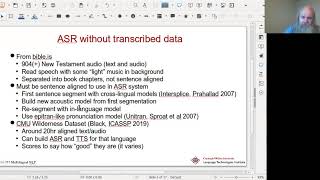
CMU Multilingual NLP 2020 - Low Resource ASR
Explore low-resource ASR techniques, including lexicon-free systems, cross-lingual recognition, and speech translation. Learn innovative approaches for languages with limited data.
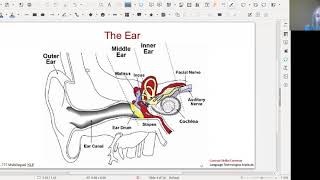
CMU Multilingual NLP 2020 - Speech
Explore speech production, language differences, and speech technologies in this comprehensive overview of vocal communication and its computational applications.
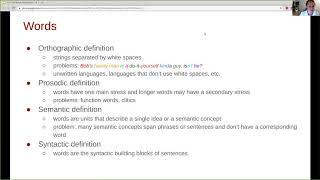
Multilingual NLP: Words, Parts of Speech, Morphology
Explore words, parts of speech, and morphology in multilingual NLP. Learn about linguistic subfields, morphemes, and morphological processes across diverse languages.
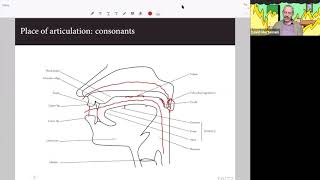
CMU Low Resource NLP Bootcamp 2020 - Linguistics: Phonology and Morphology
Explore linguistic foundations in phonology and morphology, covering articulation, IPA, sound patterns, and morpheme variations. Gain insights into language structure and representation.
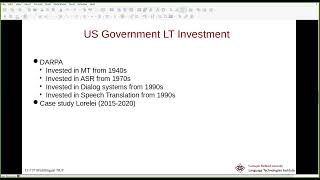
CMU Multilingual NLP - The LORELEI Project
Explore rapid development of low-resource information extraction in new languages, focusing on the LORELEI project's techniques, challenges, and real-world applications in disaster scenarios.
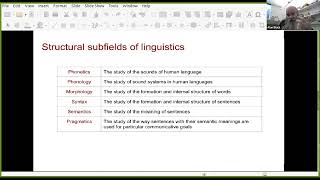
CMU Multilingual NLP 2022 - Words, Parts of Speech, Morphology
Explore words, parts of speech, and morphology in multilingual NLP, covering linguistic concepts, UD Treebank annotations, and morphological analysis techniques.
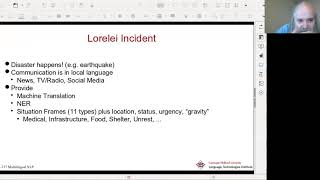
CMU Multilingual NLP - Information Extraction
Explore information extraction for low-resource languages and its application in disaster response through LORELEI project, with insights on methods, results, and practical implications.
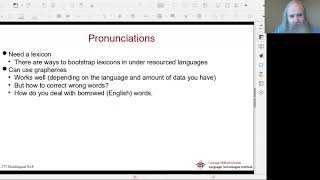
CMU Multilingual NLP 2020 - Text to Speech
Explore text-to-speech systems for low-resource languages, covering analysis, pronunciation, prosody, waveform generation, and cross-lingual models. Learn efficient TTS building and multilingual challenges.
GPT-Whale Language Models at Tools for Structure Discovery and Hypothesis Generation
Explore innovative applications of GPT-Whale models for uncovering patterns and generating hypotheses in nonhuman species communication research.
Introduction to Natural Language Processing
Explore NLP fundamentals, including language models, part-of-speech tagging, and word embeddings. Learn real-world applications and core technologies in this AI and linguistics subfield.
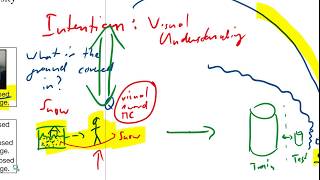
Evaluating NLP Models via Contrast Sets
Explore how contrast sets reveal NLP model limitations by exposing systematic gaps in test data, offering insights into true linguistic capabilities and decision boundaries.

Low Resource Machine Translation
Explore machine translation techniques for low-resource languages, covering evaluation methods, supervised and unsupervised learning approaches, and domain adaptation. Gain insights into Nepali-English translation case study.

Decoding Nonhuman Communication - Polylogues
Explore cutting-edge research on decoding nonhuman communication, from sperm whale vocalizations to plant acoustic responses, using machine learning and natural language processing techniques.
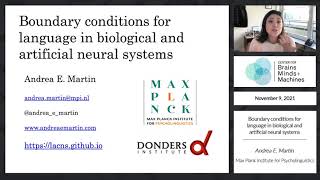
Boundary Conditions for Language in Biological and Artificial Neural Systems
Explore computational requirements for language processing in neural systems, focusing on hierarchical structures, neural oscillations, and integrating linguistic insights with neural computation principles.
AI's Role in Empowering Communication and Preserving Cultures
Explore AI's transformative power in enabling communication for individuals with disabilities and preserving endangered languages, fostering a more connected and inclusive world.
The Leverage of Language - How Information Theory Impacts Security - Lecture 2.2.2
Explore information theory and its impact on language, communication, and security in this thought-provoking talk by Conrad Constantine.
Community Driven Data Collection and Consent in AI
Exploring ethical AI data collection through community-driven models, focusing on consent and linguistic diversity. Examines Common Voice project and alternative approaches for a more inclusive AI future.