
The Future of Reproducible Research - Powered by Kubeflow
Explore the future of reproducible research using Kubeflow, an open-source platform that streamlines data science workflows and enhances scientific collaboration through easily shareable and replicable pipelines.
DevOps in Data Science - What Works and What Doesn't
Explore challenges and solutions in implementing DevOps for data science projects, focusing on balancing ML engineers' needs with data scientists' desire for simplicity using Kubeflow and other tools.
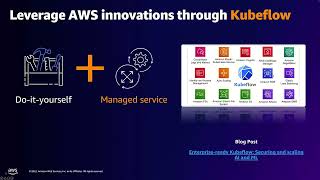
Machine Learning at Scale Using KubeFlow on AWS
Explore scalable machine learning architecture using Kubeflow on AWS, featuring hands-on demos of distributed storage and Kubernetes-based ML toolkit implementation.
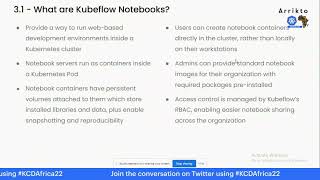
Transforming Jupyter Notebooks to Reproducible Machine Learning Pipelines with Kale
Learn to convert Jupyter notebooks into scalable Kubeflow pipelines using Kale, enabling seamless deployment of ML workflows on Kubernetes for improved reproducibility and efficiency.
From Bash Scripts to Kubeflow and GitOps - Operationalizing ML at Scale
Explore the journey of operationalizing data science workloads at scale using Kubeflow and GitOps, from initial challenges to a standardized approach for ML experiments, API creation, and batch predictions delivery.
The Good, the Bad, and the Missing Parts of Kubeflow
Explore Kubeflow's strengths, weaknesses, and future developments as an MLOps platform based on user feedback and upcoming release plans.
Production-Ready AI Platform on Kubernetes
Explore best practices for building scalable AI/ML platforms using cloud-native technologies like Kubernetes, Kubeflow, and KServe. Learn to tackle challenges in MLOps and large model inference systems.
Transforming Data Science at PepsiCo - The Kubeflow Revolution
Explore PepsiCo's data science transformation using Kubeflow, addressing challenges in model reproducibility and enhancing efficiency, collaboration, and scalability in machine learning workflows.
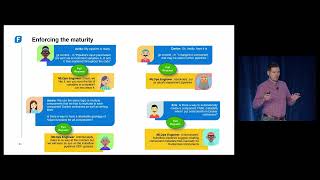
Fully Automated ML Platform Using Kubeflow and Declarative Approach to End-to-End ML Development
Explore FreshBooks' journey to MLOps maturity using Kubeflow pipelines and a declarative framework, addressing challenges and improving ML pipeline reliability from development to production.

Simplify ML Pipeline Automation and Tracking Using Kubeflow and Serverless Functions
Simplify ML pipeline automation and tracking with Kubeflow and serverless functions. Learn to streamline your machine learning workflows for improved efficiency and productivity.
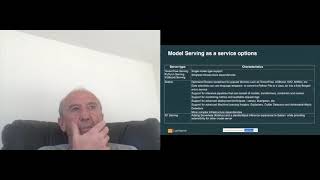
Using Model Serving in Streaming Applications
Explore model serving approaches in streaming applications using Cloudflow framework. Learn to develop, orchestrate, and operate distributed streaming applications on Kubernetes efficiently.
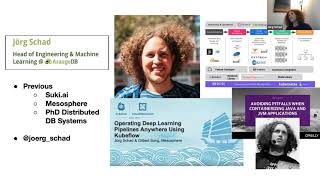
Building and Operating an Open Source Data Science Platform
Develop an end-to-end data analytics pipeline, from exploratory analysis to model deployment. Learn pipeline orchestration, distributed training, automation, and monitoring for scalable machine learning projects.

Cloud Native Artificial Intelligence - Top to Bottom
Explore how Cloud Native is shaping MLOps implementations, focusing on tools like Kubeflow and KServe. Learn to leverage Cloud Native knowledge for AI integration and future developments.
Tune Your Microservices by Learning from Traces
Learn to leverage tracing data with Kubeflow to uncover hidden patterns, optimize performance, and enhance root cause analysis in microservices architectures.
AI-Ready Microservice Architecture for Deploying and Evaluating AI Models
Explore event-driven architecture for deploying AI models in production using Knative, KServe, and Kubeflow. Includes real-time image recognition demo with audience participation.
Component Registry for Kubeflow Pipelines
Explore a component registry for Kubeflow Pipelines, enhancing ML workflow collaboration on Kubernetes. Learn how shared components can streamline common tasks and improve efficiency in machine learning projects.
Computer Vision Dog Breed Classification with Convolutional Neural Networks, TensorFlow and Kubeflow
Develop a dog breed classification system using TensorFlow, Kubeflow, and convolutional neural networks. Compare AI predictions with DNA results for accuracy.
A Deep Dive into Kubeflow Pipelines
Explore Kubeflow Pipelines' architecture and components for executing cloud-native ML workflows on Kubernetes. Gain insights into the platform's inner workings and integration of ML pipeline elements.
Training AI to Code Using Project CodeNet - Largest Code Dataset
Explore Project CodeNet's vast code dataset and learn how to leverage it for machine learning tasks using MLX, including code classification and complexity analysis on Kubernetes.
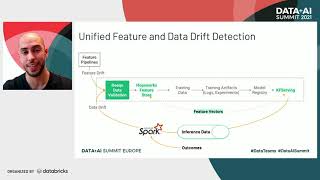
KFServing - Model Monitoring with Apache Spark and Feature Store
Explore an open-source platform for scalable model serving and monitoring using KFServing, Hopsworks Feature Store, and Spark Streaming. Learn continuous data drift detection and see a live demonstration.
Kubeflow - Orchestrating AI Workflows on Kubernetes
Discover how Kubeflow simplifies AI workflow orchestration on Kubernetes. Learn its functionality, components, and benefits for scaling machine learning solutions, with a live demo on installation and setup.