Developing Supercomputing Geoscience Applications Using Julia
Explore modular Julia packages for accelerating geocomputing, enabling high-performance stencil codes that scale from laptops to GPU-accelerated supercomputers for geoscience applications.
What's the Plan? Task Planning for Robots - JuliaCon 2024
Explore task planning for robots using Julia's features to efficiently handle complex knowledge bases and action sequences in goal-oriented scenarios.
JSOSuite.jl - One-Stop Solution for Optimization
Explore JSOSuite.jl, a comprehensive optimization package offering automatic solver selection, research-level algorithms, and flexible modeling interfaces for various problem types in Julia.
Real Time ODEs for Sound Synthesis and Parameter Exploration - JuliaCon 2024
Explore real-time ODEs for sound synthesis and parameter analysis using Julia, combining visual and auditory representations to unveil dynamical system behaviors and control parameters.
Adventures in Julia IR - Plundering Core.Compiler
Explore Julia's typed intermediate representation (IR) and learn to implement custom optimization passes, extending compiler capabilities beyond conventional metaprogramming techniques.
RxEnvironments - Reactive Multi-Agent Environments
Explore reactive programming for multi-agent environments in Julia. Learn to model complex agent-environment interactions using RxEnvironments.jl, overcoming limitations of traditional reinforcement learning frameworks.
Applications of Distributed Task Parallelism
Explore distributed task parallelism in Julia, comparing Dagger with other frameworks and libraries. Learn about unique features for efficient, scalable, and maintainable code.
Robust Calibration of Industrial HVAC and Battery Systems
Explore advanced techniques for robust calibration of industrial HVAC and battery systems using ModelingToolkit.jl, focusing on overcoming challenges in data integration and parameter identification.

OpenAPI.jl for Easy HTTP APIs
Explore OpenAPI.jl for creating HTTP APIs in Julia. Learn to generate clients, define specs, and create server/client code using this powerful tool for API development and management.
Interpretable Hierarchical Calibration of Agent-Based Models
Explore scientific machine learning's fusion of traditional modeling and ML, focusing on neural network surrogates for agent-based models in epidemiology and automated hierarchical calibration.
Workflow for Developing Multiple Interdependent Packages - JuliaCon 2024
Explore efficient workflows for developing interconnected Julia packages, covering version management, testing, and deployment strategies for large-scale projects and team collaboration.
Best Practices for Package Development Using BestieTemplate.jl
Learn best practices for Julia package development using BestieTemplate.jl, including structure, workflows, linting, and formatting. Discover how to apply and update these practices efficiently in new and existing projects.
AppBundler.jl - Bundle Your Julia GUI Application
Learn to package Julia GUI applications for desktop platforms using AppBundler.jl. Explore cross-platform bundling, customization options, and future developments in Julia application deployment.
Geant4.jl - Particle Transport in Julia
Explore Geant4.jl, a Julia wrapper for simulating particle interactions in physics. Learn about its user-friendly interface, performance benefits, and automated generation using WrapIt.
Graph-based Decomposition Approaches through Plasmo.jl
Explore Plasmo.jl for optimization problem structuring and decomposition, focusing on graph-based approaches and their applications in power systems.
Introduction of TulipaEnergyModel.jl - Optimization Model for Energy Markets
Optimization model for electricity markets and energy sectors using graph theory and flexible time resolution, enhancing adaptability and efficiency in large-scale energy system modeling.
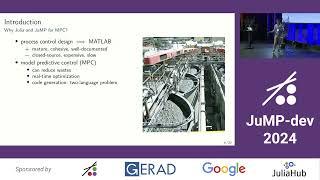
ModelPredictiveControl.jl - Advanced Process Control Using JuMP
Learn to design model predictive controllers using ModelPredictiveControl.jl, an open-source package for advanced process control based on JuMP, featuring nonlinear state estimation and visualization tools.
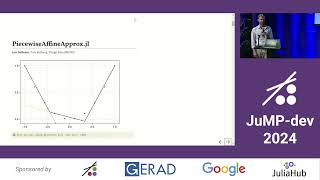
PiecewiseAffineApprox.jl - Automated Piecewise Affine Convex Approximations for Optimization Models
Explore piecewise affine convex approximations for optimization models using PiecewiseAffineApprox.jl, featuring flexible options and methods for best-fit calculations in Julia.
Differentiating Parametric JuMP Models in Julia
Explore differentiating parametric JuMP models, combining DiffOpt and ParametricOptInterface for efficient optimization and parameter sensitivity analysis in Julia.
The New DisjunctiveProgramming.jl - Modeling Generalized Disjunctive Programs
Explore the enhanced DisjunctiveProgramming.jl for modeling Generalized Disjunctive Programs, featuring improved performance, expanded constraint support, and compatibility with JuMP and InfiniteOpt.
Recent Advances in EAGO.jl and its Use With JuMP.jl
Explore EAGO.jl, an open-source global optimizer for MINLPs in Julia, and its integration with JuMP for enhanced accessibility and capabilities in solving complex optimization problems.