Recent Advances in Optimization Solvers within JuliaSmoothOptimizers
Explore cutting-edge nonlinear optimization solvers in JuliaSmoothOptimizers. Learn about new packages, performance enhancements, and flexible implementations for large-scale problems using high-level linear algebra and automatic differentiation.

Solving Matching Problems in Practical Applications Using JuMP
Optimize supply chain matching with JuMP: Efficiently model connections in transportation networks, balancing idle times, delays, and resource allocation for improved performance and robustness.

SpineOpt.jl - A Highly Adaptable Modelling Framework for Multi-Energy Systems
Flexible energy system modelling framework for operational and planning studies, featuring adaptable structures, uncertainty representation, and model decomposition for complex multi-energy systems.
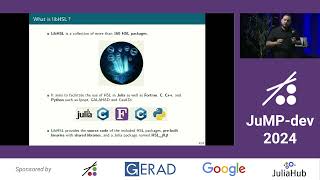
libHSL - The Ultimate Collection for Large-Scale Scientific Computation
Explore libHSL, a powerful Fortran package collection for scientific computation, now accessible in Julia through HSL.jl and Ipopt.jl with pre-built binaries.
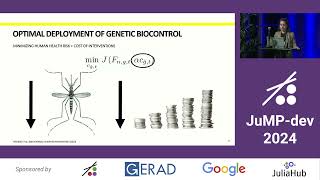
Optimal Deployment of Genetic Biocontrol Under Environmental Uncertainty
Stochastic programming approach for optimal biocontrol strategies against mosquito-borne diseases, considering uncertain weather conditions and using JuMP and Julia for efficient intervention planning.

LoReSIO.jl - Using JuMP for Semi-Infinite Optimization
Explore LoReSIO.jl, a Julia package for solving semi-infinite optimization problems using JuMP. Learn efficient techniques for handling infinite constraints and solving complex optimization challenges.
Teaching Optimization: Comparing cvxpy, pyomo, and JuMP
Explore convex optimization modeling frameworks, comparing cvxpy, pyomo, and JuMP. Learn about common student challenges and how JuMP addresses them in undergraduate and graduate courses.

Why You Should Stop Using the Monomial Basis
Explore StarAlgebras.jl for computing with arbitrary bases, improving polynomial optimization through symmetry-adapted bases and better-conditioned alternatives to monomials.
QUBO.jl - A Julia Ecosystem for Quadratic Unconstrained Binary Optimization
Explore Julia's QUBO.jl ecosystem for solving binary optimization problems, featuring solver interfaces, benchmarking tools, and quantum hardware integration for advanced optimization techniques.
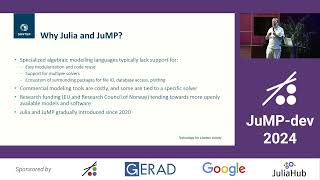
Applied Optimization with JuMP at SINTEF
Explore JuMP for flexible optimization modeling at SINTEF, focusing on hydrogen infrastructure and circular logistics. Learn about complementary packages enhancing JuMP's functionality.

Solving Integral Equations with Inti.jl - JuliaCon 2024
Explore Inti.jl for solving volume and boundary integral equations in mathematical physics. Learn about its user-friendly features, integration capabilities, and specialized routines for handling singular kernels.

Molly.jl - Molecular Dynamics in Julia
Explore Molly.jl for molecular dynamics simulations in Julia. Learn about its features, advantages, and applications in research, including differentiable molecular simulation and force field improvement.
Julia for Materials Modelling
Explore Julia's potential in materials modeling, covering its advantages, ecosystem, and applications in atomistic simulations and density functional theory.
Blending the Gap: Mixing MATLAB with Julia
Explore seamless integration of MATLAB and Julia, enabling transparent function calls and data structure access between the two languages without complex syntax or APIs.

Julia Compiler Secrets - Static Analysis - JuliaCon 2024
Explore advanced static analysis capabilities in Julia's compiler, including type inference, effect system, and escape analysis, to optimize code performance and enhance correctness.
Why Julia is the Future for Data Science Projects
Explore Julia's advantages for data science, including speed, economic viability, and reduced carbon footprint compared to R and Python.

FUSE.jl: The Power of Julia for the Fusion Industry
Explore FUSE.jl, a unified framework for fusion device design using Julia. Learn how it integrates models, enhances efficiency, and optimizes fusion power plant designs through multi-objective approaches.

BinaryBuilder 2: Return of the Compilers - JuliaCon 2024
Explore BinaryBuilder 2's redesign, addressing pain points and unlocking new capabilities for complex software projects, multiple compilers, and platforms in Julia package development.

Automated Theorem Proving with dL in Julia
Explore automated theorem proving for hybrid systems using Elenchos, a Julia package simplifying verification of ModelingToolkit.jl models with differential dynamic logic and KeYmaera X.
A Retrospect on Julia Web Services - HTTP, Performance and Memory
Explore Julia web services optimization, covering tools, bottlenecks, memory management, HTTP performance, and future developments for efficient production scaling.
Bridging Domain Science and HPC with Julia
Explore Julia's potential in HPC, combining scientific ecosystem with high performance. Gain insights on its strengths, limitations, and notable international projects from an experienced user.