The State of Julia in 2021 - JuliaCon Keynote
Comprehensive overview of Julia's progress in 2021, covering threading, compiler improvements, linear algebra advancements, package updates, and future development plans.
Cedar: A Composable ML Accelerated Analog Circuit Simulator
Explore Cedar, a novel Julia-based analog circuit simulator, offering composability, ML acceleration, and seamless integration with the Julia ecosystem for advanced circuit design and optimization.
Julia in VS Code - New Features and Enhancements
Explore new features in Julia VS Code extension: Jupyter integration, plot gallery, debugger improvements, and package release tools for enhanced development experience.
Survey of the Julia General Registry: Code, Documentation, and Testing
Explore Julia's General registry: package sizes, licenses, docs, tests, CI, and contributors. Learn to analyze packages with PackageAnalyzer.jl for ecosystem insights.
Pluto.jl - One Year Later: New Features and Future Plans
Explore Pluto.jl's latest features and future plans for interactive Julia notebooks, focusing on improvements in usability, package management, and export capabilities.
Changing Physics Education with Julia
Revolutionizing physics education by integrating Julia programming, focusing on nonlinear dynamics. Demonstrates how coding enhances understanding, introduces interactive applications, and discusses benefits of real-world exercises.
Julia: Great Language or the Greatest Language - Keynote by Jan Vitek
Keynote explores Julia's design, implementation, and performance, covering subtyping algorithms, type stability, and JIT compilation. Insights into language evolution and scientific programming revolution.
Tomographic Image Reconstruction with Julia
Explore Julia's capabilities for tomographic image reconstruction, focusing on large-scale inverse problems and matrix-free methods. Learn about package ecosystems for different imaging techniques.
Dictionaries.jl - Improved Productivity and Performance in Julia
Explore Dictionaries.jl for enhanced Julia productivity: alternative interface, data manipulation tools, implementation insights, and applications in tabular data with keys.
Agents.jl and the Next Chapter in Agent-Based Modelling
Explore Agents.jl for complex system modeling: learn its philosophy, simplicity, performance, interactivity, and integration with Julia ecosystem. Discover the future of agent-based modeling.
Introduction to Metaprogramming in Julia - JuliaCon 2021 Workshop
Comprehensive workshop on Julia metaprogramming, covering expressions, macros, and code generation. Ideal for intermediate users seeking to enhance their programming skills and create domain-specific languages.
Package Development: Improving Engineering Quality and Latency - JuliaCon 2021 Workshop
Aprenda a melhorar a qualidade e reduzir a latência no desenvolvimento de pacotes Julia, usando ferramentas avançadas para detectar e corrigir problemas de desempenho e robustez.
A Mathematical Look at Electronic Structure Theory - JuliaCon 2021 Workshop
Explore density-functional theory and numerical techniques for solving it using Julia. Learn about discretization, solution algorithms, and practical implementation with hands-on coding exercises.
Statistics with Julia from the Ground Up - JuliaCon 2021 Workshop
Learn statistical applications in Julia through hands-on examples, covering probability, data manipulation, plotting, and modeling. Ideal for R users transitioning to Julia for data science and machine learning.
GPU Programming in Julia - Workshop
Comprehensive workshop on GPU programming in Julia, covering CUDA, AMDGPU, and oneAPI packages. Explores array operations, kernel programming, profiling, and real-world applications across different GPU architectures.
Read and Manipulate Text Files in Julia - Week 4 Lesson 2
Learn to process text files in Julia, transforming them into word arrays and analyzing content through word and phrase counting techniques.
User-Defined Functions in Julia - Week 2 Lesson 3
Learn to create and use custom functions in Julia, enhancing your programming skills with practical examples and essential debugging techniques.
Discrete and Continuous Mathematics - MIT Computational Thinking Spring 2021 - Lecture 14
Explore discrete and continuous mathematics, bridging concepts through indexing, function evaluation, area calculation, and random walks in computational thinking.
Random Walks in Computational Thinking - Lecture 12
Explore random walks in computational thinking, covering visualization, Julia concepts, benchmarking, and advanced topics like mutable structs and type parameters.
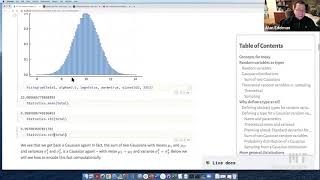
Random Variables as Types - Lecture 11
Explore random variables as types in Julia programming, covering Gaussian distributions, sampling, abstract types, and generic programming for probability distributions.
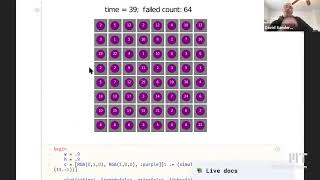
Modeling with Stochastic Simulation - Lecture 10
Explore stochastic simulation modeling using Julia, covering individual-based models, failure visualization, string interpolation, Bernoulli variables, and running simulations with practical examples.