
Attacks on Shared State in Multi-User Augmented Reality Applications
Explore security vulnerabilities in multi-user AR applications, focusing on shared state attacks, their implications, and potential defense strategies for protecting augmented reality frameworks.
Understanding How to Inform Blind and Low-Vision Users about Data Privacy through Privacy Question Answering Assistants
Explore how blind and low-vision users navigate digital privacy challenges, their risk perceptions, and the potential role of privacy Q&A assistants in improving their online safety and information access.
WEBRR: A Forensic System for Replaying and Investigating Web-Based Attacks in The Modern Web
Explore a novel forensic system that enables deterministic replay and investigation of web-based attacks through JavaScript Execution Unit Partitioning, offering enhanced visibility into cyber threats.
FIRE: Combining Multi-Stage Filtering with Taint Analysis for Scalable Recurring Vulnerability Detection
Discover how FIRE combines multi-stage filtering and taint analysis to efficiently detect recurring vulnerabilities in open-source software, achieving 90% precision and superior performance over existing tools.

MOAT: Towards Safe BPF Kernel Extension
Discover how MOAT system enhances Linux kernel security by isolating BPF programs using Intel Memory Protection Keys, offering efficient protection with minimal performance impact.

Endokernel - A Thread Safe Monitor for Lightweight Subprocess Isolation
Explore how Endokernel achieves secure subprocess isolation through thread-safe monitoring, efficient memory isolation, and systematic policy enforcement for enhanced application security.
Less is More: Revisiting the Gaussian Mechanism for Differential Privacy
Explore groundbreaking improvements to differential privacy through a novel Rank-1 Singular Multivariate Gaussian mechanism that enhances data protection while minimizing accuracy loss in high-dimensional queries.
Large Language Models for Code Analysis - Evaluating LLM Performance and Limitations
Explore the capabilities and limitations of Large Language Models in code analysis, focusing on their effectiveness with obfuscated code and real-world applications through systematic evaluation.

Content Moderation in the InterPlanetary File System - A Study of Problematic Content Detection and Filtering
Explore content moderation challenges in IPFS, examining problematic content detection, hosting patterns, and improved filtering methods for decentralized web infrastructure.

SmartCookie: Blocking Large-Scale SYN Floods with a Split-Proxy Defense on Programmable Data Planes
Discover how SmartCookie leverages programmable switches to block SYN flood attacks while maintaining network performance, offering innovative defense mechanisms for modern high-speed networks.

Differentially Private Diffusion Probabilistic Models for Image Synthesis
Explore how dp-promise leverages diffusion model noise to achieve differential privacy in image synthesis while maintaining high image quality and protecting sensitive training data.
SpecLFB: Eliminating Cache Side Channels in Speculative Executions
Discover how SpecLFB leverages Line-Fill-Buffer to eliminate cache side-channel vulnerabilities in speculative executions, offering an efficient defense mechanism with minimal performance impact.
Ahoy SAILR - A Compiler-Aware Structuring Algorithm for Binary Decompilation
Discover how SAILR, a novel structuring algorithm, revolutionizes binary decompilation by intelligently preserving necessary gotos while removing spurious ones, improving code readability and accuracy.
Diffie-Hellman Key Exchange Security Issues in Commercial VoWiFi Deployments
Explore critical security vulnerabilities in VoWiFi deployments, focusing on IPsec tunnel key exchanges and their implications for mobile network operators and user equipment worldwide.
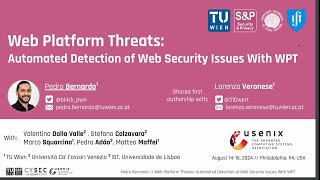
Web Platform Threats: Automated Detection of Web Security Issues with WPT
Discover how automated detection frameworks identify security flaws in web browser mechanisms, exploring practical approaches to validate web invariants and detect vulnerabilities across major browsers.
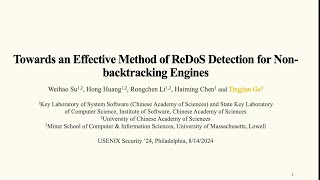
Towards an Effective Method of ReDoS Detection for Non-backtracking Engines
Explore advanced techniques for detecting ReDoS vulnerabilities in non-backtracking regex engines, featuring EvilStrGen tool and novel attack string generation methods for enhanced security testing.
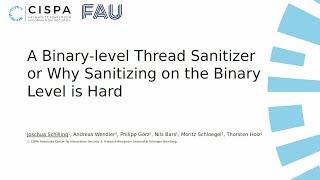
A Binary-level Thread Sanitizer - Why Sanitizing on the Binary Level is Hard
Explore the challenges and solutions of binary-level thread sanitization through BINTSAN, a novel approach for detecting data races in Linux x86-64 targets without source code access.
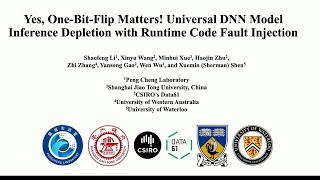
Yes, One-Bit-Flip Matters! Universal DNN Model Inference Depletion with Runtime Code Fault Injection
Explore FrameFlip, a groundbreaking attack method that depletes DNN model inference through single-bit fault injections, demonstrating universal effectiveness across major machine learning frameworks.

DMAAUTH: A Lightweight Pointer Integrity-based Secure Architecture to Defeat DMA Attacks
Explore a lightweight pointer integrity-based architecture that provides enhanced DMA attack protection while maintaining performance, demonstrated through FPGA implementation and cross-architecture evaluation.

PhishDecloaker: Detecting CAPTCHA-cloaked Phishing Websites via Hybrid Vision-based Interactive Models
Discover how PhishDecloaker uses AI and computer vision to detect CAPTCHA-protected phishing websites, improving detection rates from 0% to 74.25% and enhancing cybersecurity defenses.
Measuring Structural Limitations of Deepfake Media Datasets - A Systematic Review
Explore structural limitations in deepfake media datasets, examining metrics, generation techniques, and class distributions to understand their impact on detection systems and research reproducibility.