Neural Passage Quality Estimation for Static Pruning - Efficiency for Search
Explore neural passage quality estimation for static pruning in search efficiency, enhancing information retrieval systems.

Unsupervised Cross-Domain Image Retrieval with Semantic-Attended Mixture-of-Experts
Explore unsupervised cross-domain image retrieval using semantic-attended mixture-of-experts, enhancing retrieval accuracy across diverse visual domains.
GUITAR: Gradient Pruning toward Fast Neural Ranking - Efficiency for Search
Explore gradient pruning techniques for optimizing neural ranking models, enhancing search efficiency and performance.
What Matters in a Measure? A Perspective from Large-Scale Search Evaluation
Explore key aspects of large-scale search evaluation, focusing on crucial measurement factors and their impact on assessing search engine performance.

Can We Trust Recommender System Fairness Evaluation? The Role of Fairness and Relevance - Evaluation M1.5
Explore the reliability of fairness evaluations in recommender systems, examining the interplay between fairness and relevance metrics for more trustworthy assessments.
Enhancing Sequential Recommenders with Augmented Knowledge from Aligned LLMs - SIGIR 2024
Explore innovative techniques for enhancing sequential recommender systems using aligned large language models, improving personalized recommendations in various applications.
Large Language Models for Intent-Driven Session Recommendations - Session M1.6
Explore intent-driven session recommendations using large language models for enhanced personalized content delivery in recommender systems.
Sequential Recommendation with Latent Relations Based on Large Language Models - M1.6
Explore advanced sequential recommendation techniques using large language models to uncover latent relations in user behavior patterns.
IDGenRec: LLM-RecSys Alignment with Textual ID Learning - Lecture 1
Explore LLM-RecSys alignment through textual ID learning, enhancing recommendation systems with advanced language models.
Unsupervised Large Language Model Alignment for Information Retrieval via Contrastive Feedback - Lecture 1
Explore unsupervised LLM alignment for information retrieval using contrastive feedback, enhancing search capabilities and improving query-document relevance.
MetaHKG: Meta Hyperbolic Learning for Few-shot Temporal Reasoning - M1.2
Explore meta hyperbolic learning for few-shot temporal reasoning in knowledge graphs, enhancing reasoning capabilities with limited data.
CorpusLM: Towards a Unified Language Model on Corpus for Knowledge-Intensive Tasks - Lecture 1
Explore CorpusLM, a unified language model for knowledge-intensive tasks, combining LLM capabilities with efficient corpus search techniques.
In-Context Learning: How to Stop Worrying and Love Applied Information Retrieval - Lecture 1
Explore in-context learning in LLMs and its impact on applied information retrieval, focusing on practical applications and overcoming challenges.
Enhancing LLM Agents with Step-Wise Thought Retrieval and Aligned Decision - SIGIR 2024 - M1.1
Explore innovative techniques for enhancing LLM agents through step-wise thought retrieval and aligned decision-making processes.
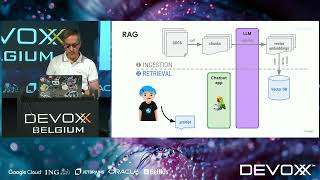
RAG: From Dumb Implementation to Serious Results - Optimizing Retrieval-Augmented Generation
Elevate RAG implementations using LangChain4j. Master advanced chunking, query refinement, metadata filtering, document reranking, data lifecycle management, and evaluation techniques for accurate, relevant results.

Retrieval Augmented Generation with LangChain: ChatGPT for Your Data - Part 1
Explore Retrieval Augmented Generation using LangChain to build a question-answering system with private data, leveraging vector stores, embedding models, and LLMs.

Mitigating RAG Hallucinations with Aporia Guardrails
Explore techniques to reduce hallucinations in Retrieval-Augmented Generation (RAG) systems using Aporia Guardrails, enhancing AI reliability and accuracy.
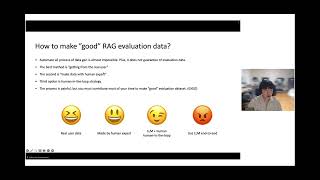
The Best Component for Your RAG System - Optimizing with AutoRAG
Optimize RAG systems automatically with AutoRAG. Boost performance by finding the ideal pipeline for your data and use-case through efficient evaluation of various modules.
ParadeDB - Postgres for Search and Analytics
Explore ParadeDB's integration of search and analytics capabilities into PostgreSQL, enhancing database functionality for modern applications.
Personalized Recommendations and Search with Retrieval and Ranking at Scale - Hopsworks Workshop
Implement personalized recommendations using retrieval and ranking architecture with two-tower embedding models. Learn offline and online infrastructure for scalable, low-latency systems on Hopsworks platform.
Large Language Models and Future of Information Retrieval: Opportunities and Challenges - Lecture 1
Explore the impact of large language models on information retrieval, discussing future opportunities and challenges in search technology.