Lucas-Kanade Tracker (KLT) - Global Motion Estimation - Lecture 10
Explore Lucas-Kanade Tracker (KLT) for computer vision, covering global motion estimation, object tracking, and 2D transformations. Gain insights into advanced tracking algorithms.
Optical Flow in Computer Vision - Lecture 6
Learn about optical flow in computer vision, covering applications, optimization problems, Laplacians, and solutions, with practical examples and in-depth explanations.
Edge Detection in Computer Vision - Lecture 3
Explore edge detection techniques in computer vision, including Marr-Hildreth and Canny methods. Learn about 2-D Gaussian filters, zero crossings, and hysteresis thresholding for improved image analysis.
Filtering in Computer Vision - Lecture 2
Learn about image filtering techniques, including noise reduction, edge detection, and smoothing. Explore applications in computer vision and gain hands-on experience with MATLAB functions for image processing.
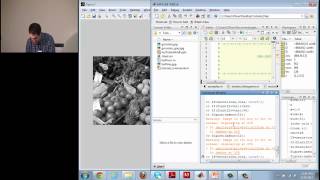
Matlab Tutorial
Learn MATLAB basics for computer vision: variables, vectors, matrices, image operations, filters, and more. Practical tutorial for beginners and intermediate users.
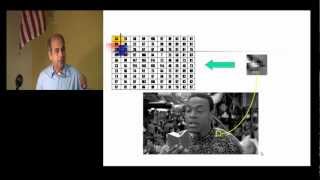
Introduction to Computer Vision - Lecture 1
Explore fundamental concepts of computer vision, including image processing, object detection, and facial recognition. Learn about real-world applications in various fields.
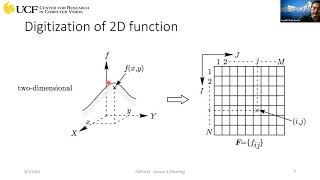
CAP5415 - Digital Image Processing: Filtering and Noise Reduction - Lecture 3
Explore image processing fundamentals, including digitization, histograms, noise types, and filtering techniques. Learn about derivatives, averages, and correlation in the context of digital image analysis.
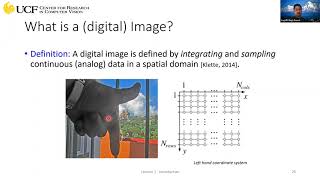
Introduction to Computer Vision - Lecture 1
Introduction to computer vision concepts, applications, and recent advancements. Explores visual perception, image types, object recognition, facial analysis, action detection, and video processing techniques.
SILCO: Show a Few Images, Localize the Common Object
Innovative approach to object detection using few support images, combining spatial similarity and feature reweighting for improved localization in challenging scenarios.
Why Can't I Dance in the Mall? Mitigating Scene Bias in Action Recognition
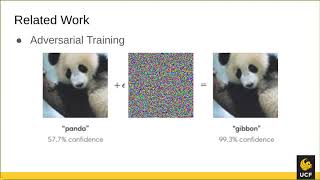
Explores scene bias in action recognition, proposing solutions like adversary training and human mask confusion loss to improve accuracy across different environments.
Unsupervised Video Interpolation Using Cycle Consistency
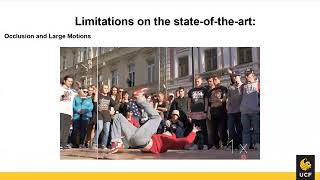
Explore cutting-edge unsupervised video interpolation techniques using cycle consistency, including implementation, constraints, and experimental results for improved frame generation.
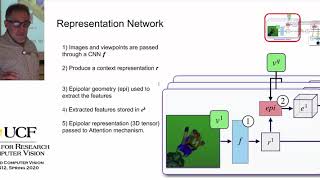
Geometry-Aware Neural Rendering for Novel View Synthesis
Explore novel view synthesis techniques and epipolar extraction in neural rendering, with a focus on geometry-aware approaches and their practical applications.
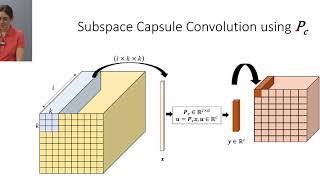
Subspace Capsule Network
Explore Subspace Capsule Networks: a novel approach to neural networks that preserves information, norms, and angles. Learn about its principles, applications, and advantages in image classification and generation.
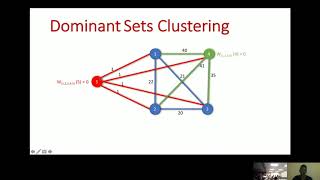
Deep Constrained Dominant Sets for Person Re-Identification
Explore advanced techniques for person re-identification using deep learning, including triplet loss, quadruplet loss, diffusion-based methods, and constrained dominant sets.
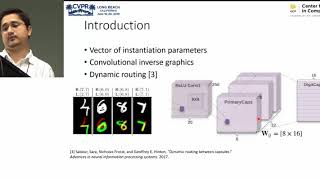
Capsule Networks - A Survey by Dr. Yogesh Rawat, UCF
Explore capsule networks in computer vision, covering dynamic routing, equivariance, and applications in segmentation, localization, and medical imaging.
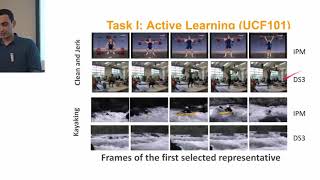
Iterative Projection and Matching: Finding Structure-Preserving Representatives and Applications
Explore iterative projection and matching for finding structure-preserving representatives, with applications in active learning, GANs, image processing, and video summarization.
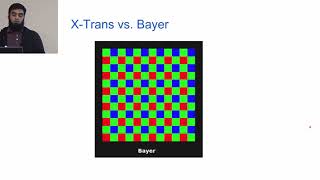
Learning to See in the Dark - Extreme Low Light Imaging Techniques
Explore extreme low-light imaging techniques using deep learning, covering dataset creation, network architecture, and experimental results for improved night vision photography.
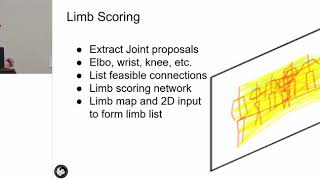
Deep Network for Integrated 3D Sensing of Multiple People in Natural Images
Explore advanced techniques for 3D human pose estimation and shape reconstruction in natural images using deep learning and computer vision approaches.
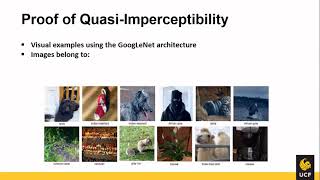
Universal Adversarial Perturbations in Machine Learning - Spring 2021
Explore universal adversarial perturbations in machine learning, covering definitions, contributions, experiments, and cross-model universality.
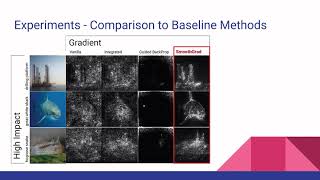
CAP6412 - SmoothGrad: Removing Noise by Adding Noise - Lecture
Explore SmoothGrad, a technique for enhancing neural network visualization by adding noise to input images and averaging resulting sensitivity maps.
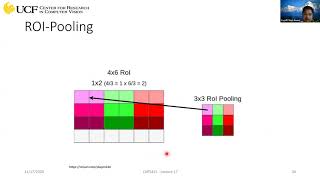
Instance Segmentation - Lecture 17
Explore instance segmentation techniques, including semantic segmentation, ROI pooling, and mask structures, for advanced computer vision applications.