Introduction to Numerical Relativistic Hydrodynamics - Lecture 2
Explore advanced concepts in numerical relativistic hydrodynamics, focusing on mathematical formulations and computational techniques for modeling high-energy astrophysical phenomena.
Listening to the Melody of the Universe - LIGO Gravitational Waves Presentation
Explore the groundbreaking detection of gravitational waves by LIGO, including the science, technology, and data processing techniques that made this historic discovery possible.
Gravitational Waves and the Dark Universe
Explore cutting-edge discoveries in gravitational waves and a new mission investigating the dark universe with experts Chiara Mingarelli and Jason Rhodes, moderated by Brian Greene.
Introduction to Numerical Relativistic Hydrodynamics - Lecture 1
Explore numerical relativistic hydrodynamics, essential for modeling high-energy astrophysical phenomena like black hole mergers and supernovae, crucial for gravitational-wave astronomy advancements.
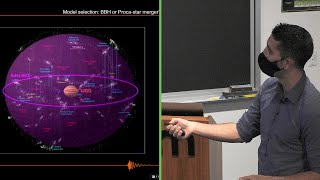
Challenge of Characterising High-Mass Compact Mergers - The Case of GW190521
Explores challenges in analyzing gravitational waves from massive binary mergers, focusing on GW190521. Discusses Bayesian inference, prior choices, and alternative interpretations like eccentric mergers or exotic objects.
Some Geometric Properties of Spacetime - Lecture 4
Explore geometric properties of spacetime with Richard Schoen, delving into advanced concepts in gravity and mathematics for a deeper understanding of our universe.
Black Hole Perturbation Theory - Lecture 4
Explore black hole perturbation theory, examining how small disturbances affect spacetime around black holes and their role in gravitational wave physics.
Black Holes, Binary Systems, and Gravitational Waves - Extreme Mass-Ratio Inspirals - Lecture 2
Explore extreme mass-ratio inspirals in binary systems, focusing on black holes and gravitational waves. Learn about cutting-edge research in astrophysics and general relativity.
Introduction to Mass and Energy in General Relativity - Lecture 1
Explore fundamental concepts of mass and energy in Einstein's theory, delving into their intricate relationship and implications for spacetime curvature and gravitational phenomena.
White Dwarf - Neutron Star Binaries and Their Gravitational Wave Signatures by Alexey Bobrick
Explore gravitational wave signatures of white dwarf-neutron star binaries, examining their unique characteristics and implications for astrophysics and gravitational wave detection.
GW Signals from Tidal Disruption Events in the Decihertz Regime by Martina Toscani
Explore gravitational wave signals from tidal disruption events in the decihertz regime, focusing on lunar detection methods and their potential for breakthrough observations in astrophysics.
A New Approach to the Binary Inspiral Problem - IPAM at UCLA
Explore modern scattering theory applications to gravitational wave calculations, focusing on advances in quantum scattering amplitudes and their relevance to binary black hole inspiral problems.
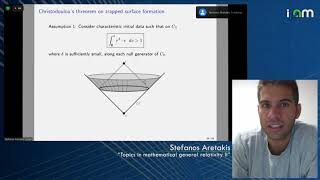
Topics in Mathematical General Relativity II - IPAM at UCLA
Explore black hole stability, linear wave equations, and Newman-Penrose constants in mathematical general relativity. Delve into extremal and subextremal cases, and examine key non-linear results in this field.
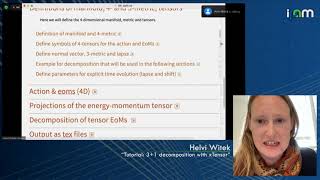
Tutorial: 3+1 Decomposition with xTensor - IPAM at UCLA
Learn to derive ADM-York equations for Einstein's equations using xTensor, an open-source tool for tensor algebra with Mathematica. Explore abstract tensor computations in gravitational wave astronomy.
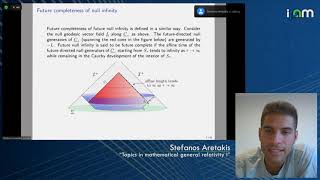
Topics in Mathematical General Relativity I
Explore key conjectures, problems, and methods in mathematical general relativity, including cosmic censorship, double null foliation, and short pulse method for studying trapped surfaces and Cauchy horizons.
Machine Learning for Gravitational Wave Astronomy - Concepts & Terminology
Explore machine learning concepts and terminology for gravitational wave data analysis, enhancing your understanding of this cutting-edge field in astronomy and physics.
Disaster Resilience and Cosmic Exploration - Keynote Lectures
Renowned scientists Lucy Jones and Takaaki Kajita discuss disaster resilience, science communication, and cosmic exploration through neutrinos, gravitational waves, and gamma rays.

From Black Holes to Quantum Computing
Explore the fascinating connection between black holes and quantum computing, uncovering how these cosmic phenomena could revolutionize our understanding of information processing and error correction.
Building New Tools for Gravitational Wave Astronomy
Explore cutting-edge techniques and innovations in gravitational wave detection with experts, enhancing our understanding of cosmic phenomena and astrophysical events.

The Spins of Binary Black Holes Following LIGO and Virgo's Third Observing Run
Explore binary black hole spins after LIGO and Virgo's third observing run, featuring insights from MIT experts on gravitational wave detections and their implications for astrophysics.
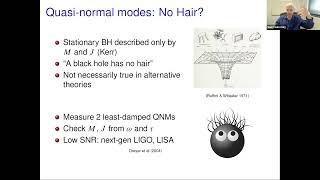
Nonlinearities in Black-Hole Ringdowns
Explore nonlinearities in black-hole ringdowns with experts Keefe Mitman and Saul Teukolsy, delving into advanced concepts in gravitational physics and astrophysics.