Surviving Runaway Stellar Remnants from Thermonuclear Supernovae - Roberto Raddi
Explore surviving stellar remnants from thermonuclear supernovae with Roberto Raddi. Discover astrometric, photometric, and spectroscopic insights into white dwarfs and their role in understanding galactic evolution.
A Road-Map to White Dwarf Pollution - Marc Brouwers
Explore white dwarf pollution through astrometric, photometric, and spectroscopic data. Gain insights into stellar remnants and their role in probing various astrophysical phenomena.
Moment of Birth - How Infant-Phase Signals from SN2018aoz Inform
Explore how infant-phase signals from supernova SN2018aoz provide insights into white dwarf physics and stellar evolution, presented by Yuan Qi Ni from the University of Toronto.
Observations of Thermonuclear Supernovae - Kate Maguire
Explore thermonuclear supernovae observations with Kate Maguire, covering astrometric, photometric, and spectroscopic data from all-sky surveys to gain insights into white dwarf populations and their astrophysical implications.
Type Ia Supernova Progenitors - Ruediger Pakmor
Explore Type Ia supernova progenitors with Ruediger Pakmor, focusing on white dwarf physics, stellar evolution, and their role in galactic populations and gravitational wave sources.
Towards a Volume-Limited All-Sky Sample of Extremely Low-Mass White Dwarfs - Ingrid Pelisoli
Explore the latest research on extremely low-mass white dwarfs using all-sky surveys, focusing on their significance in astrophysics and potential for new scientific discoveries.
A Unified Model for the Evolution of Cataclysmic Variables - Arnab Sarkar
Explores a unified model for cataclysmic variable evolution, discussing recent observational data and theoretical developments in white dwarf physics to advance our understanding of these stellar remnants.
Stellar Autopsies from White Dwarf Pulsations - JJ Hermes
Explore white dwarf pulsations as a tool for stellar autopsies, uncovering insights into stellar evolution, Galactic history, and fundamental physics through cutting-edge observational and theoretical approaches.
White Dwarf Sedimentation and Phase Separation - Status
Explore white dwarf sedimentation and phase separation with expert Evan Bauer, discussing current research status and implications for stellar evolution and galactic history.
Fractionation Processes in Crystallizing White Dwarfs - Simon Blouin
Explore fractionation processes in crystallizing white dwarfs, examining their impact on stellar evolution and composition. Gain insights into cutting-edge research in astrophysics and stellar remnants.
Mergers of White Dwarfs as Failed Type Ia Supernovae - Ashley Ruiter
Explore white dwarf mergers as potential failed Type Ia supernovae, examining their characteristics and implications for stellar evolution and galactic populations.
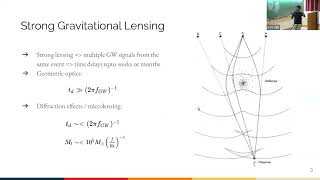
Micro-Lensing of Gravitational Wave Signals - Effect of the Galaxy Lens
Explore the intriguing effects of galaxy lensing on gravitational wave signals, delving into the phenomenon of micro-lensing and its implications for astrophysical observations.
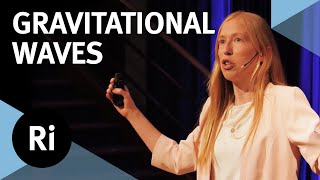
What Do Gravitational Waves Sound Like? - With Tessa Baker
Explore gravitational waves, their detection, and cosmic implications with cosmologist Tessa Baker. Learn about Einstein's theories, black holes, and cutting-edge astronomical research in this comprehensive lecture.
Modern Numerical Methods in Computational Relativity - Lecture 5
Explore advanced numerical techniques in computational relativity, focusing on simulating black hole mergers and other high-energy astrophysical phenomena for gravitational-wave astronomy.
Modern Numerical Methods in Computational Relativity - Lecture 2
Explore advanced numerical techniques for solving Einstein's equations in computational relativity, focusing on applications in gravitational-wave astronomy and astrophysical simulations.
Modern Numerical Methods in Computational Relativity - Lecture 3
Explore advanced numerical techniques for solving Einstein's equations in computational relativity, focusing on modeling gravitational waves from merging black holes and neutron stars.

Modern Numerical Methods in Computational Relativity - Lecture 1
Explore modern numerical methods for solving Einstein's equations in computational relativity, essential for modeling gravitational waves from black hole and neutron star mergers.

Mapping the Universe - Dark Energy, Black Holes, and Gravity – With Chris Clarkson
Explore the cosmos with Chris Clarkson as he unravels the mysteries of dark energy, black holes, and gravity, discussing cutting-edge cosmological surveys and their impact on our understanding of the universe's structure and evolution.
Numerical Relativity: Mathematical Formulation - Lecture 4
Explore mathematical foundations of Numerical Relativity, essential for modeling gravitational waves from black hole mergers and other high-energy astrophysical phenomena.
Introduction to Numerical Relativistic Hydrodynamics - Lecture 5
Explore advanced concepts in numerical relativistic hydrodynamics, focusing on computational techniques for modeling high-energy astrophysical phenomena and gravitational wave sources.

Numerical Relativity: Mathematical Formulation - Lecture 5
Explore mathematical foundations of Numerical Relativity, essential for modeling gravitational waves from black hole mergers and other high-energy astrophysical phenomena.