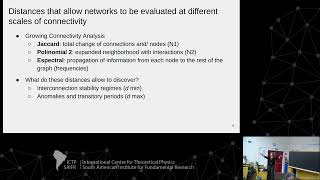
Economic and Financial Networks: Models and Analysis - Class 4
Explore advanced models and analysis techniques for economic and financial networks in this final session of a comprehensive series.
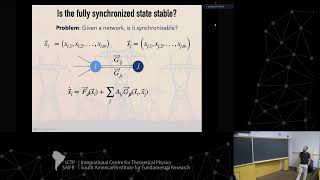
Complex Networks and Applications to Neuroscience - Class 3
Explore complex networks' applications in neuroscience, focusing on advanced concepts and their relevance to brain function and connectivity.
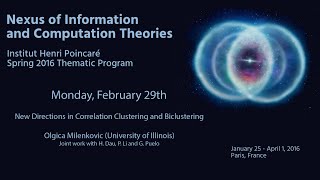
New Directions in Correlation Clustering and Biclustering
Explore advanced techniques in correlation clustering and biclustering, focusing on novel approaches and applications in data analysis and machine learning.

Self-Adjusting Networks for Optimized Datacenter Topology Design
Explore self-adjusting networks optimized for datacenter traffic, including metrics, design principles, and research challenges. Gain insights into demand-aware graphs and related optimization problems.
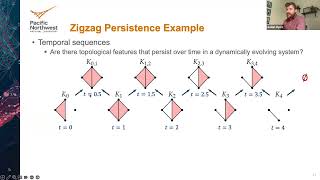
Understanding Temporal Hypergraph Dynamics with Zigzag Persistence
Explore temporal hypergraphs and zigzag persistence to analyze complex systems' topological evolution, applied to cybersecurity and social networks for understanding underlying dynamics.
Sublinear Algorithms in Social Networks via Core-Periphery Decomposition
Explore sublinear algorithms for large networks using core-periphery structure and degree distribution. Learn about accelerating tasks like node sampling and shortest path computations.
Computing Small Rainbow Cycle Numbers with SAT Modulo Symmetries
Explores computing rainbow cycle numbers using SAT modulo Symmetries, enhancing understanding of envy-freeness in fair division of indivisible goods and improving EFX allocation feasibility guarantees.

Bipartite Graph Factorization in Static Decoding Graphs with Long-Span Acoustic Context
Explore bipartite graph factorization for efficient speech recognition search space representation, addressing challenges in large vocabulary systems with long-span acoustic context.
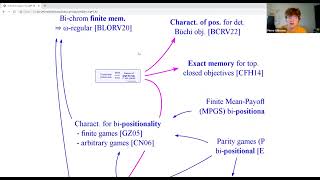
Infinite Duration Games, Memory and Graphs - Part 2
Delve into advanced concepts of infinite duration games, exploring memory structures and graph theory through rigorous mathematical analysis and computational complexity perspectives.
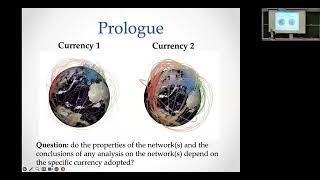
Network Science Is Not Scale Invariant
Explore the concept of scale dependence in network science, challenging common assumptions and examining its implications for complex systems analysis.
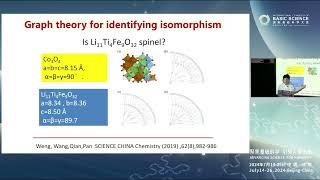
Graph Theory for Exploration of Material Genes and Structural Chemistry of Li-ion Batteries
Explore graph theory's application in material genes and structural chemistry of Li-ion batteries. Uncover new paradigms for advancing critical battery materials through interdisciplinary research methods.

Visualization for Data Science: Network Analysis - Part 2
Explore advanced network visualization techniques and data science principles for creating effective visual representations of complex networked systems and relationships.
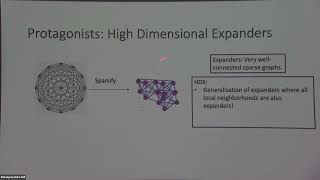
Quasi-Linear Size PCPs with Small Soundness from High-Dimensional Expanders
Delve into probabilistically checkable proofs (PCPs), exploring their encoding, verification, and applications in computer science, with focus on achieving small soundness using high-dimensional expanders.
Fault Tolerant Routing Protocols on High-Dimensional Expanders
Delve into fault-tolerant routing protocols on high-dimensional expanders, exploring efficient message transmission systems that maintain reliability even with corrupted network edges and enable advanced distributed computing applications.
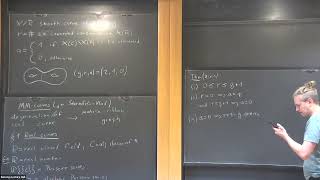
Maximal Mumford Curves and Graph Embeddings in Real Algebraic Geometry
Explore the geometric properties of MM-curves, focusing on real stable curves, hyperplane arrangements, and graph embeddings in relation to Mumford curves and their deformations.
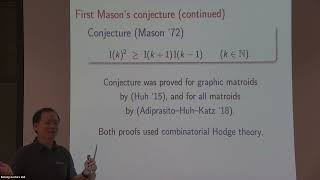
Complexity of Log-concave Inequalities in Matroids
Delve into the mathematical complexity of log-concave inequalities in matroids, exploring combinatorics, complexity theory, and geometric approaches to understanding Mason's conjecture and related mathematical concepts.
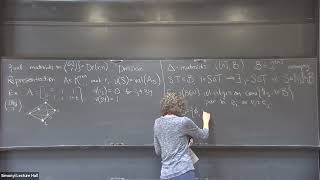
Valuated Delta Matroids and Principal Minors
Delve into advanced mathematical concepts of valuated Delta matroids, their relationship with principal minors of Hermitian matrices, and their applications in combinatorial structures.
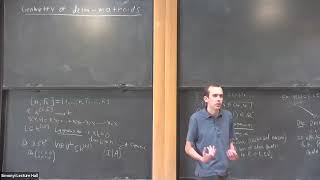
Geometry of Delta-Matroids
Explore advanced geometric constructions in delta-matroids, examining their relationship to matroids and proving ultra log-concavity of independent sets in mathematical structures.

Visualization for Data Science: Network Analysis - Part 1
Master network visualization techniques and data science principles for effectively analyzing and presenting complex interconnected datasets and network structures.
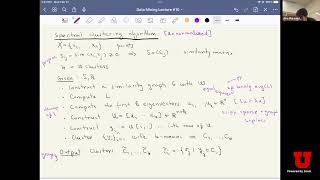
Spectral Clustering and Graph Partitioning - Data Mining Spring 2023
Master spectral clustering concepts through graph theory, Laplacians, eigenvalues, and practical algorithms for data partitioning and similarity analysis.
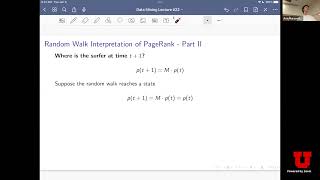
Matrix Completion and PageRank in Data Mining - Spring 2023
Dive into matrix completion techniques and PageRank algorithms, exploring fundamental concepts for data mining and graph analysis applications.