
Formal Probabilistic Methods for Combinatorial Structures using the Lovász Local Lemma
Explore formal probabilistic methods for combinatorial structures, focusing on the Lovász Local Lemma and its application to hypergraph coloring in Isabelle/HOL.

Designing the Morphology of Separated Phases in Multicomponent Liquid Mixtures
Explore algorithms for constructing phase diagrams and predicting morphology in multicomponent liquid mixtures, with applications from industry to cellular biology.

Networks and Recommendation Systems
Explore graph-based recommendation systems, their transparent implementation, and real-world applications in this technical deep dive for data science practitioners.
The Power of Knowledge Graphs and AI - A New Era for Developers and Data Scientists
Explore Knowledge Graphs and AI: Learn technical aspects, real-world applications, and future trends. Discover how to leverage these technologies for data harmonization and inference.
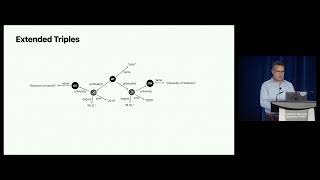
Saga: Continuous Construction and Serving of Large Scale Knowledge Graphs
Explore continuous construction and serving of large-scale knowledge graphs with Saga, an end-to-end platform. Learn about challenges in industrial settings and various graph services.
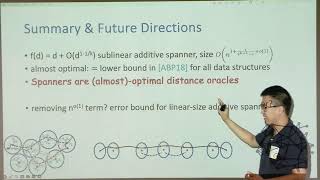
Almost-Optimal Sublinear Additive Spanners in Graph Theory
Explore sublinear additive spanners in graph theory, focusing on optimal stretch functions and size bounds for undirected unweighted graphs. Learn about recent advancements and their implications.
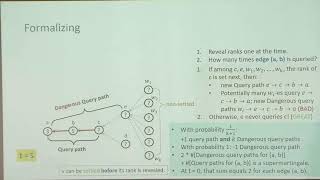
Sublinear Algorithms for Correlation Clustering
Explore sublinear algorithms for correlation clustering, focusing on a 3+eps approximation method using LCA probes, MPC rounds, and dynamic updates. Analyze technical results for maximal independent set computation.
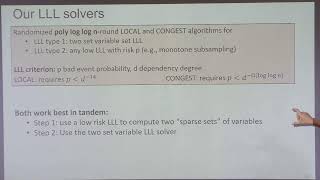
Sparsification for Communication-Efficient Distributed Symmetry-Breaking
Explore sparsification techniques for efficient distributed algorithms, focusing on local symmetry-breaking problems in graph theory and the CONGEST model.
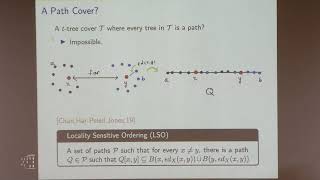
Recent Progress on Euclidean Spanners
Explore recent advancements in Euclidean spanners, including sparse, light, fault-tolerant, and dynamic variants, while discovering outstanding open problems in the field.
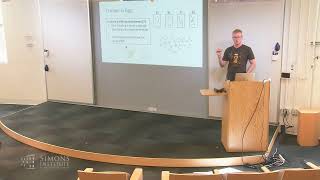
Parallel Algorithms for Local Problems in Sparse Graphs
Explore efficient parallel algorithms for locally checkable problems in sparse graphs, focusing on techniques beyond graph sparsification for improved performance in sublinear regimes.
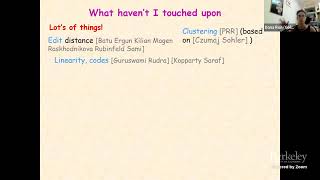
Tolerant Property Testing and Distance Approximation in Sublinear Algorithms
Explore tolerant property testing and distance approximation algorithms for various object types and properties. Gain insights into bipartiteness, monotonicity, uniformity, and subsequence-freeness.
Geometric Properties of Quantum States Representing Directed Graphs on Quantum Computer
Explore geometric properties of multi-qubit states represented by directed graphs, examining curvature, torsion, and entanglement using quantum computers and simulators.
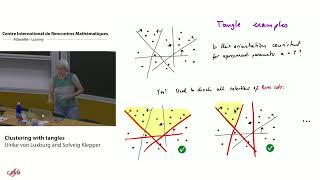
Clustering with Tangles - Machine Learning and Signal Processing on Graphs
Explore clustering with tangles, covering partitions, agreement parameters, cost functions, and applications in machine learning and signal processing on graphs.
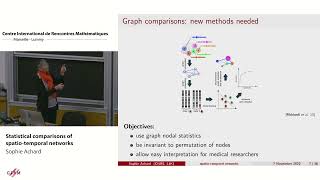
Statistical Comparisons of Spatio-Temporal Networks - Sophie Achard
Explore statistical methods for comparing spatio-temporal networks, focusing on brain analysis and graph comparisons. Learn nodal statistics and structural patterns for network characterization.
A Max-Flow Approach to Random Tensor Networks
Explore a Max-Flow approach to Random Tensor Networks, delving into mathematical concepts and applications in quantum information theory.
The Largest Common Subtree of Uniform Attachment Trees
Explore the largest common subtree of uniform attachment trees in this advanced mathematics workshop, featuring expert talks and collaborative sessions on network analysis and discrete probability.
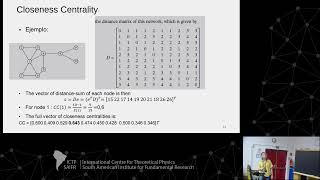
Neo4J Graph Data Science: Centrality Algorithms
Explore centrality algorithms in Neo4J Graph Data Science Library for advanced network analysis and machine learning applications.
Geometry of Nonequilibrium Reaction Networks
Explore geometric interpretations of nonequilibrium reaction networks, extending Hill-Schnakenberg theory to hypergraphs and analyzing cycles, cocycles, and stochastic models.
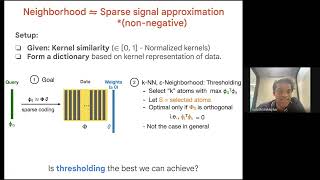
Revisiting Nearest Neighbors from a Sparse Signal Approximation View
Explore nearest neighbor methods from a sparse signal approximation perspective, uncovering improved neighborhood definitions and their applications in graph-based signal processing and machine learning.
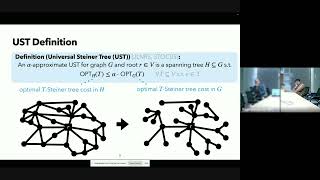
One Tree to Rule Them All: Polylogarithmic Universal Steiner Trees and Strong Sparse Partition Hierarchies
Explore polylogarithmic universal Steiner trees and strong sparse partition hierarchies. Learn about new constructions improving approximation guarantees and matching logarithmic lower bounds.
Economic and Financial Networks: Models and Analysis - Class 3
Explore economic and financial network models and analysis techniques in this advanced lecture on nonlinear systems in socio-economic complexity.