
GraphRAG: The Most Incredible RAG Strategy Revealed
Explore GraphRAG, an advanced retrieval-augmented generation system enhancing AI responses with relevant context. Learn implementation, setup, and advantages over traditional methods.
A New Wave of Network Science - From Fantasy to Applications
Explore innovative applications of network science algorithms, from analyzing Game of Thrones characters to transforming urban landscapes and creating data-driven art through real-world case studies.
TONCAS - Introduction to Graph Theory and Mathematical Conditions
Discover the powerful TONCAS mathematical acronym and its applications in graph theory, exploring bipartite graphs, planar embeddings, and degree sequences through clear mathematical reasoning.
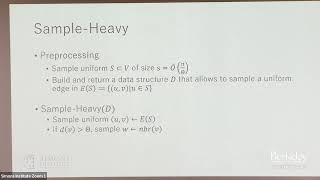
Sampling Multiple Edges Efficiently
Dive into efficient algorithms for sampling multiple edges in graphs, exploring innovative techniques and mathematical frameworks presented by MIT researcher Talya Eden.
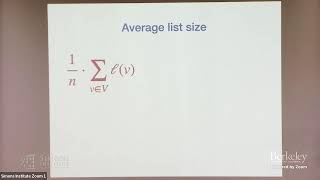
Simple Sublinear Algorithms for Vertex Coloring
Dive into advanced graph theory concepts and efficient vertex coloring algorithms, exploring sublinear approaches for optimizing computational complexity.
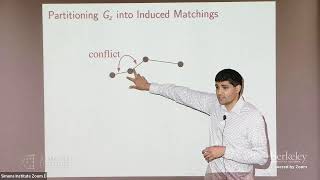
The Magic of Ruzsa-Szemeredi Graphs
Dive into the fascinating properties and applications of Ruzsa-Szemeredi graphs, exploring their mathematical significance and theoretical implications in graph theory.

Decoding on Graphs: Empowering LLMs with Knowledge Graphs Through Well-Formed Chains
Discover how to enhance LLM capabilities by integrating Knowledge Graphs through the Decoding on Graphs framework, focusing on graph-aware constrained decoding and well-formed reasoning chains.

Building Network Analysis Applications with Streamlit and st-link-analysis - Python Tutorial
Learn to create interactive network analysis applications using Streamlit and st-link-analysis, featuring customizable visualizations, real-time interaction, and efficient data handling capabilities.
Performance and Limitations of QAOA at Constant Levels on Large Sparse Hypergraphs and Spin Glass Models
Delve into quantum algorithm analysis, exploring QAOA's performance limitations on large hypergraphs and spin glass models through theoretical frameworks and mathematical proofs.
Electric Flow Sampling and Quantum Walks on Trees
Explore electric flow sampling (elfs) in quantum walks, examining their connection to random walks, hitting times on trees, and applications in quantum algorithms for distribution sampling.
Quantum Algorithms and the Power of Forgetting - The Welded Tree Problem
Explore quantum algorithms and the welded tree problem through groundbreaking research that reveals why quantum computations must sometimes "forget" their paths to achieve exponential speedup.
A Unified Graph-Theoretic Framework for Free-Fermion Solvability
Explore a unified graph-theoretic framework that connects quantum spin systems with free-fermion solutions through frustration graphs, extending Jordan-Wigner transformations and four-fermion model solutions.
Improved Product-state Approximation Algorithms for Quantum Local Hamiltonians
Delve into advanced algorithms for approximating ground state energy and free energy in quantum local Hamiltonians, exploring new techniques for dense systems and sparse graphs with fixed minor exclusions.
Quantum Algorithm for Path-Edge Sampling
Explore quantum algorithms for path-edge sampling in graphs, focusing on efficient query complexity and applications in path finding and cut finding between nodes, with practical implementations.
A Graphical #SAT Algorithm for Formulae with Small Clause Density
Explore a novel graphical approach to solving #SAT problems using ZH-calculus, focusing on Boolean satisfiability with small clause density and its applications in quantum circuit analysis.
On the Power of Nonstandard Quantum Oracles - Complexity Theory and Oracle Models
Delve into quantum oracle complexity theory and its impact on property testing, exploring how different oracle designs affect quantum algorithms and verification protocols in graph analysis.
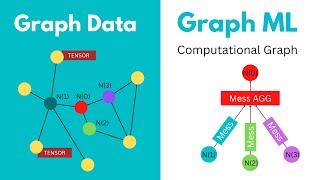
Unlocking the Potential of Message Passing - Exploring GraphSAGE, GCN and GAT Networks
Dive into message passing techniques in Graph Neural Networks, exploring GraphSAGE, GCN, and GAT architectures for effective graph-based learning and network analysis.
Text-to-Graph with Large Generative Graph Models
Explore cutting-edge research on large generative graph models and their applications in biomedicine and cybersecurity through diffusion-based technology and text-to-graph conversion.
Node Classification with Graph Convolutional Networks for Graph Machine Learning
Master Graph Convolutional Networks (GCN) implementation in PyG for node classification, featuring practical coding examples and theoretical foundations of spectral graph convolutions.

On-The-Fly Static Analysis via Dynamic Bidirected Dyck Reachability
Explore a novel dynamic algorithm for bidirected Dyck reachability, optimizing on-the-fly static analysis with superior performance and efficiency for continuous code updates.
A Better Approximation for Interleaved Dyck Reachability
Explore a novel approach to interleaved Dyck reachability, offering improved precision for context- and field-sensitive static analyses through refined CFLs and on-demand application.