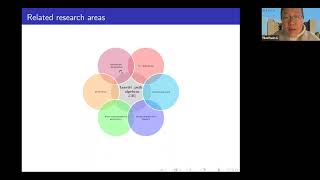
Graded and Filtered K-Theory for Leavitt Path Algebras
Explore graded and filtered K-theory applications to Leavitt path algebras in this advanced mathematical seminar by Huanhuan Li.

Wolfram's Hypergraphs - A New Approach to Unified Physics Theory
Explore how Stephen Wolfram's revolutionary approach using hypergraphs and computer code could potentially unify fundamental physics laws and resolve conflicts with Einstein's theories.
Network Neuroscience - Where the Brain and Social Networks Work the Same
Explore fascinating parallels between neural networks and social interactions, discovering how billions of neurons mirror human communication patterns in network neuroscience.
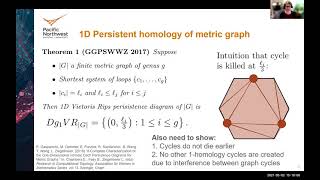
Homology of Graphs and Hypergraphs
Explore topological structures of graphs and hypergraphs, including recent findings on homology and persistent homology, with applications in combinatorial and metric space analysis.
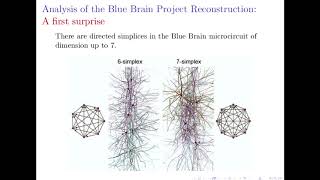
Ran Levi - Bedlewo: Topological Analysis of Neural Networks
Explore topological analysis of neural networks using algebraic topology techniques on biologically accurate digital reconstructions, revealing structural and functional insights into brain connectivity.
Insights from Comparative Connectomics in Drosophila
Explore insights from fruit fly brain connectomes, including FlyWire resource, edge weight interpretation, cell type definition, and variability analysis in comparative connectomics.
Monogamy of Highly Symmetric States in Quantum Entanglement
Explore entanglement limits in highly symmetric quantum states on complete graphs, using semidefinite programming and representation theory to solve long-standing problems.
Defective Tensor Network Varieties
Explore defective tensor networks and their anomalies in algebraic varieties, focusing on graph structure, dimensions, and unexpected deviations from parameter-based expectations.
Combinatorial QFT on Graphs
Explore geometric structures through combinatorial quantum field theory on graphs, focusing on innovative approaches and applications in mathematical physics.
Embeddings and Statistical Mechanics in Dimer Graphs - Part 2
Explore geometric embeddings of dimer graphs and their algebra-combinatorial properties in this advanced tutorial on statistical mechanics and integrability.
Rotation-Invariant Web Bases from Hourglass Plabic Graphs and Symmetrized Six-Vertex Configurations
Explore symmetrized six-vertex model, hourglass plabic graphs, and their applications in statistical mechanics and combinatorics. Discover connections to tableaux, alternating sign matrices, and plane partitions.
Local Weak Convergence for Random Constraint Satisfaction Problems
Explore local weak convergence in random constraint satisfaction problems with Princeton's Allan Sly, delving into advanced statistical mechanics concepts beyond two dimensions.
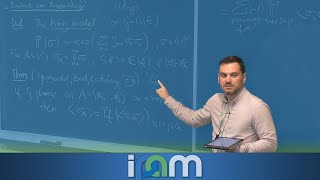
On Pfaffians in Spin Models
Explore Pfaffian relations in spin models, focusing on Ising models on planar graphs and their correlation functions. Discover insights into ferromagnetic spin models and graph simplifications.
The Multinomial Dimer Model - Statistical Mechanics and Discrete Geometry
Explore the multinomial dimer model's limit shape theory, bistochastic gauge, and 3D Aztec diamond applications in statistical mechanics and discrete geometry.
Interacting Polya Urns - Statistical Mechanics Beyond 2D
Explore interacting Polya urns on graphs, their asymptotic behavior, and convergence to equilibrium in this statistical mechanics presentation by Omer Angel at UCLA's IPAM workshop.
The Arboreal Gas - Percolative Properties of Random Forests
Explore the percolative properties of random forests in the arboreal gas model, examining the formation of giant trees and its applications to branched polymer gelation.
Poisson-Dirichlet Distribution for the Interchange Process in Five Dimensions
Explores the emergence of macroscopic cycles in the interchange process on high-dimensional tori, proving convergence to Poisson-Dirichlet distribution for cycle lengths in dimensions 4 and above.
Minimal Bipartite Dimers and Maximal Riemann Surfaces
Exploration of critical weights for dimer models on isoradial graphs, extending Kenyon's results using theta functions on maximal Riemann surfaces, with applications to spectral theorems and Laplacians.
On the Higher-Rank Dimer Model
Richard Kenyon explores the higher-rank dimer model, discussing GL(n) local systems, Kasteleyn operators, and n-multiwebs. He presents scaling limit results for SL(3) and their conformal invariance in this advanced mathematics talk.
Quantum Automorphism Groups of Some Classes of Graphs
Explore quantum symmetries in graphs, revealing hidden quantum behaviors and comparing classical and quantum automorphism groups through examples and recent computations.
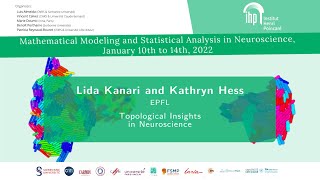
Topological Insights in Neuroscience
Explore topological approaches in neuroscience, uncovering insights into brain structure and function through mathematical analysis.