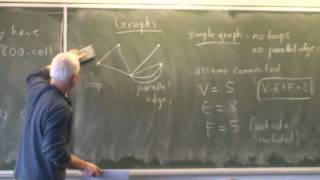
Applications of Euler's Formula and Graphs in Algebraic Topology
Explore Euler's formula applications to Platonic solids, polyhedra, and higher dimensions. Learn about planar graphs and delve into advanced geometric concepts in algebraic topology.
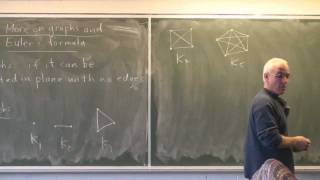
More on Graphs and Euler's Formula in Algebraic Topology - Lecture 10
Explores applications of Euler's formula in planar graphs, including complete and bipartite graphs, Five neighbours theorem, Six colouring theorem, and Pick's formula for computing areas of integral polygonal figures.
Euler's Relation Between Vertices, Edges, and Faces of Platonic Solids - Famous Math Problems 15
Explore Euler's famous formula relating vertices, edges, and faces of Platonic solids. Discover its historical context, proof, and significance in modern topology.
The Graceful Tree Conjecture - Famous Math Problems
Explore the Graceful Tree Conjecture in graph theory, learning about vertex labeling, graceful graphs, and evidence supporting this famous mathematical problem.
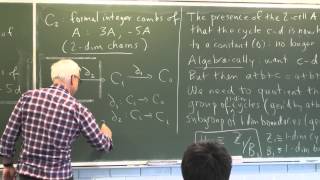
Introduction to Homology in Algebraic Topology - Part 2
Explores cycles, boundaries, and homology in algebraic topology, focusing on graph modifications and using commutative group theory to analyze formal combinations of geometric elements.
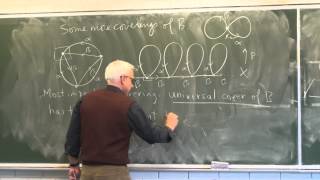
Covering Spaces and 2-Oriented Graphs - Algebraic Topology
Explore covering spaces through wedge of circles, examining graphs with labeled edges. Learn about universal covering spaces and their fundamental groups in algebraic topology.
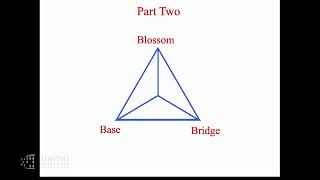
A Theory of Alternating Paths and Blossoms, from the Perspective of Minimum Length
Explores the Micali-Vazirani algorithm for maximum cardinality matching in graphs, presenting new ideas and insights into its structure and efficiency through a novel theory of alternating paths and blossoms.
An Algebraic Perspective on Perfect Graphs - Theory Seminar
Explore the algebraic perspective on perfect graphs, connecting graph theory with polynomial algebra and sum of squares decomposition. Gain insights into sos-perfectness and its equivalence to graph perfectness.
Data Deduplication for Redundant Graph Structures Files
Explore robust data deduplication techniques for sparse graph structures, connecting to classical combinatorial problems and their wide-ranging applications.
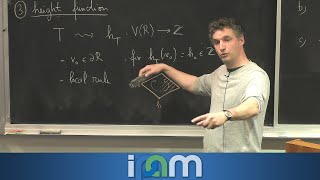
Dimer Models and Random Tilings - Part 1
Explore dimer models and random tilings with Cédric Boutillier. Learn about Kasteleyn's theory, combinatorial correspondences, and asymptotic methods for studying perfect matchings on lattices.

Is It Easier to Count Communities Than Find Them?
Explore computational challenges in detecting community structures in random graphs, examining statistical and computational phase transitions, and the difficulty of inferring community properties.
Non-virtually Abelian Discontinuous Group Actions vs Proper SL(2,R)-Actions - Aleksy Tralle
Explore non-virtually Abelian discontinuous group actions and proper SL(2,R)-actions in this advanced mathematics lecture, part of a program on Zariski dense subgroups and geometric applications.
Perfect t-embeddings of Uniform Aztec Diamond Graphs
Explores t-embeddings of uniform Aztec diamond graphs, providing new formulas and asymptotic analysis to prove convergence of dimer model height fluctuations to a Gaussian Free Field.
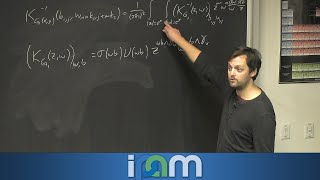
Dimer Models and Random Tilings - Part 2
Explore dimer models, perfect matchings, and tilings with advanced mathematical tools. Delve into Kasteleyn's theory, combinatorial correspondences, and asymptotic methods for large-scale limits.
Spectrum of Sparse Inhomogeneous Random Graphs
Explore the spectrum of sparse inhomogeneous random graphs, examining structural properties and applications in network science, probability theory, and statistical physics.

Path Convergence of Markov Chains on Large Graphs
Explore path convergence of Markov chains on large graphs, examining theoretical aspects and applications in network science, probability theory, and complex systems analysis.
Algorithms on Networks
Explore algorithms for network analysis, optimization, and control. Learn techniques for solving complex problems on graphs and networks, with applications in various fields.
Best Arm Identification Through Fluid-Based Methods
Explore fluid-based methods for best arm identification in multi-armed bandit problems. Learn innovative techniques to optimize decision-making in uncertain environments.
Well Posedness for Hamilton-Jacobi Equations for Linearly Controlled Gradient Flows
Explore well-posedness of Hamilton-Jacobi equations for linearly controlled gradient flows, examining mathematical foundations and applications in optimization and control theory.
Asymptotics of Invariant Measures of Mean-field Markov Models on Countable State Spaces
Explore asymptotics of invariant measures in mean-field Markov models on countable spaces. Gain insights into network science, probability theory, and applications in complex systems and data analysis.
The Friendship Paradox for Sparse Random Graphs
Explore the friendship paradox in sparse random graphs, examining structural properties and implications for network analysis and social dynamics.