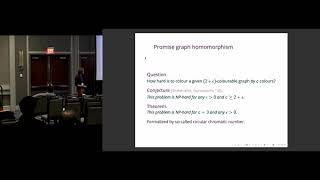
The Complexity of 3-Colouring H-Colourable Graphs
Explore the intricacies of graph theory, focusing on 3-colouring H-colourable graphs and their computational complexity. Gain insights into advanced mathematical concepts and algorithmic challenges.
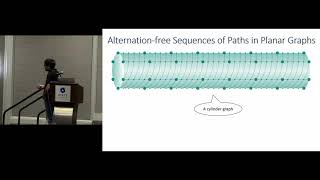
Parametric Shortest Paths in Planar Graphs
Explore efficient algorithms for computing shortest paths in planar graphs with varying edge weights, enhancing understanding of graph theory and optimization techniques.
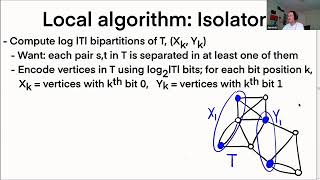
Deterministic Min-cut in Poly-logarithmic Max-flows
Explore cutting-edge algorithms for efficiently solving network flow problems, focusing on deterministic min-cut techniques and their relationship to max-flow computations.
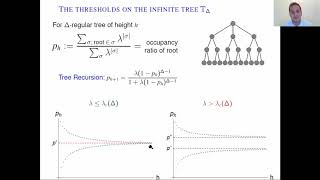
The Complexity of Approximating Averages on Bounded-Degree Graphs
Explore the intricacies of approximating averages on bounded-degree graphs, delving into computational complexities and algorithmic approaches.
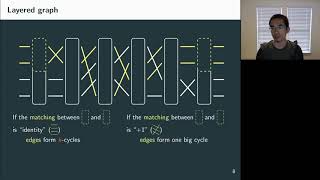
Multi-Pass Graph Streaming Lower Bounds for Cycle Counting, MAX-CUT, Matching Size, and Other Problems
Explore multi-pass graph streaming lower bounds for cycle counting, MAX-CUT, matching size, and related problems in this advanced computer science presentation.
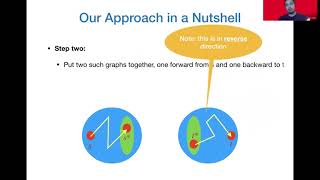
Near-Quadratic Lower Bounds for Two-Pass Graph Streaming Algorithms
Explore near-quadratic lower bounds for two-pass graph streaming algorithms, covering streaming models, graph problems, and Ruzsa-Szemeredi graphs.
Dynamic PageRank: Additive Error and Batch Recomputation
Explores dynamic PageRank algorithms, proving hardness of relative error approximations and demonstrating efficiency of batch recomputation for L1 error metric in dynamic graph settings.
Decremental Shortest Paths Against an Adaptive Adversary
Explore efficient algorithms for maintaining shortest paths in dynamic graphs undergoing deletions, with a focus on near-optimal deterministic data structures and adaptive adversary scenarios.

Solving the Hardest Problems in Mathematics - Interview with Daniel Spielman
Mathematician Tom Crawford interviews Daniel Spielman about his career, the Nevanlinna Prize, and contributions to mathematical aspects of information sciences, offering insights into solving complex problems.
Distributed Graph Techniques in the MPC Model
Explore advanced distributed graph algorithms in the Massively Parallel Computation model, focusing on efficiency and scalability for large-scale data processing.
Discovering Emerging Open Source Communities Through Graphical Analysis
Explore graph theory techniques to visualize open source ecosystems, identify emerging communities, and uncover relationships between projects using centrality algorithms and the Augur OSS project.
Inverse Problems on Graphs with Geometric Deep Learning
Explores geometric deep learning for graph inverse problems, focusing on non-Euclidean geometries, physics-based approaches, and applications in particle physics and community detection.
Minimum Isolating Cuts - A New Tool for Solving Minimum Cut Problems
Explore a powerful new tool for solving minimum cut problems in combinatorial optimization, with applications to global, Steiner, and all-pairs min-cut algorithms.
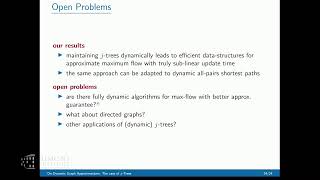
On Dynamic Graph Approximations - The Case of J-Trees
Explores dynamic maintenance of j-trees in graph theory, discussing implications for cut-based optimization, maximum flows, and minimum cost-flow computations in algorithmic design.
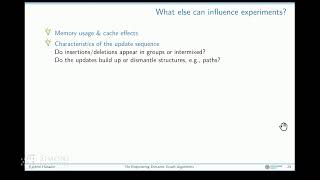
On Engineering Dynamic Graph Algorithms
Explore challenges, techniques, and best practices for engineering dynamic graph algorithms, with insights on experimental approaches and design considerations.
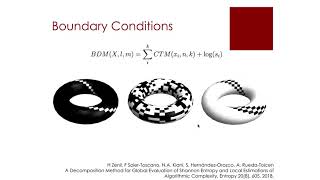
Graph and Tensor Algorithmic Complexity - Unit 6, Module 5
Explore algorithmic complexity in graphs and tensors, focusing on computational approaches to causality and living systems from networks to cells.
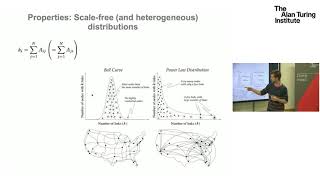
A Gentle Introduction to Network Science - Dr Renaud Lambiotte, University of Oxford
Explore key properties and modeling tools for real-life networked systems across various domains, from biology to sociology, with Dr. Renaud Lambiotte's comprehensive overview of network science.
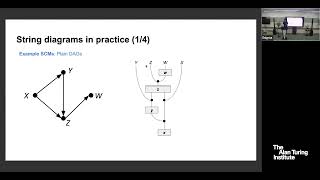
String Diagrams for Structural Causal Modeling and Inference
Explore structural causal modelling and inference using string diagrams, a powerful visual tool for understanding complex causal relationships in data analysis.
A Theory of Alternating Paths and Blossoms from the Perspective of Minimum Length - Part 2
Explores advanced graph theory concepts, focusing on alternating paths and blossoms in minimum length perspective. Provides in-depth insights into algorithm design for maximum cardinality matching in general graphs.
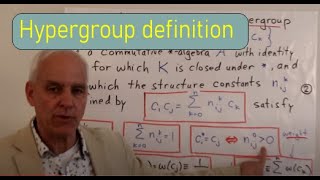
Hypergroup Definition and Five Key Examples - Diffusion Symmetry 4
Explore finite commutative hypergroups through five key examples, including class and character hypergroups, distance-transitive graphs, double cosets, and automorphism orbits. Gain insights for applications in physics and chemistry.
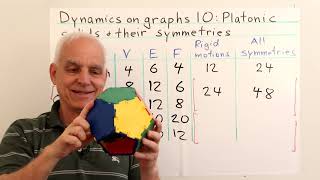
Platonic Solids and Their Symmetries - Dynamics on Graphs 10
Explore Platonic solids' symmetries, focusing on rotations and reflections. Discover connections to exceptional structures in mathematics and physics, laying groundwork for understanding 4D regular solids.