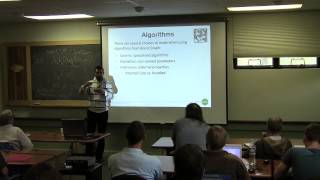
Boost.Graph for Beginners
Learn to use Boost.Graph library's algorithms for graph operations, with examples of input/output parameters and function calls to simplify implementation in C++ projects.
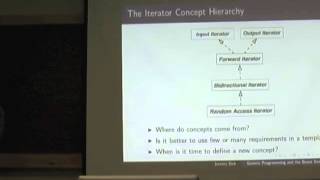
Generic Programming and the Boost Graph Library
Explore generic programming principles and their application in the Boost Graph Library, learning C++ template techniques for efficient and flexible graph problem-solving.
D&D and G - A Daring Tale of Dungeons and Dragons and Also Graph
Explore graph algorithms through a D&D adventure! Learn to convert mazes and networks into graphs, and discover practical applications for 8 key algorithms in this intuitive, story-driven presentation.
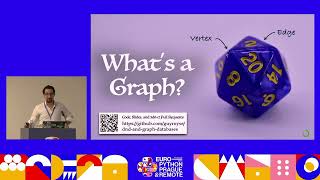
Hitchhickers Guide to D&D
Explore graph algorithms through a D&D-inspired adventure, leveraging Pythonic capabilities to navigate mazes and maximize CPU performance in this unique programming journey.

Using Graph Databases to Understand Complexly Connected Data - Application Development
Explore Neo4j and graph databases, their use cases, and advantages over relational databases. Learn about property graph models, query languages, and practical applications in data analysis.
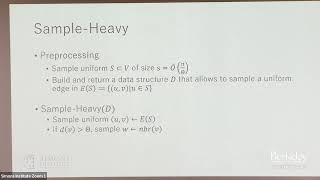
Sampling Multiple Edges Efficiently
Dive into efficient algorithms for sampling multiple edges in graphs, exploring innovative techniques and mathematical frameworks presented by MIT researcher Talya Eden.
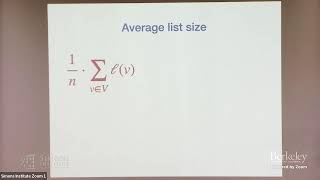
Simple Sublinear Algorithms for Vertex Coloring
Dive into advanced graph theory concepts and efficient vertex coloring algorithms, exploring sublinear approaches for optimizing computational complexity.
Recursive State Machine Guided Graph Folding for Context-Free Language Reachability
Explore an innovative approach to improve CFL-reachability scalability through graph folding, reducing input size and enhancing performance in program analysis applications like alias and value-flow analysis.
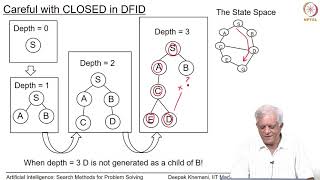
Depth First Iterative Deepening
Explore depth-first iterative deepening algorithm, combining benefits of depth-first and breadth-first searches for efficient problem-solving in artificial intelligence.
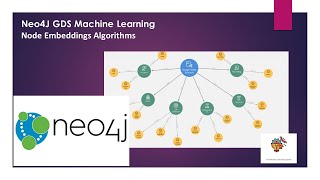
Neo4J GDS: Node Embeddings Algorithms for Data Science and Machine Learning
Explore node embedding algorithms in Neo4J GDS for data science and machine learning, creating powerful graph-based representations.
Leveraging Graphs for AI
Explore graph theory's role in AI, from data structures to machine learning, with practical examples and applications in analytics, algorithms, and neural networks.
Fun with Algorithms
Explore problem-solving techniques through graph algorithms, dynamic programming, and data structures. Learn to build solutions from first principles and apply algorithmic skills to real-world programming challenges.
Networks and Recommendation Systems
Explore graph-based recommendation systems, their transparent implementation, and real-world applications in this technical deep dive for data science practitioners.
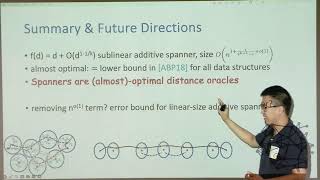
Almost-Optimal Sublinear Additive Spanners in Graph Theory
Explore sublinear additive spanners in graph theory, focusing on optimal stretch functions and size bounds for undirected unweighted graphs. Learn about recent advancements and their implications.
Neo4J GDS: Machine Learning Node Classification Pipelines
Crea pipelines de clasificación de nodos con Neo4J y Graph Data Science Library para aprender técnicas avanzadas de machine learning en grafos.
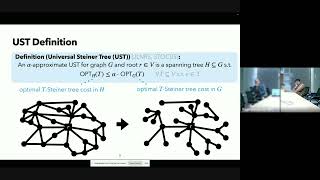
One Tree to Rule Them All: Polylogarithmic Universal Steiner Trees and Strong Sparse Partition Hierarchies
Explore polylogarithmic universal Steiner trees and strong sparse partition hierarchies. Learn about new constructions improving approximation guarantees and matching logarithmic lower bounds.
Adversarial Machine Learning: Categories, Concepts, and Current Landscape
Explore adversarial machine learning vulnerabilities, including data subversion, evasion, and model revelation. Learn to identify potential threats and build robust defense strategies.
Modeling, Querying and Seeing Time Series Data within a Self-Organizing Mesh Network
Explore graph database modeling for dynamic power grid networks. Learn to query and analyze sensor data, triage at-risk components, and understand network healing processes.
Graph Algorithms and Data Structures in C++20 - Lecture
Explore modern, composable graph algorithms and data structures in C++20. Learn to leverage concepts for systematic organization and discover an emerging proposal for a standard graph library.

Independent Sets and Turán's Theorem
Explore the probabilistic method in combinatorics through graph theory, focusing on independent sets, cliques, and the fundamental principles behind Turán's theorem.
Vertex, Edge, Clique - Understanding Graph Theory Fundamentals
Explore fundamental concepts of graph theory, from basic elements like vertices and edges to complex structures like cliques, enhancing your understanding of network analysis and data relationships.