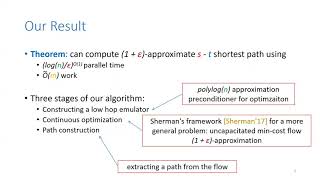
Parallel Approximate Undirected Shortest Paths Via Low Hop Emulators
Explore efficient parallel algorithms for approximating undirected shortest paths using low hop emulators, with applications and open problems in graph theory and network analysis.
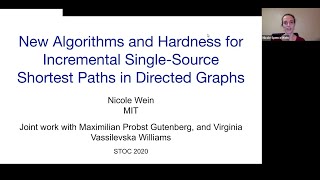
New Algorithms and Hardness for Incremental Single-Source Shortest Paths in Directed Graphs
Explore cutting-edge algorithms and complexity analysis for incremental single-source shortest paths in directed graphs, focusing on ES Tree and Lazy ES Tree approaches.

Graph-Based Approximate Nearest Neighbors and HNSW
Explore graph-based algorithms for efficient nearest neighbor search, focusing on HNSW. Learn advantages, construction, and practical applications in large-scale search solutions.
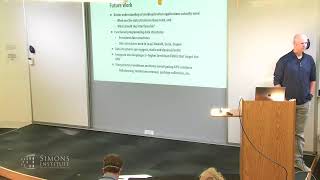
Dynamic Graphs on the GPU
Explore GPU-accelerated techniques for dynamic graph algorithms, focusing on efficient data structures and parallel processing for real-time graph updates and analysis.
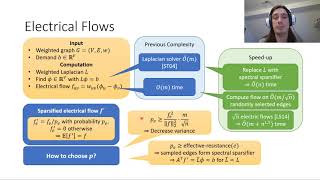
Bipartite Matching in Nearly-linear Time on Moderately Dense Graphs
Discover efficient algorithms for bipartite matching in moderately dense graphs, exploring nearly-linear time solutions and their implications for graph theory and optimization.
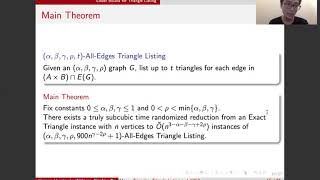
Monochromatic Triangles, Triangle Listing and APSP
Explore efficient algorithms for triangle-related problems and their connections to All-Pairs Shortest Paths, presented by MIT researchers Williams and Xu.
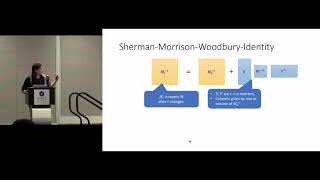
Dynamic Approximate Shortest Paths and Beyond - Subquadratic and Worst Case Update Time
Explore cutting-edge algorithms for dynamic approximate shortest paths, focusing on subquadratic and worst-case update time complexities in graph theory and network optimization.
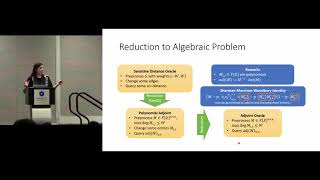
Sensitive Distance and Reachability Oracles for Large Batch Updates
Explore efficient algorithms for maintaining distance and reachability information in dynamic graphs, focusing on techniques for handling large batch updates.
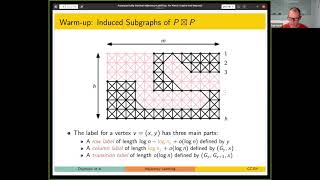
Graph Algorithms and Coding - Session 4C
Explore advanced graph algorithms and coding techniques in this IEEE session, focusing on cutting-edge research and practical applications in computer science.
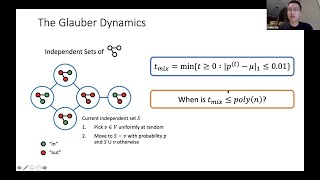
Dynamic Graphs - Session 8B
Explore cutting-edge research on dynamic graph algorithms and their applications in computer science at this IEEE FOCS 2020 session.
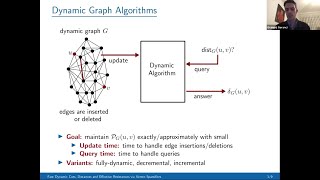
Dynamic Graphs - Session 7B
Explore cutting-edge research on dynamic graph algorithms and their applications in computer science at this IEEE FOCS 2020 session.
A Simple Quantum Sketch With Applications to Graph Algorithms
Explore quantum sketching for set analysis and its applications in graph algorithms, including triangle counting and Max-Dicut, with potential for significant space efficiency gains.
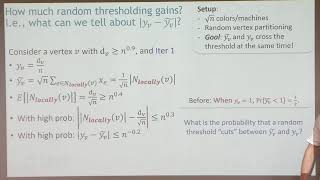
Graph Algorithms in the Massively Parallel Computation Model
Explore efficient graph algorithms in the Massively Parallel Computation model, focusing on techniques for near-linear memory regime and comparing MPC to other distributed/parallel models.
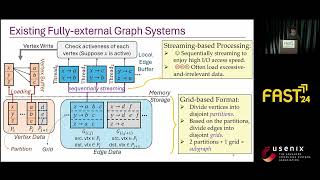
Seraph: Scalable and Efficient Fully-External Graph Computation via On-Demand Processing
Explores Seraph, a novel fully-external graph computation system that balances scalability and efficiency through on-demand processing, hybrid data formats, and selective pre-computation.
G-Retriever: Retrieval-Augmented Generation for Textual Graph Understanding
Explore G-Retriever: a novel approach for textual graph understanding, enabling conversational interaction with graphs and enhancing AI applications in drug discovery and beyond.
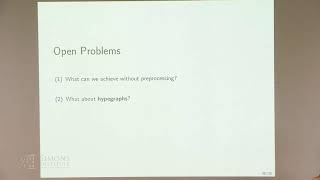
Linear and Sublinear Algorithms for Graphlet Sampling
Explore efficient algorithms for graphlet sampling, including linear and sublinear preprocessing techniques, with applications to semi-streaming and MPC settings.
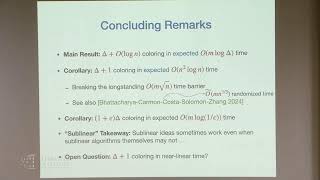
Sublinear Insights: A Faster Classical Algorithm for Edge Coloring
Explores a novel randomized algorithm for near-linear time graph edge coloring, improving on decades-old methods. Discusses implications for Vizing's theorem and dense graph coloring efficiency.

Analyze Connections and Find Patterns in Data with Graphs
Explore Oracle's Graph Studio for analyzing connections in data, featuring customer use cases, new features, and quick setup for graph analysis in Autonomous Database.
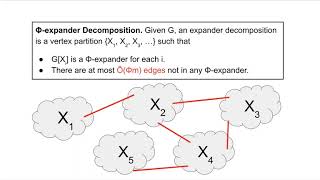
Deterministic Decremental Reachability, SCC, and Shortest Paths via Directed Expanders and Congestion Balancing
Explore advanced graph algorithms for dynamic reachability, strongly connected components, and shortest paths using directed expanders and congestion balancing techniques.
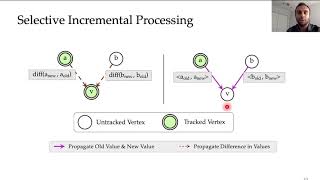
Controlling Memory Footprint of Stateful Streaming Graph Processing
Innovative techniques for reducing memory usage in streaming graph processing systems, enabling analysis of larger dynamic graphs while maintaining performance and accuracy.
ObliVM - A Programming Framework for Secure Computation
Explore ObliVM, a framework for secure computation offering a domain-specific language, user-friendly abstractions, and efficient oblivious representations for various applications like data mining and genomic analysis.