Advancing Earth System Predictability with Machine Learning Methods
Explore machine learning methods for improving Earth system predictions, featuring insights from Dan Lu of Oak Ridge National Laboratory on enhancing climate modeling and forecasting.
A Geometric Approach to Modeling and Analysis of Mixed-Dimensional and Multi-Continuum Materials
Explore geometric modeling of complex materials, unifying concepts from differential geometry and functional analysis to analyze fractured porous media and multi-continuum models.
Scaling and Fractals After Mandelbrot - On the Frontiers of the Geosciences - Part 1
Explore scaling and fractals in geosciences, building on Mandelbrot's work. Discover cutting-edge applications and insights at the frontiers of Earth and space sciences.
Two Topics in Sheared Suspensions - Contact Force Networks & Inertial Flow - Jeffrey Morris
Explores contact force networks and inertial flow in sheared suspensions, discussing advances in understanding multiphase geophysical flows through observations, experiments, simulations, and theory.
How the Growth of Ice Depends on the Fluid Dynamics Underneath - Federico Toschi
Explores fluid dynamics beneath ice growth, integrating field observations, lab experiments, and simulations to understand multiphase geophysical flows in atmospheric and oceanic systems.
Alaska's Thawing Permafrost: Impacts and Future Projections
Experts discuss Alaska's thawing permafrost, unveiling new findings and projections. They explore impacts on ecology, infrastructure, and carbon release, introducing a permafrost forecast system.
Latest Methods in Best Practices and Mitigation Efforts for Induced Seismicity
Explore cutting-edge techniques for managing and mitigating induced seismicity, focusing on best practices and innovative strategies to minimize earthquake risks associated with human activities.
The Early Earth - Emergence of a Habitable Planet I
Explore Earth's early development, from water oceans to continental rise, geomagnetic field formation, and atmospheric changes. Gain insights into our planet's journey to habitability through expert presentations.
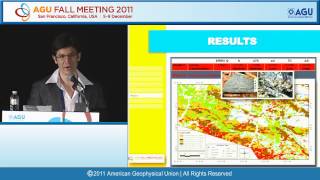
Computational Intelligence in Earth and Space Systems I
Explore cutting-edge computational intelligence applications in Earth and space systems, featuring innovative research and advancements in data analysis, modeling, and prediction techniques.

The Influence of Multiple Scales in Fractured Media on Flow and Transport Properties
Explore how fracture geometry and network structure in low-permeability media affect fluid flow and solute transport using discrete fracture network models and high-fidelity simulations.
Deep Learning Applications for Automated Subsurface Model Building
Explore AI/ML applications in geoscience for automated subsurface model building, improving efficiency and accuracy in workflows using seismic, wellbore, and geophysical data.
Pore to Darcy to Field Scale: Challenges in Upscaling Porous Media Models
Explore multiscale modeling in porous media, from nanometers to kilometers. Discuss upscaling challenges, theoretical advances, and practical applications in geosciences, with insights on physics and data integration.
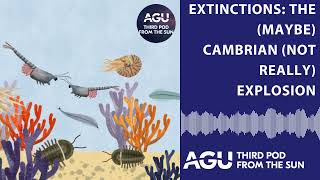
Extinctions: The Cambrian Explosion Revisited
Geoscientist Rachel Wood challenges the traditional view of the Cambrian explosion, offering new insights into the emergence of animals on Earth and redefining our understanding of this pivotal period in evolutionary history.
Frontiers in Subsurface Transport - 2020 Hydrology Early Career Award Lecture
Explore cutting-edge research in subsurface transport with Dr. Veronica Morales from UC Davis. Part of AGU's Hydrology Early Career Award lecture series, showcasing emerging leaders in hydrology.

Building a Borderless World of Geoscience for the Future of Earth and Humanity
Explore the vision for a unified global geoscience community and its potential impact on Earth's future and humanity's well-being with AGU President Robin Bell.
Storied Careers: What You Didn't Learn in Geoscience Class
Exploring the evolution of Earth science education and its impact on climate change response, featuring insights from geologist and educator Michael Wysession on curriculum development and science standards.
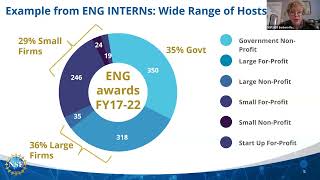
NSF GEO Internship Webinar
Learn about exciting geoscience internship opportunities through the NSF GEO program, including application tips and insights from past participants.
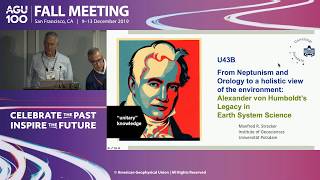
Two Hundred Fifty Years of Alexander von Humboldt - Humboldtian Systems Science in the 21st Century
Explore Alexander von Humboldt's holistic approach to Earth sciences and its modern relevance. Discover his groundbreaking contributions and how they shape today's understanding of our planet's complex systems.
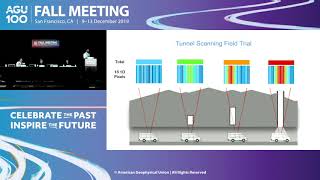
Geoscience Grab Bag - Lunar Dust, Freshwater Evolution, Maritime Activities, and Railway Tunnels
Diverse geoscience research: lunar dust interactions, extreme freshwater evolution, maritime surveillance, and railway tunnel safety. Cutting-edge findings across Earth and space sciences.
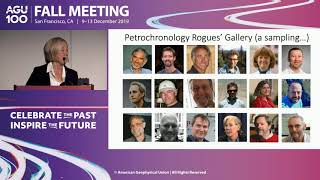
2019 Norman L. Bowen Lecture - Advances in Geoscience
Explore groundbreaking geoscience research in this prestigious annual lecture, honoring Norman L. Bowen's legacy and featuring cutting-edge insights from leading experts in volcanology, geochemistry, and petrology.
Marine Carbon Dioxide Removal: Research, Funding, Applications and Ethics
Experts discuss advances in marine carbon dioxide removal, including research, funding, applications, and ethical considerations, with insights on a Pacific Northwest pilot project.