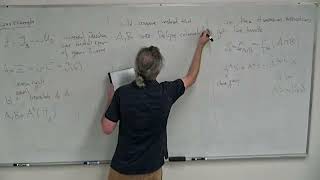
Extensions in MHM and Hain's Biextension Line Bundle - Part 2
Explores biextension line bundles, their extensions, and algebraic structures. Presents a formula for Q-line bundles, building on Hain and Pearlstein's work on normal functions and complex manifolds.
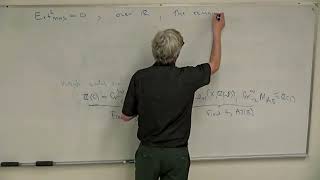
Extensions in MHM and Hain's Biextension Line Bundle - Part 1
Explore complex manifolds, biextension line bundles, and normal functions in algebraic geometry. Discover formulas for Q-line bundle extensions and their topological invariants.
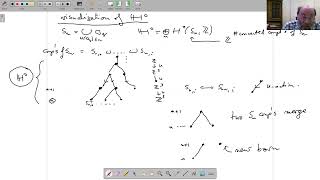
Lattice Cohomology - Part 2
Explores advanced concepts in lattice cohomology, focusing on topological and analytic aspects, their connections to singularity theory, and implications for geometric structures.

Hyper-Kähler Manifolds - Part 2
Explore advanced properties of hyper-Kähler manifolds, focusing on 4-dimensional cases and their topological characterization in relation to K3 surfaces and abelian surfaces.
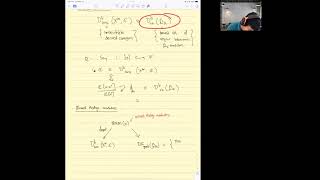
Constructible Sheaves and Filtered D-Modules
Explore the Riemann-Hilbert correspondence and its p-adic analogue, connecting constructible sheaves to filtered D-modules with applications in algebraic geometry.
On the Geometry of Cubics
Explore classical and new results on the geometry of cubics in three, four, and five dimensions, delving into their fascinating mathematical properties and structures.
Hilbert Schemes of Plane Curve Singularities and Matrix Factorizations
Explore connections between algebraic geometry and topology through plane curve singularities, Hilbert schemes, and matrix factorizations in this advanced mathematics lecture.
On the Deleted Squares of Lens Spaces
Explores homotopy equivalence of configuration spaces in lens spaces, using differential characters and Massey products to investigate topological properties of deleted squares.
The Average Genus of a 2-Bridge Knot Grows Linearly with Respect to Crossing Number
Explore the linear growth relationship between Seifert genus and crossing number in 2-bridge knots using Chebyshev billiard table diagrams, building on previous research and experimental data.

Braids and Line Arrangements - Old and New
Explore the interplay between braid groups, configuration spaces, and hyperplane arrangements, focusing on recent advances in understanding fundamental groups of complex line arrangement complements.
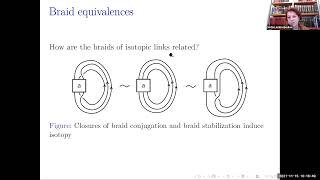
Braidings and Braid Equivalences
Explore braiding algorithms and braid equivalences for various knot types, including classical, virtual, and singular, with a focus on knotoids and braidoids.
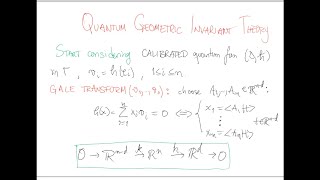
Quantum Toric Geometry II - Non-Commutative Geometric Invariant Theory
Explore quantum geometric invariant theory, extending classical GIT to non-commutative cases. Gain insights into cutting-edge research in quantum toric geometry.
Mirror Symmetry and Cluster Varieties
Explore symplectic geometry of cluster varieties and their applications to mirror symmetry, including homological mirror symmetry for Gross-Hacking-Keel cluster varieties.
On the Kontsevich Geometry of the Combinatorial Teichmüller Space
Explore combinatorial Teichmüller space, global Fenchel-Nielsen coordinates, and Kontsevich symplectic form. Learn about integrating geometric functions over combinatorial moduli spaces in this advanced mathematics lecture.
Topological Recursion for Hurwitz Theory and Intersection Theory of Moduli Spaces of Curves
Explore topological recursion in Hurwitz theory and its connections to moduli spaces of curves. Discover ELSV-type formulae and their impact on understanding ramifications and cohomological field theories.
Open-Relative Correspondence and Topological Recursion
Explore the connection between open Gromov-Witten invariants and relative Gromov-Witten invariants in symplectic geometry, and their relation to topological recursion.
Homological Mirror Symmetry for Some Non-Kähler Elliptic Surfaces
Explore homological mirror symmetry for non-Kähler elliptic surfaces, including logarithmic transformations and potential applications to singular curves and mirror operations.
Quantum Spectrum in Algebraic Geometry I
Explore quantum spectrum in algebraic geometry, focusing on quantum blow-up formula and its applications in birational geometry, motivic measures, and singularity resolution.
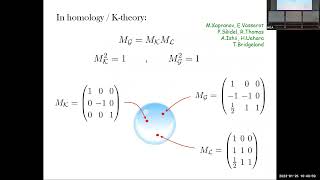
Homological Mirror Symmetry - Coulomb Branches & Rozansky-Witten Theory Pt. II
Explore Rozansky-Witten theory and its connection to homological mirror symmetry, from basics to modern developments involving non-compact and infinite-dimensional target spaces.
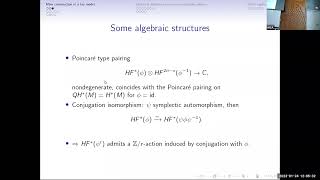
Homological Mirror Symmetry - Twisted Shklyarov Pairing & Applications
Explore twisted Shklyarov pairing in Hochschild homology, its applications to Lefschetz fibrations, mirror symmetry, and classical problems. Joint work with Paul Seidel presented.
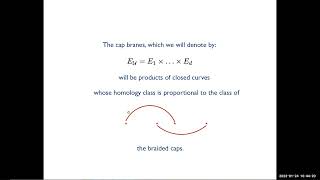
Homological Mirror Symmetry - Homological Link Invariants from Floer Theory
Explore a groundbreaking connection between homological mirror symmetry and representation theory, solving the knot categorification problem and generalizing Heegard-Floer theory to simple Lie superalgebras.