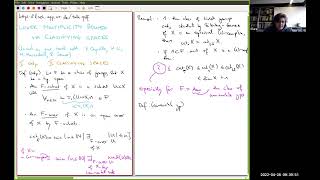
Lower Multiplicity Bounds via Classifying Spaces
Explore equivariant methods and classifying spaces to analyze Lusternik-Schnirelmann category variations, focusing on open covers with fundamental group constraints and applications to amenable subgroups.
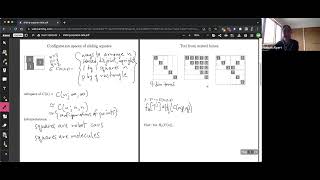
Homology of Sliding-Squares Configuration Spaces
Explore homology of sliding-squares configuration spaces, comparing point and square configurations in planes and rectangles. Discover surprising growth patterns in homology group ranks.
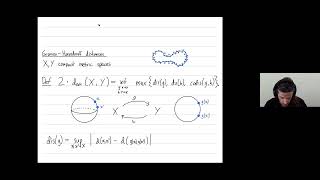
Gromov-Hausdorff Distances, Borsuk-Ulam Theorems, and Vietoris-Rips Complexes
Explore Gromov-Hausdorff distances, Borsuk-Ulam theorems, and Vietoris-Rips complexes in geometry. Learn about recent advancements in lower bounding distances between spheres using innovative mathematical techniques.
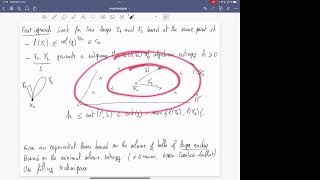
Macroscopic Scalar Curvature and Local Collapsing
Exploration of macroscopic scalar curvature in Riemannian geometry, focusing on volume bounds for manifolds with hyperbolic metrics and collapsing techniques in metric geometry.
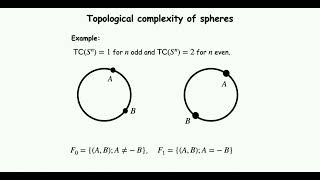
Michael Farber - Topological Complexity of Spherical Bundles
Explore parametrized motion planning algorithms and the topological complexity of sphere bundles, examining characteristic classes and specific examples in applied algebraic topology.
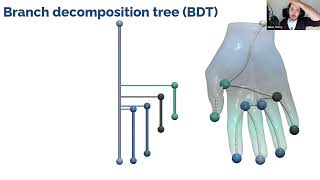
Wasserstein Distances, Geodesics and Barycenters of Merge Trees
Explore computational frameworks for merge trees, including Wasserstein distances, geodesics, and barycenters. Learn efficient algorithms and applications in visualization, feature tracking, and ensemble clustering.
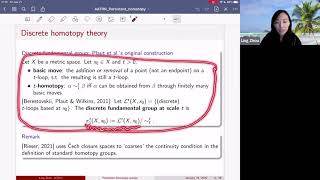
Persistent Homotopy Groups of Metric Spaces
Exploring persistent homotopy groups of metric spaces, blending topology and geometry to capture dataset features beyond persistent homology, with applications and stability properties.
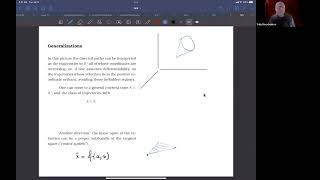
Linear Obstacles in Linear Systems and Ways to Avoid Them
Explore topology in control theory, focusing on obstacle-avoiding paths and cohomology rings using homotopy limits. Gain insights into theoretical computer science applications.
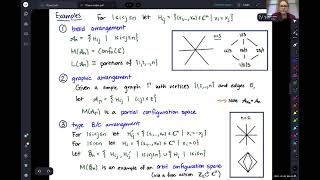
Parametrized Topological Complexity of Hyperplane Arrangement Bundles
Exploring parametrized motion planning in hyperplane arrangement bundles, focusing on topological complexity under supersolvability conditions. Joint work with Dan Cohen.

Robert Adler Interviewed by Omer Bobrowski
Insightful interview exploring Robert Adler's contributions to applied algebraic topology, offering valuable perspectives on the field's development and future directions.
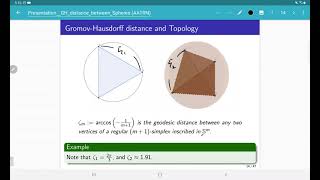
The Gromov-Hausdorff Distance Between Spheres
Explore upper and lower bounds for Gromov-Hausdorff distances between spheres, including optimal correspondences and topological concepts related to the Borsuk-Ulam theorem.
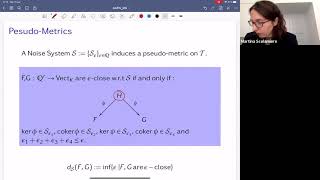
Extracting Persistence Features with Hierarchical Stabilisation
Explore hierarchical stabilisation for extracting stable invariants from persistence modules, focusing on the stable rank and its applications in data analysis and classification tasks.
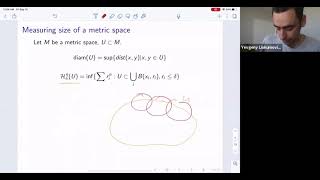
Yevgeny Liokumovich - Urysohn Width, Isoperimetric Inequalities and Scalar Curvature
Explore metric spaces, Hausdorff measure, and continuous mappings. Discover connections to isoperimetric inequalities and Riemannian geometry's positive scalar curvature.
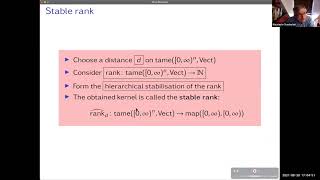
Enabling a Machine to Sense Geometry
Explore how to construct a reach space of kernels on persistent modules, enabling machine intelligence to sense geometry, with applications in synthetic and real scenarios.
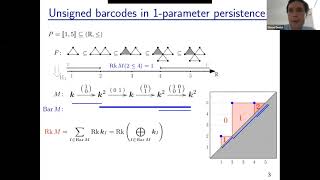
Signed Barcodes for Multi-Parameter Persistence via Rank Decompositions
Explore signed barcodes: a new visual representation for multi-parameter persistence modules, encoding rank invariants and enhancing exploration of complex topological structures.
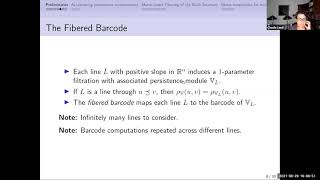
Discrete Morse Theory Meets Multi-Parameter Persistence
Exploring connections between discrete Morse theory and multiparameter persistence in topological data analysis, focusing on critical cells, fibered rank invariant, and computational efficiency.
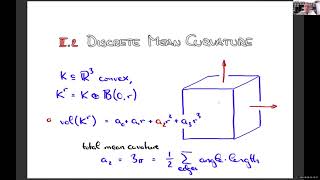
The Intrinsic Volumes of a Space Filling Diagram and Their Derivatives
Explore intrinsic volumes in molecular dynamics, focusing on space-filling diagrams and their derivatives. Learn formulas for weighted volumes and curvatures in Alpha shape representations.
An Introduction to Spectral Data for Higgs Bundles
Explore spectral data for Higgs bundles, a key concept in algebraic geometry and mathematical physics, with insights on integrable systems and moduli spaces.
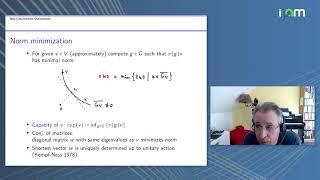
Towards a Theory of Non-commutative Optimization - Geodesic First and Second Order Methods for Moment Maps and Polytopes
Explore non-commutative optimization theory for geodesically convex problems, unifying diverse applications in computer science, mathematics, and physics through innovative first and second-order methods.
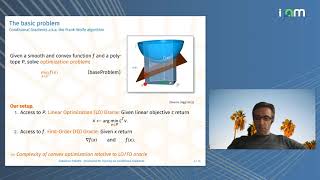
Structured ML Training via Conditional Gradients
Explore conditional gradient methods for structured optimization in machine learning, covering applications in traditional and deep learning, with a focus on incorporating polyhedral structures into solutions.

Subtly Knotted Surfaces Separated by Many Internal Stabilizations
Exploration of smoothly knotted surfaces in 4-manifolds, focusing on isotopy, internal stabilizations, and diffeomorphisms. Discusses infinite collections of surfaces with unique properties and infinite stabilization diameter.