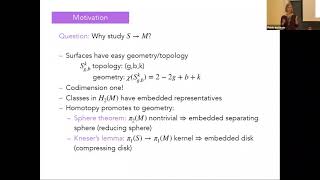
Surfaces in 3-Manifolds and the Thurston Norm
Explore the Thurston norm in 3-manifold topology, its significance in measuring surface complexity, and its role in understanding modern topological breakthroughs.
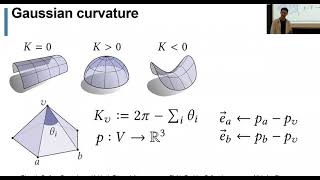
Discrete Surface Geometry and Intrinsic Triangulations
Explore discrete surface geometry and intrinsic triangulations, bridging theory and algorithms in geometric computing. Learn about surface meshes, Gaussian curvature, and applications in robust geometry processing.
Constrained Optimization on Riemannian Manifolds
Explore advanced mathematical techniques for solving optimization problems on curved spaces, with applications in machine learning and data analysis.
Introduction to Minimal Surfaces
Explore zero mean curvature surfaces in Euclidean 3-space, their mathematical aspects, and natural occurrences as idealized soap films. Recommended: Review complex analysis concepts.
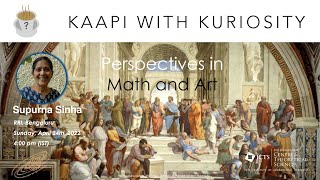
Perspectives in Math and Art by Supurna Sinha
Explore the fascinating intersection of mathematics and art during the European Renaissance, focusing on Projective Geometry and its impact on artistic representation and mathematical development.
Complex Dynamics and Arithmetic Geometry by Laura DeMarco
Exploring connections between dynamical systems and arithmetic geometry, focusing on periodic points, torsion points, and algebraic curves in genus 2. Insights from polynomial dynamics and Julia sets illustrate key concepts.

Herbert Edelsbrunner Interviewed by Dmitriy Morozov - September 30, 2020
Insightful interview with Herbert Edelsbrunner, exploring his contributions to computational geometry and topology, career journey, and perspectives on the field's evolution and future directions.

Algebraic Tools for Multiparameter Persistent Homology
Explore advanced algebraic techniques for analyzing multiparameter persistent homology, including primary decomposition and multigraded algebra, with examples and applications in topology.
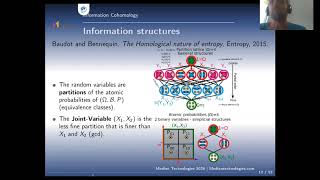
Cohomological Characterization of Information Structures
Exploring cohomological methods to quantify statistical interactions in datasets, linking information theory, statistical physics, and machine learning for improved data analysis and interpretation.
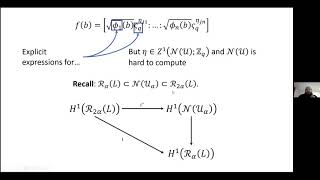
Data Driven Torsion Coordinates and Wasserstein Stability
Explore data-driven torsion coordinates in finite Lens spaces, LPCA dimensionality reduction, and Wasserstein stability for topological data analysis and nonlinear dimensionality reduction.
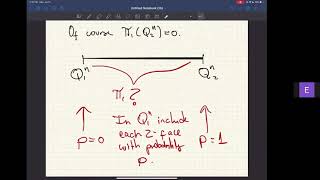
The Fundamental Group of 2-Dimensional Random Cubical Complexes
Explores fundamental groups in random 2D cubical complexes, analyzing their behavior and structure at different probability thresholds. Insights into topology and percolation theory.
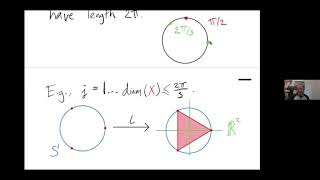
Borsuk–Ulam Theorems for Maps into Higher-Dimensional Codomains
Explore Borsuk-Ulam theorems for sphere maps to higher-dimensional spaces, examining topological properties and optimal diameter bounds for odd maps from S^n to R^k where k > n.
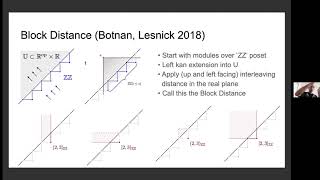
Comparative Stability of Two Zigzag Bottleneck Distances
Explores zigzag persistence in algebraic topology, comparing bottleneck distances for zigzag modules. Analyzes similarities and differences between approaches, focusing on Auslander-Reiten quiver perspective.
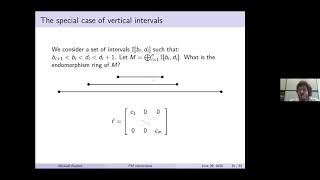
Every nD Persistence Module Is the Restriction of an (n+1)D Indecomposable Module
Explore a constructive process for building (n+1)D indecomposable modules from nD persistence modules, with insights on its implications and consequences.
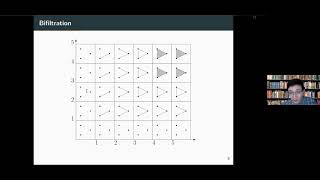
Efficient Approximation of the Matching Distance for 2-Parameter Persistence
Explore efficient algorithms for approximating matching distance in 2-parameter persistence modules, focusing on quad-tree refinement and local adaptive bounds for improved computational performance.
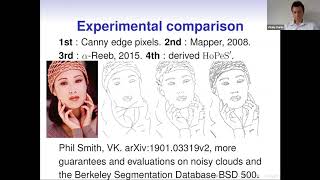
Persistence-Based Skeletonization of Images
Explores algorithms for splitting images into convex polygons using topological persistence, including Convex Constrained Mesh and Persistent Resolution-Independent Mesh for edge detection.
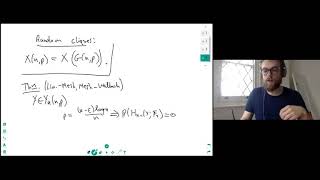
From Large to Infinite Random Simplicial Complexes
Explore two models of random simplicial complexes extending the Erdos-Renyi model, examining their Alexander duality relation and the unique infinite Rado simplicial complex.
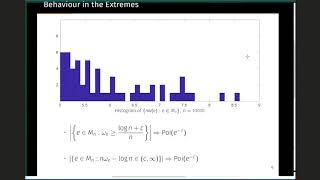
The Bulk and the Extremes of Online Minimal Spanning Acycles
Explores distributional properties of weights in random minimum spanning acycles, focusing on online settings. Examines bulk convergence to giant shadow measure and extremal convergence to inhomogeneous Poisson point process.

Geometry and Topology of Decision
Explore geometric and topological approaches to decision-making when faced with conflicting expert opinions, examining theoretical concepts and practical applications in various scenarios.
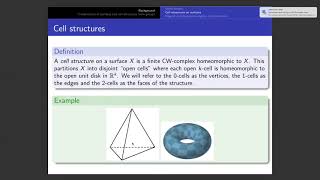
On a Canonical Construction of Tessellated Surfaces From Finite Groups
Explores a construction linking finite group multiplication tables to tessellated surfaces, discussing properties, group actions, and connections to classical mathematical constructions.
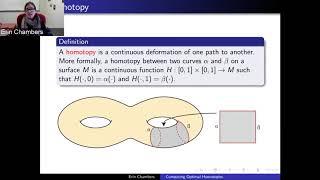
Computing Optimal Homotopies
Explore curve similarity measures and homotopy-based deformations in GIS, medical imaging, and graphics. Survey geometric and topological metrics, algorithms, and open questions in optimal homotopy computation.