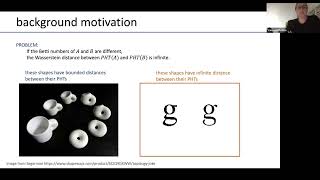
Vanessa Robins - The Extended Persistent Homology Transform for Manifolds with Boundary
Explore extended persistent homology transform for shape analysis, offering finite distances between shapes with different Betti numbers and applications in shape clustering.
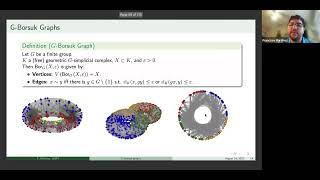
Chromatic Number of G-Borsuk Graphs
Explore G-Borsuk graphs, their chromatic numbers, and topological connections. Delve into G-actions, Hom-complexes, and random graph thresholds for a deeper understanding of this algebraic topology concept.

New Results in Computing Zigzag and Multiparameter Persistence
Explore new advancements in computing zigzag and multiparameter persistence, including efficient conversion methods and improved algorithms for 2-parameter persistence modules.
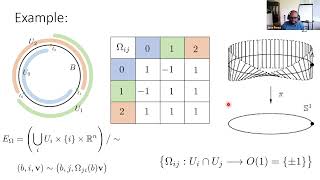
Vector Bundles for Data Alignment and Dimensionality Reduction
Explore vector bundles in data science, focusing on synchronization problems and topology-preserving dimensionality reduction. Applications in computational chemistry and dynamical systems are presented.
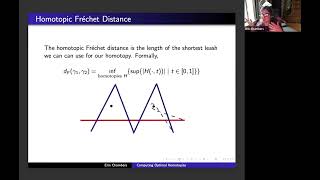
Computing Optimal Homotopies
Explore optimal curve similarity measures using homotopy-based approaches, examining structural properties, algorithms, and open questions in topology and computational geometry.
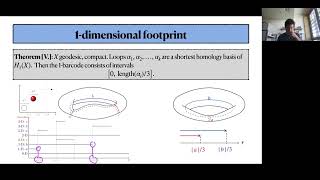
Žiga Virk - Information Encoded in Persistence Diagrams
Explore topological data analysis through persistence diagrams, uncovering spatial properties like homology, geodesics, and proximity in various mathematical contexts.
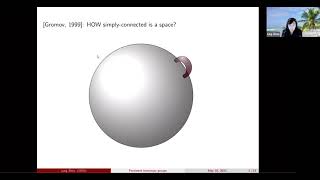
Persistent Homotopy Groups of Metric Spaces
Explore persistent homotopy groups of metric spaces, their stability, and advantages over persistent homology. Learn about tree-like structures and ultrametrics in fundamental groups.
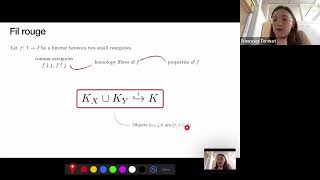
What's Behind the Homotopical Decomposition of a Simplicial Complex
Explore homotopical decomposition of simplicial complexes, focusing on conditions for homotopy type preservation and the mathematics behind decomposability results.

Chirality and Quantifying Embeddability
Explore chirality, embeddings, and non-embeddability in topology, with applications to chemical structures and generalizations of classical results.
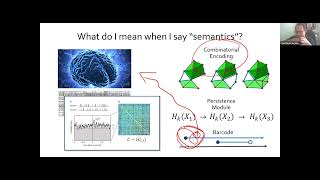
An Approach to Assigning Semantics to Persistent Homology Classes
Explore a novel approach to interpreting persistent homology classes in applied settings, overcoming traditional limitations by leveraging comparative measurements against known models.
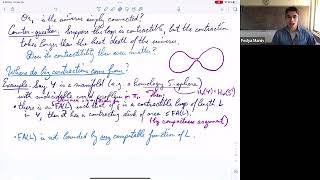
Fedor Manin - Linear Nullhomotopies of Maps to Spheres
Explore controlled Lipschitz constant nullhomotopies of maps to spheres, focusing on mathematical techniques and recent research developments in algebraic topology.
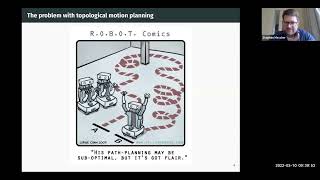
Geodesic Complexity of Riemannian Manifolds
Explore geodesic complexity in Riemannian manifolds, connecting robot motion planning to topology and geometry. Learn about cut loci, bounds, and applications in this advanced mathematical talk.
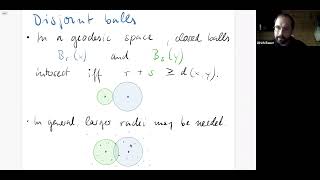
Ulrich Bauer - Gromov Hyperbolicity, Geodesic Defect, and Apparent Pairs in Rips Filtrations
Explore Gromov hyperbolicity, geodesic defect, and apparent pairs in Rips filtrations, extending Rips' results on contractibility and examining computational implications for persistent homology.
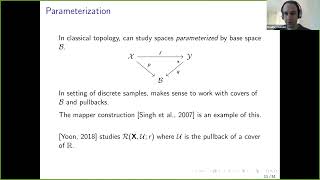
Bradley Nelson: Parameterized Vietoris-Rips Filtrations via Covers
Explore computational topology techniques for large filtered geometric complexes, focusing on Vietoris-Rips filtrations and cover-based methods for parallel computation and compression.
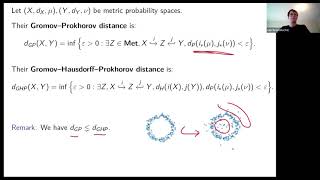
Luis Scoccola - Density-Sensitive and Robust Vietoris-Rips Filtrations
Explore density-sensitive and robust Vietoris-Rips filtrations in algebraic topology, including function-Rips, degree-Rips, and subdivision-Rips, with applications and open questions.
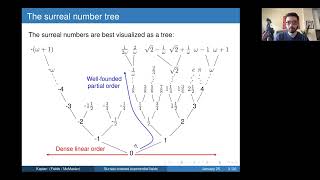
Surreal Ordered Exponential Fields
Explore surreal numbers, exponential fields, and their connections to real exponentiation. Delve into Hahn fields, transseries, and models of mathematical structures beyond traditional number systems.
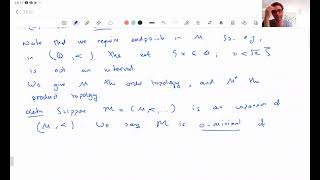
O-minimality and the Pila-Wilkie Theorem - Lecture 1
Explore o-minimality, its foundations, and key theorems in this graduate-level lecture, emphasizing mathematical concepts and their applications in tame geometry.
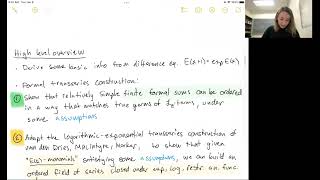
Sublogarithmic-Transexponential Series
Explore sublogarithmic-transexponential series with Adele Padgett, covering motivation, intuition, and key concepts in geometry and model theory. Gain insights into exponential fields and transeries.
Parametrizations and Complexity of Preparation
Explore parametrizations, preparation complexity, and the Wilkins conjecture. Learn induction methods and recent results in tame geometry and transseries applications.
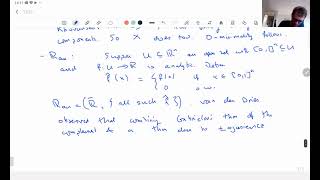
Introduction to O-Minimality and the Pila-Wilkie Theorem
Explore o-minimality and the Pila-Wilkie Theorem, covering definitions, examples, proofs, and key concepts in tame geometry. Gain insights into this fundamental area of mathematical logic and its applications.
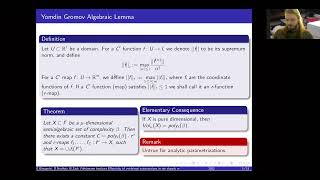
Effectivity of Standard O-Minimal Results in the Sharply O-Minimal Setting
Explore the effectiveness of o-minimal results in sharply o-minimal contexts, covering algebraic lemmas, cellular versions, and cylindrical parametrization techniques.