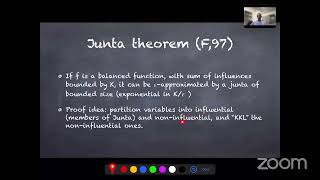
Ehud Friedgut- KKL’s Influence on Me
Explore KKL theorem, hypercontractivity, graph properties, isoperimetric inequalities, and intersecting families in this mathematical journey through influential concepts and applications.
The Box Problem: Optimizing Volume in Rectangular Cardboard Boxes - Grades 8-9
Explore volume optimization through 'The Box Problem'. Investigate using models, tables, and graphs. Learn to define variables, write functions, and use graphing calculators for advanced analysis.
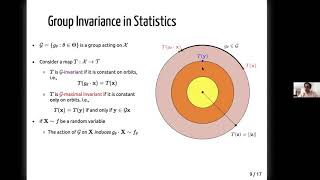
Statistical Invariance of Betti Numbers in the Thermodynamic Regime
Explore statistical invariance of Betti numbers in random topology, examining conditions for topological inference through parametric statistics lens. Investigates asymptotic behavior and group invariance concepts.
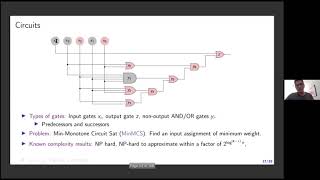
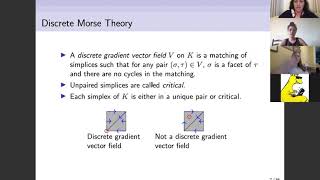
Hardness Results in Discrete Morse Theory for 2-Complexes
Explore inapproximability and parameterized complexity in discrete Morse theory for 2-complexes, focusing on minimizing critical simplices and presenting new hardness results and an approximation algorithm.
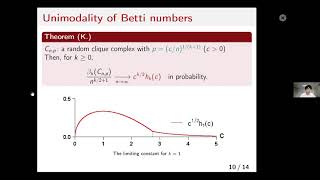
A Limit Theorem for Betti Numbers of Random Simplicial Complexes
Explore asymptotic behavior of Betti numbers in homogeneous and spatially independent random simplicial complexes, extending previous work on Linial-Meshulam complexes using local weak convergence.
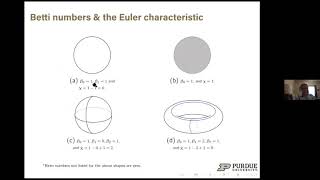
Andrew Thomas - Functional Limit Theorems for Euler Characteristic Processes
Explore functional limit theorems for Euler characteristic processes in Vietoris-Rips complexes, covering strong law of large numbers and central limit theorem in the thermodynamic regime.
Morse-Based Fibering of the Rank Invariant
Explore multi-parameter persistence in data analysis using discrete Morse theory to compute rank invariants, partition parameter space, and deduce persistence diagrams for equivalent classes of lines.
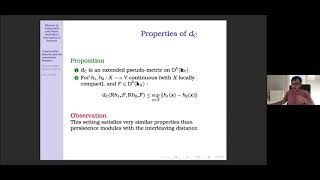
Sheaves as Computable and Stable Topological Invariants for Datasets
Explores sheaf theory in topological data analysis, connecting level-sets persistence with derived sheaves. Presents functorial equivalences, stability theorems, and barcode decompositions for continuous data analysis.
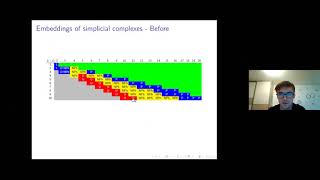
Embeddings and Tverberg-Type Problems: New Algorithms and Undecidability Results
Explore computational topology: algorithmic embeddability, undecidability in higher dimensions, and polynomial-time decidability of r-Tverberg problem in metastable range.

Convex Sunflower Theorems and Neural Codes
Explore convex sunflower theorems and neural codes, connecting neuroscience with discrete geometry to understand place cell encoding and cognitive mapping in rat hippocampus.
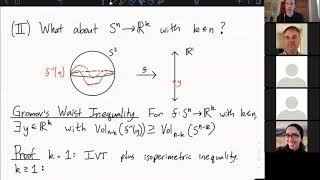
Borsuk-Ulam Theorems into Higher-Dimensional Codomains
Exploration of Borsuk-Ulam theorems in higher dimensions, generalizing results and discussing open questions related to optimal diameters and Schur polynomials.
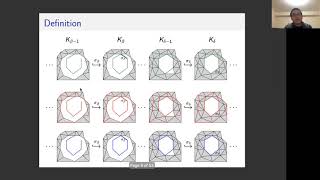
Computing Minimal Persistent Cycles - Polynomial and Hard Cases
Explores computing minimal persistent cycles in algebraic topology, discussing polynomial and NP-hard cases, and presenting algorithms for weak pseudomanifolds with applications to scientific data analysis.
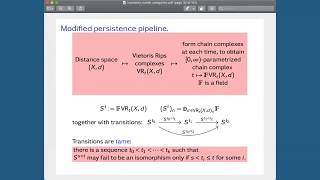
Wojciech Chachólski - TDA Invariants and Model Categories
Exploring TDA invariants and model categories in data analysis, focusing on simplification techniques from homotopy theory to extract meaningful summaries while balancing information retention.
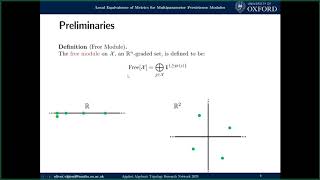
Oliver Vipond - Local Equivalence of Metrics for Multiparameter Persistence Modules
Explore local equivalence of metrics for multiparameter persistence modules, focusing on fibered bar codes' discriminative power and stability in topological data analysis.
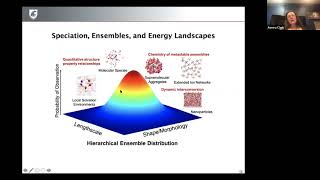
Topology in Chemistry Applications
Explore topological data analysis in chemistry, focusing on molecular relationships, graph theory, and network analysis to extract new insights from chemical data.
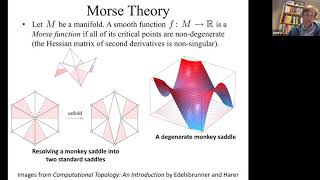
Henry Adams and Enrique Alvarado - An Introduction to Morse Theory
Explore Morse theory's applications in topology, including CW complexes, key theorems, and simplification techniques, with real-world examples in material science.
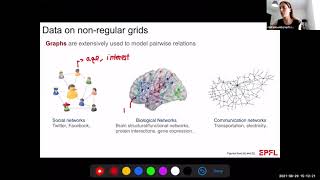
Simplicial Neural Networks
Explore simplicial neural networks, a generalization of graph neural networks for multi-dimensional data, and their applications in imputing missing data on coauthorship complexes.
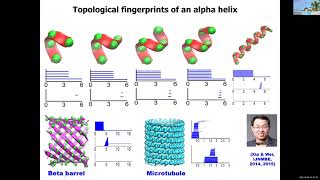
How Math and AI Are Revolutionizing Biosciences
Exploring how mathematics and AI revolutionize biosciences, focusing on tackling challenges in biological data complexity, dimensionality, and nonlinearity to enhance AI's capabilities in drug design and viral mutation prediction.
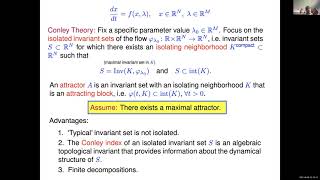
Solving Systems of ODEs via Combinatorial Homological Algebra
Exploring efficient computation of homological representations in dynamical systems, with applications to differential equations and parameter space analysis.
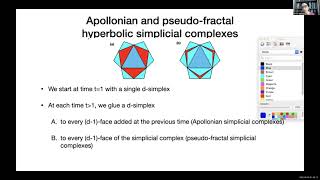
The Topological Dirac Operator and the Dynamics of Topological Signals
Explore topological signals, higher-order Laplacians, and the Dirac operator in network science. Learn about spectral properties, diffusion dynamics, and topological synchronization in simplicial complexes and multiplex networks.
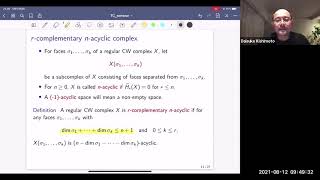
Tverberg’s Theorem for Cell Complexes
Explore Tverberg's theorem generalization, homotopy decomposition of discretized configuration spaces, and topological extensions in this advanced algebraic topology discussion.