Endpoint Fourier Restriction and Unrectifiability
Explore endpoint Fourier restriction and its connection to measure unrectifiability in R^d, featuring a dichotomy between absolute continuity and 1-pure unrectifiability.
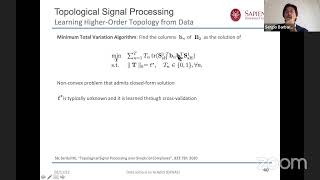
Topological Signal Processing and Learning
Explore advanced techniques in signal processing using topological methods, enhancing data analysis and learning algorithms for complex datasets.
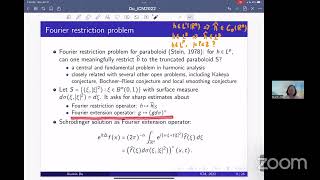
Weighted Fourier Extension Estimates and Applications
Explore weighted Fourier extension estimates and their applications in PDEs and geometric measure theory, covering topics like Fourier restriction, SME, and Falconer's distance set problem.
Neural Sense Relations and Consciousness - A Diagrammatic Approach
Explores neural sense relations and consciousness through inversion symmetry, proposing a topological model linking subject-object domains in brain function, with implications for understanding subjective experience.

Making Up Our Minds
Explore how minds and thoughts are constructed through cognitive processes, examining the nature of consciousness, memory, and perception using interdisciplinary models and mathematical frameworks.
Sketches of a Mathematical Theory of Qualia
Exploración matemática de los qualia: definición, estructura y relación con la teoría cuántica. Propone un modelo de conciencia basado en principios abstractos del comportamiento de dispositivos que detectan qualia.
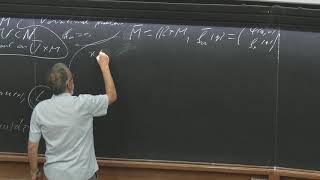
Introduction to Geometric Control Theory - Lecture 4
Explore geometric control theory's advanced concepts, focusing on mathematical foundations and practical applications in dynamic systems and optimization.
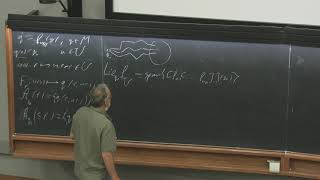
Introduction to Geometric Control Theory - Lecture 3
Explore advanced concepts in geometric control theory, focusing on mathematical principles and applications in dynamic systems and optimization.
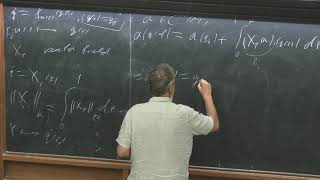
Introduction to Geometric Control Theory - Part II
Explore advanced concepts in geometric control theory, focusing on mathematical principles and applications in dynamic systems and optimization.
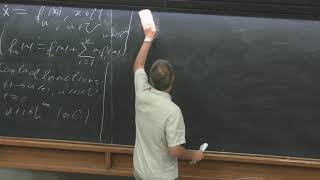
Introduction to Geometric Control Theory - Lecture 1
Explore geometric control theory fundamentals with expert Andrei Agrachev, covering key concepts and applications in this comprehensive lecture from ICTP Mathematics.
Tame Control Theory - Lecture 5
Explore advanced concepts in tame control theory, focusing on phenomena over real fields. Delve into graduate-level mathematical analysis and applications.
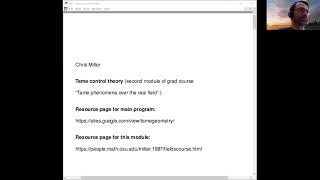
Tame Phenomena Over the Real Field - Graduate Course Lecture 1
Explore fundamental concepts of tame control theory, focusing on real field applications and advanced mathematical principles in this graduate-level lecture.
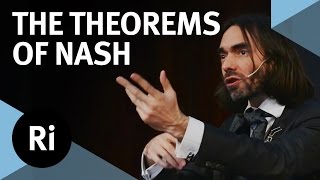
The Extraordinary Theorems of John Nash
Explore John Nash's revolutionary contributions to game theory and geometric analysis with Fields Medal winner Cédric Villani, delving into the world of mathematical genius and groundbreaking theorems.

Leonardo da Vinci: The Man Behind the Myths
Explore Leonardo da Vinci's life, works, and genius through expert insights, debunking myths and revealing the fascinating reality behind the Renaissance polymath.
Private Convex Optimization via Exponential Mechanism - Differential Privacy for Machine Learning
Explore private convex optimization using the exponential mechanism. Learn differential privacy, noisy SGD, and isoperimetric inequality for ML applications.
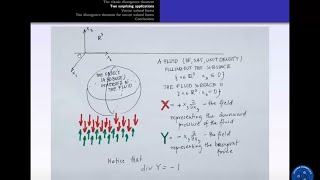
The Divergence Theorem for Vector Fields - Applications and Generalizations
Explore the divergence theorem's applications in PDEs, geometry, physics, and engineering, including proofs of Archimedean principle and multidimensional Pythagorean theorem.
Insights into the Geometric Harmonic Analysis Associated to 1-Parameter Sets
Explore geometric harmonic analysis of 1-parameter sets with insights from D. Dominique Kemp's research at the Institute for Advanced Study.
Robot Learning From Few Demonstrations by Exploiting Data Structure and Geometry
Explore robot learning from limited demonstrations, leveraging data structure and geometry. Discover optimal control strategies and intuitive interfaces for efficient skill acquisition in human-robot interaction.
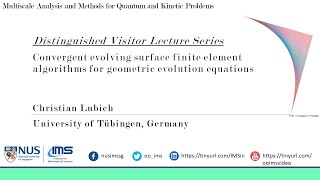
Convergent Evolving Surface Finite Element Algorithms for Geometric Evolution Equations
Explore convergent evolving surface finite element algorithms for geometric evolution equations, presented by Prof. Christian Lubich from University of Tübingen.
Stable Adaptation and Learning in Nonlinear Systems and Neural Networks
Explore nonlinear systems tools for insights on collective computation and learning in large dynamical networks, focusing on stable adaptation and implicit sparse regularization.
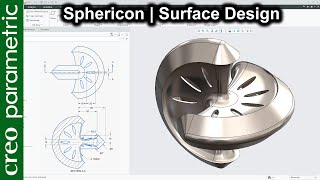
Sphericon Design in Creo Parametric - Part 2
Design a Sphericon using Creo Parametric, exploring advanced modeling techniques for this unique geometric shape.