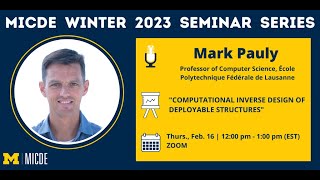
Computational Inverse Design of Deployable Structures
Explore computational design methodologies for deployable structures, combining geometry, simulation, and optimization to create innovative material systems with multiple geometric states.
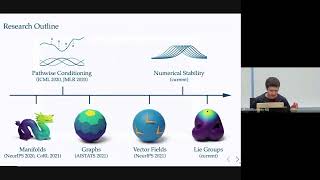
Pathwise Conditioning and Non-Euclidean Gaussian Processes
Explore advanced Gaussian process techniques for efficient Bayesian optimization, including pathwise conditioning and models on graphs and manifolds, enhancing decision-making in complex settings.
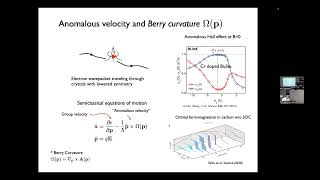
Non-reciprocal Quantum Matter: Quantum Geometry and Kramers Degeneracy
Explore non-reciprocal quantum matter, focusing on quantum geometry and Kramers degeneracy. Delve into field-free paradigms, linear and nonlinear phenomena, and extreme nonlinearities in layered materials.
Entangleability of Cones
Explore tensor products of finite-dimensional proper cones, solving Barker's conjecture using convex geometry and algebraic topology, with applications to entanglement in non-classical systems.
Sailing the Security Seas with Tetragon Tutorial
Explore Tetragon for runtime security: learn to filter and examine events, strengthen defenses against intrusions, and gain hands-on experience using the tetra CLI in this interactive tutorial.
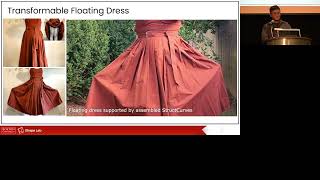
StructCurves - Interlocking Block-Based Line Structures
Discover innovative techniques for creating interlocking block structures through line-based design methods and computational approaches for stable construction assemblies.
From Observability to Enforcement: Lessons Learned Implementing eBPF Runtime Security
Dive into eBPF runtime security implementation, exploring the transition from observability to enforcement. Learn kernel-level security event collection, attack prevention strategies, and practical insights from the Tetragon team.

Comparing Kubernetes Security Agents: Falco, Tetragon and KubeArmor
Explore a detailed comparison of three leading eBPF-based Kubernetes security solutions, examining performance impacts, required privileges, and key features to make an informed choice for cluster protection.
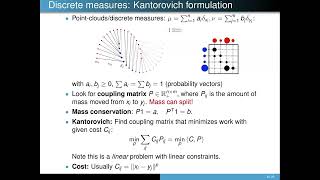
Trajectory Inference in Wasserstein Space
Explore advanced trajectory inference methods using Wasserstein geometry and B-spline approximation for analyzing dynamic processes in computational biology and point cloud data.
High-Dimensional Convexity: Testing, Learning, and Complexity
Explore the fascinating parallels between high-dimensional convex sets and monotone Boolean functions, examining algorithmic structures and mathematical complexities in Gaussian space.
How Can Large Language Models Learn From Humans? - Understanding Psycholinguistic Predictions and Sheaf Theory
Explore how combining lexical predictions from LLMs with syntactic structures can improve language understanding, using sheaf theory to better match human reading patterns and comprehension.

The Moduli Space of Matroids - Lecture 1
Delve into advanced mathematical concepts exploring matroid theory, F1-geometry, and tropical schemes, focusing on Baker-Bowler's theory and its applications to Grassmannians and representation theory.
Anchored Symplectic Embeddings and Non-Squeezing Phenomena in Four Dimensions
Delve into advanced symplectic geometry, exploring non-squeezing phenomena, Markov numbers, and the relationship between symplectic embeddings and surface anchors in four-dimensional spaces.
Linear Stability of the Brunn-Minkowski Inequality
Delve into advanced mathematical concepts exploring the linear stability of Brunn-Minkowski inequality, examining volume control in convex geometry and its connections to additive combinatorics.
The Fargues-Fontaine de Rham Stack in p-adic Analytic Geometry
Explore advanced concepts in analytic geometry through the Fargues-Fontaine de Rham stack, examining p-adic D-modules and their applications in p-adic Hodge theory and cohomology theories.

Daz Studio Workflow Optimization Tips and Tricks - Part 1
Master essential Daz Studio workflow optimization techniques, from managing VRAM and geometry to improving render efficiency through interactive updates, subdivision levels, and scene organization.
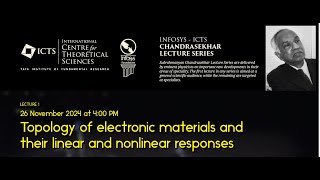
Topology of Electronic Materials and Their Linear and Nonlinear Responses - Lecture 1
Delve into quantum physics concepts like Berry curvature and electron wavefunction geometry, exploring topological states and their applications in electronic materials through advanced theoretical frameworks and experimental observations.
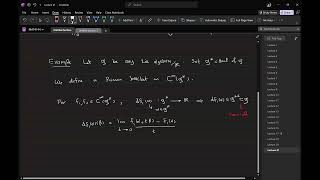
Lie Groups and Quantization - Lecture 21
Delve into advanced mathematical concepts exploring Lie groups and their applications in quantization theory through rigorous theoretical frameworks and practical examples.
Profinite Properties of Artin Groups
Delve into advanced group theory concepts exploring Artin groups, their profinite properties, residual finiteness, and connections to braid groups through mathematical analysis and recent research findings.
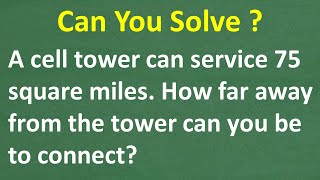
Solving Cell Tower Coverage Area - Finding Distance Using Circle Area
Learn how to calculate the maximum connection distance from a cell tower by solving a practical geometry problem involving circular area and radius.
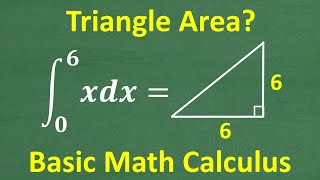
Basic Math Calculus - Finding the Area of a Triangle Using Simple Methods
Discover how to calculate a triangle's area using simple calculus concepts, making complex mathematical principles accessible through basic mathematical understanding.