The Multinomial Dimer Model - Statistical Mechanics and Discrete Geometry
Explore the multinomial dimer model's limit shape theory, bistochastic gauge, and 3D Aztec diamond applications in statistical mechanics and discrete geometry.
Hitchin Systems - An Introduction to Complex Geometric Structures
Explore Hitchin systems with Marina Logares, delving into their mathematical properties and applications in algebraic geometry and theoretical physics.

Stability and Chaos in Dynamical Last Passage Percolation
Explore stability and chaos in dynamical last passage percolation, examining energy landscapes, ground states, and the transition from stability to chaos using probabilistic and geometric techniques.

A New Kind of Quantum Computer - The Map of Topological Quantum Computing
Explore Microsoft's innovative topological quantum computing approach, featuring Majorana quasiparticles and exotic superconductivity. Learn about noise reduction, chip fabrication, and the potential for groundbreaking advancements in quantum technology.
Spectrum of the Ising Model
Explore the correspondence between Ising models and algebro-geometric data, extending Kenyon and Okounkov's work on dimer models and Harnack curves in this advanced mathematical presentation.

Minimal Bipartite Dimers and Maximal Riemann Surfaces
Exploration of critical weights for dimer models on isoradial graphs, extending Kenyon's results using theta functions on maximal Riemann surfaces, with applications to spectral theorems and Laplacians.
The Double Scaled SYK Model - Quantum Chaos and Non-Commutative Geometry
Explore quantum chaos and non-commutative geometry in the double scaled SYK model. Delve into advanced string theory concepts and their implications for spacetime and black hole information.

On the Higher-Rank Dimer Model
Richard Kenyon explores the higher-rank dimer model, discussing GL(n) local systems, Kasteleyn operators, and n-multiwebs. He presents scaling limit results for SL(3) and their conformal invariance in this advanced mathematics talk.
Tracial and G-invariant States on Quantum Groups
Explore tracial and G-invariant states on quantum groups, examining connections between traceability and G-invariance in discrete quantum group C*-algebras.
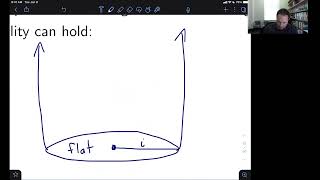
Capacity in Low Regularity with Connections to General Relativity
Explore capacity in metric spaces, its behavior under convergence, and connections to general relativity's total mass concept.
Topological Matter in Quantum Gases: Prospects and Challenges
Explore topological matter in quantum gases, examining prospects and challenges with expert Sylvain Nascimbène from Collège de France, Paris.
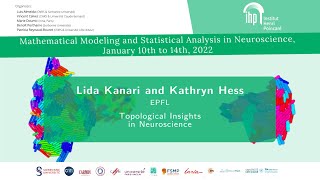
Topological Insights in Neuroscience
Explore topological approaches in neuroscience, uncovering insights into brain structure and function through mathematical analysis.
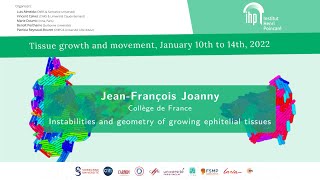
Instabilities and Geometry of Growing Epithelial Tissues
Explore instabilities and geometry in growing epithelial tissues, focusing on key concepts and recent research findings in this fascinating field of biophysics.

The Nonlinear Stability of Black Holes: An Overview
Explore the mathematical properties of black holes, focusing on their stability as solutions to Einstein's equation and recent proof of nonlinear stability for slowly rotating Kerr black holes.
Supersymmetry and Trace Formulas: From Atiyah-Singer to Jacobi-Poisson and Selberg
Explore supersymmetry's mathematical origins and applications, from Atiyah-Singer formula to Jacobi-Poisson and Selberg trace formulas, in this advanced mathematics colloquium.
Supersymmetry and Trace Formulas: From Atiyah-Singer to Jacobi-Poisson and Selberg - Part 1
Explore supersymmetry's mathematical origins and applications, from Atiyah-Singer formula to Jacobi-Poisson and Selberg trace formulas, in this advanced mathematics colloquium.
Combinatorial Approximations to the Continuum for Fluid Computation
Explore combinatorial approximations in fluid computation, featuring insights from Dennis Sullivan and Ruth Lawrence-Naimark in this geometry and analysis workshop.
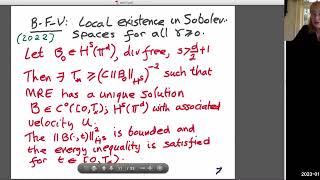
In Search of Euler Equilibria via the Magnetic Relaxation Equations
Explore geometric fluid dynamics, focusing on Euler equilibria and Moffatt's Magnetic Relaxation equations. Delve into recent findings on these mathematically challenging active vector equations with cubic nonlinearity.
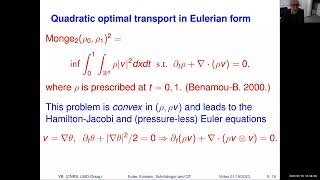
From the Monge Transportation Problem to Einstein's Gravitation Through Euler's Hydrodynamics
Explore the mathematical journey from Monge's transportation problem to Einstein's gravitation, connecting through Euler's hydrodynamics in this insightful lecture.
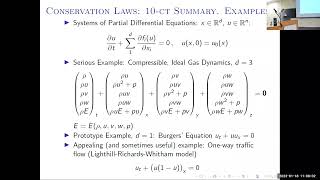
Can a Scalar Conservation Law Imitate a Diffeomorphism? - Lecture on Fluid Flow Geometry
Explore the representation of scalar convex conservation laws as paths in diffeomorphism spaces, examining weak solutions and their implications for fluid dynamics.
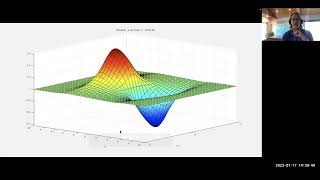
Geometry of Shock Formation and Maximal Development for Euler
Explore the geometry of shock formation and maximal development in Euler equations, focusing on fluid flow analysis and honoring David Ebin's contributions.