Java 8 -and 9- in Anger
Explore Java 8 and 9 features through live coding. Learn lambda expressions, streams API, and new collection methods while building a real-time data processing application with JavaFX dashboard.
When Less is More and More is Less - Trade-Offs in Algebra
Explore algebraic structures in functional programming, focusing on semigroups and semilattices. Learn their applications, trade-offs, and how to choose the right structure for your programming needs.
The Perfect Language
Explore the quest for the perfect programming language, examining modern language design, tradeoffs, and future tools to make programming less challenging.
Idioms for Building Fault-tolerant Applications with Elixir
Explore Elixir's approach to building fault-tolerant applications with José Valim. Learn about functional programming, processes, and message passing for robust, concurrent systems.
Denotational Design - From Meanings To Programs
Explore denotational design for functional programming libraries, focusing on precise mathematical models to define APIs and guide implementations, illustrated with examples like FRP and image synthesis.
A Tour of the Modern Java Platform
Explore modern Java platform advancements, including language features, dev environments, and cloud-native technologies. Live coding demos showcase Kotlin, Spring Boot, and cutting-edge tools for efficient development.
What's New in F# 5.0 & Beyond
Explore F# 5.0's enhancements in DSLs, performance, scripting, and tooling. Learn about new features for improved expressivity, state machines, package management, and interactive programming.
Functional Programming & Composing Actors
Explore functional programming and actor composition for building resilient, non-deterministic systems. Learn design strategies for handling failures and communication latency in distributed environments.
Unison - A Friendly Programming Language from the Future Part 2
Explore Unison's unique approach to functional programming, featuring cryptographic signatures, immutable distributed codebases, and simplified deployment for enhanced developer experience.
Teaching New Tricks to Old Programs Part 2
Explore advanced functional programming techniques for reinterpreting existing code, including hardware circuits, automatic differentiation, and interval analysis, using Haskell and GHC plugins.
Teaching New Tricks to Old Programs Part 1
Explore new interpretations for functional programs, including hardware circuits and automatic differentiation. Learn techniques for overloading lambda and organizing interpretations in Haskell.
Intro to Functional Programming in Rust
Explore functional programming in Rust, covering algebraic data types, pattern matching, ownership, higher-order functions, and advanced topics. Compare Rust's strengths and weaknesses as a functional language.
Testing Patience
Explore challenges to testing orthodoxy in microservices, transient code, and functional programming. Reflect on future testing practices and their impact on software development.
A Taste of Type Theory
Explore the foundations of type theory in programming, from algebraic data types to dependent types, with insights on mathematical connections and future developments in the field.
Why Functional Programming Matters
Explore the history and significance of functional programming with John Hughes, covering classic papers, personal favorites, and key themes that define this influential programming paradigm.
Reactive Machine Learning and Functional Programming
Explore reactive machine learning systems using functional programming principles. Learn to build responsive, resilient, and elastic applications with Scala, Akka, and Spark, focusing on architectural patterns and implementation.
Simplicity & Complexity - The Beauty & the Beast
Explore the tension between simplicity and complexity in software development, discussing strategies to reduce complexity and create more effective solutions.
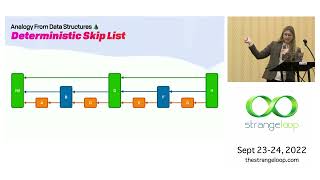
The Skip Ratchet
Innovative cryptographic ratchet for decentralized environments, combining hierarchical hashing and skip lists. Enables efficient key agreement, synchronization, and backward secrecy in local-first deployments.
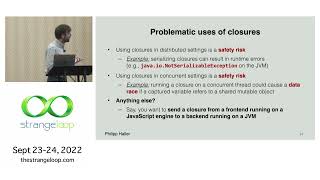
How to Avoid Safety Hazards When Using Closures in Scala
Explore safety hazards in Scala closures, learn to identify unsafe code, write safer closure-using code, and utilize new library components for increased flexibility and safety in parallel and distributed programming.
Writing Parsers Like It Is 2017
Explore safe parsing techniques using Rust and parser combinators to address memory violations in low-level programming, with practical examples and implementation strategies.
Nom - A Byte-oriented, Streaming, Zero-copy Parser Combinators Library in Rust
Explore Rust's Nom library for efficient, safe parsing. Learn about byte-oriented, streaming, and zero-copy techniques in parser combinators for improved performance and security.