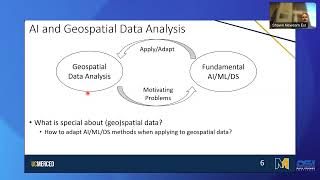
GeoAI: Past, Present, and Future
Explore GeoAI's evolution, applications, and future prospects in geographic data analysis. Gain insights into spatial context integration, multi-modal foundation models, and potential challenges with generative AI.
Fine-Tuning Language Models with Declarative ML Orchestration
Gain hands-on experience using Flyte to declaratively specify infrastructure for fine-tuning language models on your own data, overcoming compute resource challenges.
Foundation Models for Science
Explore foundation models' potential in scientific research, focusing on their applications and impact on various scientific disciplines.
Aurora: A Foundation Model of the Atmosphere - Tutorial 1
Explore Aurora, a groundbreaking foundation model for atmospheric science, and learn its applications in climate modeling and weather prediction.
Leveraging Pre-trained Vision Foundation Models for Geophysical Data Processing and Interpretation
Discover how to adapt computer vision foundation models for geoscience applications, focusing on efficient processing and interpretation of geophysical data like seismic and lunar imagery.
Generative AI for Multimodal Biomedicine
Explore groundbreaking developments in multimodal biomedicine AI, including GigaPath, OCTCube, and BiomedParse foundation models, and their potential impact on advancing medical applications through multi-agent frameworks.
Progress in Agentic AI - From Chatbots to Autonomous Systems
Explore the latest advancements in agentic AI systems, from automated ML research to self-optimizing models, with insights into Sakana AI's groundbreaking developments and future prospects.

TokenFormer - Rethinking Transformer Scaling with Tokenized Model Parameters
Delve into an innovative approach to transformer architecture scaling that treats model parameters as tokens, enabling flexible parameter adjustments without complete retraining from scratch.
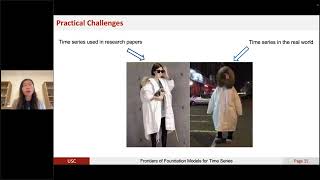
Frontiers of Foundation Models for Time Series Analysis and Applications
Explore groundbreaking applications of GPT-inspired architectures in time series modeling, from climate science to healthcare, with insights from USC machine learning expert Yan Liu on capturing dynamic patterns across domains.
Mixture of Transformers for Multi-modal Foundation Models
Explore Meta's Mixture-of-Transformers (MoT) architecture, a revolutionary approach to handling multi-modal AI tasks combining text, speech, images, and videos with enhanced efficiency and performance.
The Promises and Pitfalls of Open-source Agent Systems
Explore the potential and challenges of open-source AI agent systems, examining their performance compared to closed-source alternatives and key issues in evaluation and generalization.
Recent Progress on Foundation Model Supervision for Robot Learning
Discover how foundation models from non-robot domains can revolutionize robot learning, enabling automated task acquisition without extensive data collection or manual controller design.
Open-Source and Science in the Era of Foundation Models
Explore the critical role of open-source models in AI development, focusing on API access, open weights, and community-driven innovation for advancing foundation model research.
Take a Peek Under the Hood of Cloud-Native AI at Scale
Dive into real-world challenges and solutions for managing large-scale AI infrastructure on Kubernetes, focusing on GPU optimization, hardware reliability, and observability tools for foundation model training.
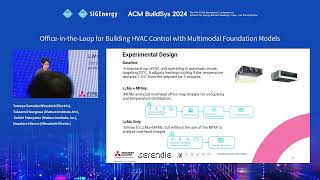
Office in the Loop for Building HVAC Control with Multimodal Foundation Models
Discover how multimodal foundation models can optimize HVAC control systems in office buildings, improving energy efficiency and occupant comfort through innovative AI-driven solutions.
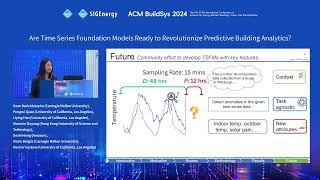
Time Series Foundation Models in Predictive Building Analytics - A Critical Analysis
Explore the potential impact of time series foundation models on predictive building analytics, examining their readiness and capabilities for revolutionizing building management systems.
From Supercomputing to Serving: A Case Study Delivering Cloud Native Foundation Models
Discover how a small team scaled ML infrastructure across multiple cloud providers, managing supercomputing challenges, networking, and capacity for AI workloads using cloud-native approaches.