A Practical Guide to Securing Your AI Application
Explore practical strategies for securing AI applications, from responsible AI principles to vulnerability control and evaluation techniques. Learn to implement guardrails and observability in generative AI projects.
Large Language Models for Computational Biology - A Primer
Explore large language models in computational biology, covering transformers, pretraining, and applications in genomics and single-cell analysis.

Generative Artificial Intelligence for Decision Making in Robotics
Explore generative AI's potential in robotics, leveraging video foundation models and internet-trained models to solve complex, long-horizon manipulation tasks efficiently.
Towards High-Fidelity Open-Vocabulary 3D Scene Understanding
Explore open-vocabulary 3D scene understanding using Transformer-based networks and foundation models. Learn about object segmentation, human body part segmentation, and vectorized floorplan reconstruction.
Ontologies, Graph Deep Learning, and AI in Materials Science
Explore ontologies, graph deep learning, and AI in materials science, focusing on advanced manufacturing and synchrotron science. Learn about innovative approaches for multimodal analysis and decision-making.
Foundation Models and the Transfer of Embodied Autonomy
Explore challenges in developing foundation models for sequential decision-making, including transfer learning, and discuss future research directions in embodied autonomy.
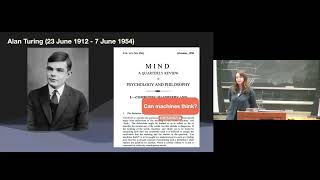
A Universe To Be Decided: Towards Specialized Foundation Models for Advancing Astronomy
Explore specialized foundation models in astronomy, including AstroLLaMa-1 and AstroLLaVA, to enhance scientific inquiry and democratize access to astronomical knowledge.
Computational Social Choice and AI Value Learning
Explore computational social choice and AI value learning, focusing on misspecification in RLHF, model interpretability, and foundation model capability evaluations.
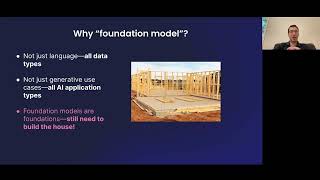
Data-Centric Development is Key to Production-Level AI
Explore data-centric AI development approaches for adapting foundation models to complex use cases, focusing on techniques for pre-training, instruction-tuning, and task-specific fine-tuning.
ROBOSHOT: Improving Foundation Model Performance Without Fine-Tuning
Boost zero-shot foundation model performance with ROBOSHOT. Learn to improve robustness, reduce biases, and understand conditions for enhanced results without fine-tuning.
Alfred: Building Training Data with Foundation Models and Weak Supervision - Snorkel AI
Streamline data labeling with Alfred, combining foundation models and weak supervision to create high-quality training datasets for academic research and machine learning projects.

Building an Ecosystem for Open Foundation Models - Challenges and Opportunities
Explore open source foundation model ecosystem development, balancing data quality, architecture, and infrastructure while optimizing GPU clusters and enhancing model quality through structured data reasoning.
Generative AI for Business: Principles and Strategies
Demystify generative AI technology and learn principles for business strategy, exploring IBM's watsonx platform and research breakthroughs in computing.
Jumpstart Your AI/ML Program with Vertex AI Model Garden
Explore Vertex AI Model Garden to easily deploy and manage state-of-the-art AI models, transforming your startup with minimal coding and effort.
Accelerate Software Development with Vertex AI's Codey APIs
Enhance developer productivity using Vertex AI's Codey APIs for code chat, generation, and customization with foundation models.
Building Differentiated Generative AI Applications on Google Cloud
Explore building Generative AI apps on Google Cloud using Vertex AI's models, embeddings APIs, and vector databases. Learn to create enterprise-grade conversational AI and search experiences.
Tuning Foundation Models: A Comprehensive Guide
Explore techniques for customizing foundation models with your data, improving performance across tasks while understanding limitations and future prospects.
Accelerate Your Generative AI Projects with New Tools on Vertex AI
Discover how to choose and implement foundation models for generative AI projects using Vertex AI's Model Garden, streamlining workflows and enhancing project efficiency.
What's Next with Generative AI at Google Cloud
Explore Google Cloud's approach to generative AI, learn about new announcements, and discover how organizations are leveraging it to create value.
Customizing Generative AI Models with Vertex AI
Explore Vertex AI's capabilities for customizing foundation models, including supervised fine-tuning and distillation techniques, to enhance performance and create unique AI offerings.
Operationalizing Generative AI on Vertex AI
Explore MLOps fundamentals, adaptations for generative AI, and Vertex AI capabilities to support new workflows in the era of foundation models.