
Distributed Mesh Processing and Geometric Deep Learning for Wind Prediction
Discover how Ray's distributed computing powers real-time wind prediction in urban design through mesh processing, geometric deep learning, and CFD data analysis for architectural innovation.

Five Ways to Understand Kubernetes Networking for Performance-Intensive Workloads
Explore Kubernetes networking innovations for high-performance workloads. Compare CNI implementations using real-world benchmarks to analyze performance in scientific computing and machine learning.

Meta-Learning Dynamics Forecasting Using Task Inference
Explore meta-learning dynamics forecasting using task inference to improve generalization across heterogeneous domains in deep learning models for predicting complex systems.
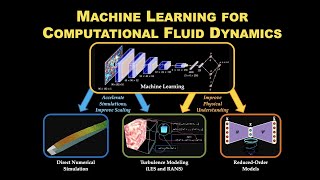
Machine Learning for Computational Fluid Dynamics
Explore machine learning's potential to enhance computational fluid dynamics, covering applications in simulations, turbulence modeling, and reduced-order models while emphasizing physics-informed approaches.
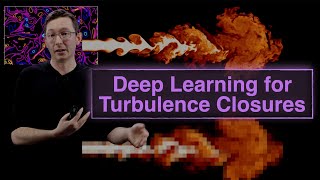
Deep Learning for Turbulence Closure Modeling
Explore how deep learning revolutionizes turbulence modeling in fluid dynamics, focusing on RANS equations and large eddy simulations for advanced computational techniques.
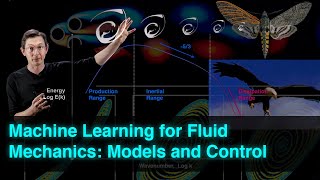
Machine Learning for Fluid Dynamics: Models and Control
Explore machine learning applications in fluid dynamics modeling and control, covering patterns, complexity, RANS closure models, SINDY, and deep MPC for flow control.
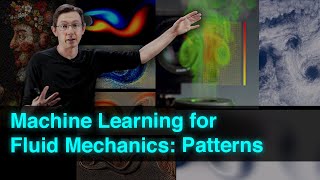
Machine Learning for Fluid Dynamics - Patterns
Explore machine learning applications in fluid dynamics, focusing on pattern extraction and coherent structure identification in high-dimensional systems.
Machine Learning for Fluid Mechanics
Overview of machine learning applications in fluid mechanics, exploring historical context, pattern recognition, reduced-order modeling, and flow control, with insights on AI's impact on this data-rich field.
Blender Tutorial - Fire Particle Animation
Learn to create realistic fire particle animations in Blender 2.90 using Mantaflow and the Particle System. Master fluid flow force fields to make particles follow smoke for stunning visual effects.
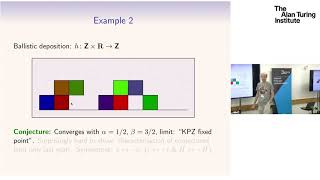
Universality Classes for 1+1 Dimensional Systems
Explore universality classes in 1+1 dimensional systems, focusing on weak universality conjecture, graphical construction, and links to Brownian web. Gain insights into complex systems modeling.
Interpretable and Generalizable Machine Learning for Fluid Dynamics - Steven Brunton
Explore interpretable and generalizable machine learning techniques for fluid dynamics, focusing on sparse identification of nonlinear dynamics and incorporating physical constraints for improved accuracy.
Physics-Guided Deep Learning for Fluid Dynamics - Rose Yu
Explores physics-guided deep learning for fluid dynamics, focusing on accelerating turbulence simulations and incorporating symmetry for generalization in ocean current forecasting.
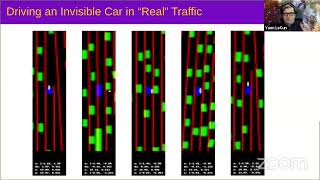
The Deep Learning - Applied Math Connection
Explore the intersection of deep learning and applied mathematics, focusing on advancements in signal processing, optimization, and self-supervised learning for predictive modeling.
Machine Learning for Analysis of High-Dimensional Spatiotemporal Chaotic Dynamical Systems
Discover how machine learning techniques can analyze and predict complex chaotic systems, with insights from cutting-edge research in physics and data science.
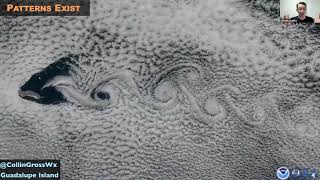
Machine Learning in Fluid Dynamics and Climate Physics
Explore machine learning applications in fluid dynamics and climate modeling, including physics-informed approaches, data integration, and simulation validation techniques.

Coding Adventure: Simulating Fluids
Explore particle-based fluid simulation techniques, from basic physics to advanced concepts like smoothed particles, density calculation, and pressure forces, with practical coding examples and optimizations.

On Random Grid Neural Processes for Solving Forward and Inverse Problems
Explore innovative deep learning models for parametric PDEs using random grids and variational neural processes, addressing challenges in physics-informed frameworks and data integration.
Machine Learning Tutorial Exercise
Hands-on tutorial exploring machine learning applications in geophysical fluid dynamics, covering data analysis, modeling, and prediction techniques for climate and ocean systems.
Basic Aspects of Convolutional Neural Networks - Tutorial
Explore fundamental concepts of convolutional neural networks in this tutorial, covering key principles and applications in deep learning for image processing and pattern recognition.
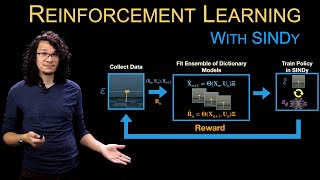
SINDy-RL: Interpretable and Efficient Model-Based Reinforcement Learning
Explores SINDy-RL, a framework combining sparse identification of nonlinear dynamics with reinforcement learning for efficient, interpretable control policies in complex environments.
Deep Learning and Numerical Methods Intersections for Improving Molecular and Fluid Dynamics
Explore intersections of deep learning and numerical methods to enhance molecular and fluid dynamics simulations, improving accuracy and efficiency in scientific computations.