Critical Phenomena at the Permafrost-Atmosphere Interface
Explore critical phenomena at the permafrost-atmosphere interface, examining complex interactions and their impact on climate dynamics and environmental systems.
Quantifying Marine Carbon Dioxide Removal Through Ocean Modeling - Lecture 1
Explore ocean modeling techniques to quantify marine carbon dioxide removal, focusing on theoretical and practical aspects of geophysical fluid dynamics and climate science.
Diapycnal Mixing in the Coastal Ocean
Explore diapycnal mixing in coastal oceans: mechanisms, impacts, and latest research findings on this crucial process affecting ocean dynamics and climate.
Symmetries and Transition to Turbulence in Plane Poiseuille Flow
Explores symmetries and turbulence transition in plane Poiseuille flow, examining fluid dynamics principles and their applications in geophysical systems.
Near-inertial Wave Energy Propagation Out of the Mixed Layer - The Role of Stratification
Explores near-inertial wave energy propagation from the ocean's mixed layer, examining key factors influencing this process and its implications for oceanic energy transfer and climate dynamics.
Unraveling the Dynamical Interactions Between Mesoscales and Submesoscales in Geophysical Fluid Dynamics
Explore dynamical interactions across oceanic scales, focusing on energy transfers, turbulent mixing, and instabilities. Learn cutting-edge techniques in geophysical fluid dynamics and climate modeling.
Detection of Mesoscale Oceanic Eddies Over Bay of Bengal Using Explainable Deep Learning
Explore deep learning techniques for detecting mesoscale oceanic eddies in the Bay of Bengal, with a focus on explainable AI methods to enhance understanding of eddy dynamics and their impact on regional climate.
Meso- to Submesoscale Turbulence in the Ocean - Lecture 2
Explores meso- to submesoscale ocean turbulence, focusing on energy transfers, instabilities, and mixing processes. Examines theoretical frameworks and observational insights to enhance understanding of multi-scale oceanic dynamics.
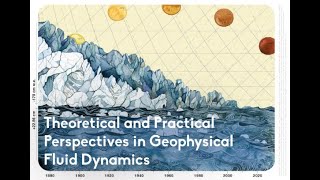
Meso- to Submesoscale Turbulence in the Ocean - Lecture 1
Explore ocean turbulence from meso to submesoscale, examining energy transfers, instabilities, and mixing processes. Gain insights into the complex dynamics shaping Earth's climate and marine ecosystems.
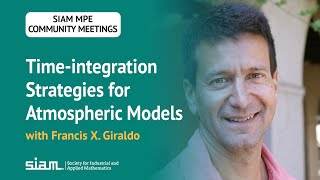
Advanced Time-Integration Methods for Atmospheric Modeling - SIAM MPE Webinar
Explore advanced time-integration methods for atmospheric modeling, focusing on element-based Galerkin methods and horizontally explicit vertically implicit time-integrators for weather and climate prediction.
Dynamics of Biological Systems - Lecture 4
Explore biological dynamics using physics tools to model predator-prey oscillations, ecosystem chaos, and microbial swimming. Learn to predict species competition, population changes, and collective behavior in fluids.
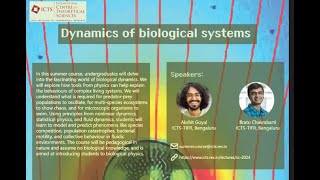
Dynamics of Biological Systems - Lecture 1
Explore biological dynamics using physics tools to model complex living systems, from predator-prey oscillations to bacterial motility, in this introductory course for undergraduates.
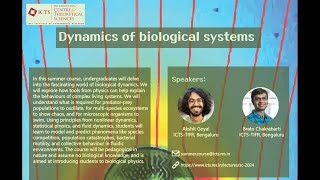
Dynamics of Biological Systems - Lecture 2
Explore biological dynamics using physics tools to model predator-prey oscillations, ecosystem chaos, and microbial swimming. Learn to predict species competition, population changes, and collective behavior in fluids.
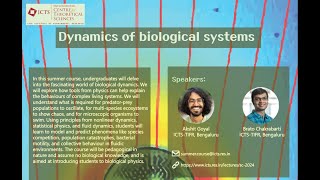
Dynamics of Biological Systems - Lecture 3
Explore biological dynamics using physics tools to model predator-prey oscillations, ecosystem chaos, and microbial swimming. Learn to predict species competition, population changes, and collective behavior in fluids.
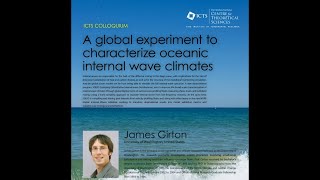
A Global Experiment to Characterize Oceanic Internal Wave Climates
Explore oceanic internal waves' impact on global climate, mixing processes, and circulation patterns through the SQUID program's innovative global observations and data analysis techniques.
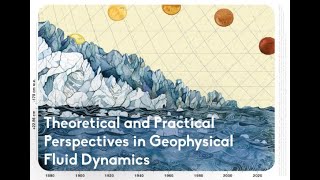
The Balance Conundrum in Geophysical Fluid Dynamics
Explore geophysical fluid dynamics, covering eddies, waves, turbulence, and energy transfers in Earth's climate. Gain insights from theory, models, and observations, with tutorials on visualization and machine learning.
Energetically Consistent Climate Modelling - Part 1
Explore energetically consistent climate modeling techniques, focusing on atmospheric and oceanic dynamics, energy transfers, and multi-scale interactions in Earth's climate system.
Exploring Internal Gravity Wave Interactions with Eddies and Waves
Investigación sobre interacciones entre ondas de gravedad internas, remolinos y otras ondas en fluidos geofísicos, examinando su impacto en la dinámica atmosférica y oceánica.
The Geostrophic Eady Problem Revisited - Lecture 1
Revisiting the geostrophic Eady problem: Exploring atmospheric and oceanic dynamics, instabilities, and energy transfers in geophysical fluid systems through theoretical and practical perspectives.
Impact of a Mesoscale Eddy on the M2 Internal Tide in 5km ICON-O
Explore the influence of mesoscale eddies on M2 internal tides using high-resolution ICON-O simulations. Gain insights into complex ocean dynamics and energy transfers in geophysical fluid systems.
On Scaling Theories of Vortex Dynamics in Two-dimensional Turbulence
Explores scaling theories of vortex dynamics in 2D turbulence, examining energy transfers and cascades in geophysical fluid systems. Contributes to understanding multi-scale interactions in atmospheric and oceanic flows.