A New Geometric Explanation for the Formation of Sand Dunes and Bedforms
Innovative theory on sand dune formation based on geometric principles, explaining bedform development through surface-to-volume ratios and bed shortening, with validated predictions of dune migration rates.
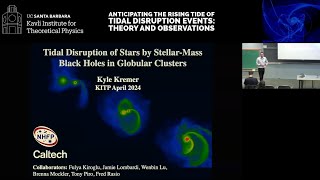
Hydrodynamics of Collisions and Close Encounters between Compact Objects and Stars in Dense Stellar Environments
Explore hydrodynamics of compact object collisions and stellar encounters in dense environments, examining tidal disruption events and their impact on galactic nuclei and black holes.
Fluid-Solid Coupling with FLOW-3D HYDRO and RocScour - Rock Scour Assessment in Water Infrastructure
Explore rock scour assessment in water infrastructure using numerical modeling and fluid-solid coupling. Learn about CFD, Flow-3D Hydro, and computational methods through case studies and practical examples.

Links between Eddy Horizontal and Vertical Structure: A Geostrophic Turbulence Perspective
Explores connections between horizontal and vertical eddy structures in geostrophic turbulence, offering insights into ocean dynamics and energy transfers across scales.

A Global Experiment to Characterize Oceanic Internal Wave Climates
Explore the SQUID program's global study of oceanic internal waves, their impact on deep-sea mixing, and implications for climate models and ocean circulation patterns.

Hybrid Filtering for Lagrangian Data Assimilation and Tipping Points in Earth Systems
Explore hybrid filtering for Lagrangian data assimilation and tipping points in Earth systems. Gain insights into advanced geophysical fluid dynamics techniques and their applications in climate science.
Oceanic Energy Flux Across Scales - Observational Evidence and Mechanisms
Explores oceanic energy transfers across scales using observational evidence and mechanisms. Discusses multi-scale interactions, turbulent mixing, and energy cycle in Earth's climate system.
Small-scale Instabilities in Inertia-gravity Waves
Explores small-scale instabilities in inertia-gravity waves, examining their impact on atmospheric and oceanic dynamics. Discusses theoretical perspectives and implications for geophysical fluid dynamics.
A Quasi-Biweekly Oscillation in the Equatorial Indian Ocean and Bay of Bengal
Explores a quasi-biweekly oscillation in the equatorial Indian Ocean and Bay of Bengal, examining its characteristics, mechanisms, and impacts on regional climate dynamics.
Reynolds Decomposing Heat Waves - Geophysical Fluid Dynamics
Explore Reynolds decomposition for analyzing heat waves, focusing on atmospheric dynamics and energy transfers across scales. Gain insights into geophysical fluid dynamics and climate modeling techniques.
Interaction of Atmospheric Cold Pools with Mean Flow
Explores the dynamics of atmospheric cold pools interacting with mean flow, examining their impact on weather patterns and climate systems through theoretical and practical perspectives in geophysical fluid dynamics.
Decadal Heat Content Variability in the South Indian Ocean
Explore decadal heat content variability in the South Indian Ocean, examining key factors influencing oceanic energy dynamics and their implications for regional climate patterns.
Observations of Localized Submesoscale Kinetic Energy Fluxes
Explores submesoscale kinetic energy fluxes in geophysical fluid dynamics using observational data, contributing to understanding of multi-scale energy transfers in Earth's climate system.
Links Between Eddy Horizontal and Vertical Structure: A Geostrophic Turbulence Perspective
Explores connections between horizontal and vertical structures in geostrophic turbulence, focusing on eddy dynamics in oceanic and atmospheric flows.
Exploring Climate Dynamics Through Physics of Complex Systems
Discover how complex systems physics illuminates climate dynamics, offering insights into multi-scale interactions, energy transfers, and modeling challenges in Earth's atmospheric and oceanic systems.
Submesoscale Processes Associated with the East India Coastal Current
Explores submesoscale processes in the East India Coastal Current, examining their impact on ocean dynamics and energy transfers across scales in geophysical fluid dynamics.
Mesoscale and Submesoscale Ekman Pumping in a Turbulent Ocean - Lecture 2
Explores mesoscale and submesoscale Ekman pumping in turbulent oceans, examining dynamics, energy transfers, and interactions across scales in geophysical fluid systems.
Mesoscale and Submesoscale Ekman Pumping in a Turbulent Ocean - Lecture 1
Explore mesoscale and submesoscale Ekman pumping in turbulent oceans. Gain insights into geophysical fluid dynamics, focusing on eddies, waves, and energy transfers across multiple scales.
Stochastic Multi-Scale Reconstruction of Turbulent Rotating Flows
Explores stochastic methods for reconstructing turbulent rotating flows across multiple scales, advancing understanding of complex fluid dynamics in geophysical systems.
Lagrangian Means and Their Computation
Explore Lagrangian means in geophysical fluid dynamics, focusing on computational methods and applications in atmospheric and oceanic dynamics.
A Spectral Framework for Constraining Anisotropic Eddy Viscosity - Lecture 2
Explores a spectral framework for constraining anisotropic eddy viscosity in geophysical fluid dynamics, focusing on advanced modeling techniques and their applications in understanding complex oceanic and atmospheric processes.