Vortices over Bathymetry - Dynamics of Planetary-scale Fluid Flows
Explore long-lived anticyclones over topographic basins in oceans, examining their coexistence with cyclonic circulation and analyzing variational solutions in two-layer models.
Modeling Density-Driven Flows in the Presence of Chaotic Advection
Explore a hybrid kinematic-dynamic model for density-driven flows, combining traditional Stommel Box and chaotic advection approaches to study oceanic feedback processes.
Dipolar Geophysical Vortices: Coastal Eddies and Mesoscale Ocean Dipoles
Explore coastal eddy modeling and mesoscale dipoles in ocean dynamics. Analyze vortex-wave interactions, energy fluxes, and quasi-geostrophic equations for planetary-scale fluid flows.
The Limits of Beta Plane Turbulence
Explore jet separation scales in quasigeostrophic shallow-water systems, examining flow structure simplification and transitions in jet structure across varying deformation radii.
Wind-Driven Transport at the Ocean Surface: Beyond the f-Plane
Explore wind-driven ocean transport beyond the f-plane, examining Ekman's theory extensions to β-plane and sphere, and analyzing water column trajectories using advanced mathematical techniques.
The Dynamics of Oceanic Vortices
Explore mesoscale vortices in Earth's oceans, their connections to regional currents and submesoscale structures, using observations and models. Compare with other planetary atmospheres.
Balance, Jets and Coherent Structures in Geophysical Fluid Dynamics - Lecture 4
Explore planetary-scale fluid dynamics, focusing on balance, jets, and coherent structures in geophysical systems.
Balance, Jets and Coherent Structures in Geophysical Fluid Dynamics - Lecture 3
Explore planetary-scale fluid dynamics, focusing on balance, jets, and coherent structures in geophysical systems.
Mathematical Fluid Dynamics of Atmospheric and Oceanic Flows
Explore mathematical fluid dynamics for atmospheric and oceanic flows, focusing on thin-shell approximation in rotating spherical coordinates and perturbation theory for atmospheric modeling.
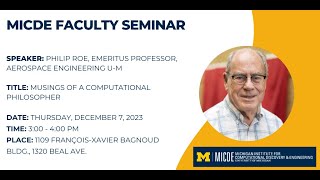
Musings of a Computational Philosopher - Exploring Accuracy in Compressible Flow Algorithms
Explore computational fluid dynamics through philosophical lens. Delve into accuracy, information flow, and innovative algorithms for compressible flow problems. Gain insights from an emeritus professor's decade-long research.
Particle-Laden Flows: Simulations and Data-Driven Modeling
Explore particle-laden flows through simulations and data-driven modeling techniques, gaining insights into complex fluid dynamics and engineering applications.
Nonequilibrium: From Heat Conduction to Turbulence and Life - Rothschild Lecture
Explore nonequilibrium phenomena from heat conduction to turbulence, with insights on mathematical approaches and potential applications to life systems.

Laminar and Turbulent Flows - Part 3 - Lecture 32
Explore laminar and turbulent flows, delving into advanced concepts and applications in fluid dynamics.
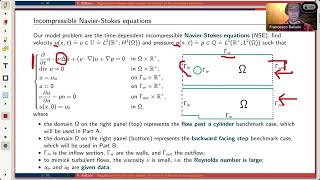
Regularized Reduced Order Models for Control of Navier-Stokes Equations
Explore regularized reduced order models for controlling Navier-Stokes equations in convection-dominated flows, focusing on evolve-filter-relax and approximate deconvolution techniques for numerical stabilization.
The Physics of Scale with Falling Hail
Explore the fascinating physics of falling hail, examining how changes in size affect its behavior and impact. Learn about scaling laws in meteorology.
Exploring Lagrangian Data Assimilation: Methods and Uncertainty - SIAM MPE Community Meeting
Explore Lagrangian data assimilation methods and uncertainty in fluid dynamics. Learn about ensemble techniques, analytical solutions, and optimal tracer deployment for improved state estimation.
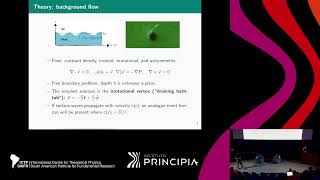
Superradiance and Ergoregion Instabilities in Vortices
Explore superradiance and ergoregion instabilities in vortices, examining quantum aspects of gravity and their potential laboratory observations.
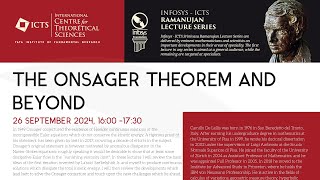
C^0 Convex Integration for Incompressible Euler - Lecture 4
Explore C^0 convex integration for incompressible Euler equations, focusing on a novel iteration method producing continuous solutions, drawing parallels with Nash's theorem from Lecture 3.
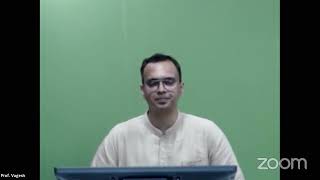
Turbulence Modeling - Lecture 1
Explore turbulence modeling concepts with Prof. Vagesh D Narasimhamurthy in this comprehensive lecture on fluid dynamics and computational methods.
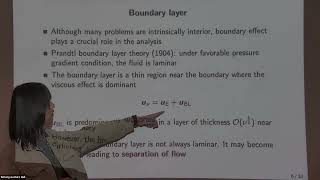
Energy Dissipation of Navier-Stokes Equation with Non-Characteristic Boundary
Explore energy dissipation in Navier-Stokes equations with non-characteristic boundaries, presented by Jincheng Yang from the Institute for Advanced Study.
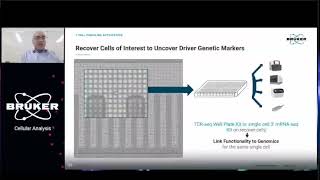
Harnessing the Power of Beacon Platform to Accelerate Antibody Discovery and Cell Therapy Development
Explore Bruker's Beacon® Optofluidic System for comprehensive single-cell analysis, enabling serial multi-modal examination and real-time imaging to accelerate antibody discovery and cell therapy development.