
Reducing Security Risks in the Hybrid Workplace with Windows 11 and Surface
Discover how Windows-enhanced security settings on Surface devices reduce organizational security risks by 60% in hybrid workplaces, leveraging Microsoft's holistic ecosystem from chip to cloud.

Project Cerberus: Hardware Root of Trust for Cloud Security
Explore hardware-enforced secure boot and measured boot with Project Cerberus, a cryptographic microcontroller enhancing firmware security for cloud platforms and data centers.
Demystifying Intel Security Technologies in Firmware
Explore Intel's firmware security technologies, including Converged Security, Boot Guard, and Trusted Execution, with insights on implementation and platform protection mechanisms.
IoT and OT Firmware Security Analysis with EMBA - From Firmware to Exploit
Automated firmware analysis for IoT and OT devices using EMBA, an open-source tool that detects vulnerabilities, identifies exploits, and supports penetration testing of embedded systems.

Design and Implementation of a Security Architecture for Critical Infrastructure Industrial Control Systems
Comprehensive security architecture for critical infrastructure, addressing nation-state cyber threats. Covers hardware roots of trust, secure boot, and integrity measures across various systems and networks.
Firmware Vulnerabilities in Critical Infrastructure - Tools and Techniques for Security Analysis
Explore firmware vulnerabilities in critical infrastructure using open-source tools. Learn techniques for deep security analysis, uncovering risks, and leveraging AI to simplify research and reverse engineering.
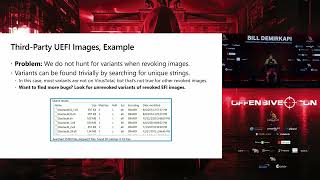
Booting with Caution: Dissecting Secure Boot's Third-Party Attack Surface
Dissect Secure Boot's third-party attack surface, exploring vulnerabilities and potential exploits in boot processes.
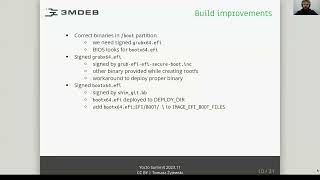
Dealing with UEFI Secure Boot Using Yocto Project
Implement UEFI Secure Boot in production using Yocto Project. Learn analysis, integration, and maintenance processes for this critical functionality in ongoing projects.
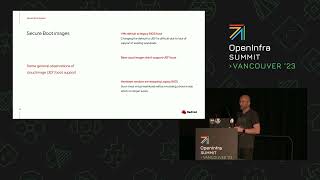
UEFI Secure Boot in Cloud Workloads - Implementation and Benefits
Explore UEFI Secure Boot implementation in OpenStack environments, covering benefits for virtual workloads, image compatibility, and configuration methods for bare metal deployments using Ironic.
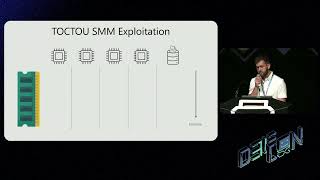
RingHopper: From User-Land to SMM - A Journey Through UEFI Vulnerabilities
Delve into the discovery of RingHopper, a critical UEFI vulnerability affecting billions of devices, exploring exploitation techniques and elevation methods across Windows and Linux systems.
Verifiable End-to-End Secure OCI Native Machines
Explore a secure toolchain for verifiable workloads using signed OCI images, ensuring tamper-proof boot processes and authenticated communication with hosts.
Establishing Trust in Linux Keyrings - Built-in, Imputed, or Transitive Trust
Explore Linux keyrings, trust models, and key management in firmware, kernel, and user space. Learn about trust domains, scope, usage constraints, and security implications for different systems.
IoT Security - Ecosystem, Interoperability and Standards
Explore IoT security challenges and solutions with the Security & Privacy Development Lifecycle framework, addressing ecosystem complexities, privacy concerns, and compliance issues in rapidly evolving IoT landscapes.

A Canonical Event Log Structure for IMA - Optimizing Attestation Information
Explore a new Canonical Event Log structure for IMA, enhancing Linux system attestation with algorithm agility, sequence numbering, and optimized storage for improved security and efficiency.

Replace Your Exploit-Ridden Firmware with Linux
Learn how to replace vulnerable UEFI firmware with NERF, an open-source system using a tiny Linux kernel and initramfs, enhancing security and reducing exploit risks in PC and laptop firmware.
OpenPOWER Host OS Secure Boot Key Management
Explore OpenPOWER's flexible key management for Linux-based secure boot, covering architecture, ownership, updates, storage, and compatibility across firmware, kernel, and userspace.
IoT Developer's Guide to Building Secure IoT Devices
Learn essential strategies and best practices for developing secure IoT devices, focusing on key vulnerabilities and effective mitigation techniques.

Leveraging and Managing SBAT Revocation Mechanism on Distribution Level
Explore SBAT revocation mechanisms at the distribution level, focusing on leveraging and managing these systems for enhanced security and efficiency.
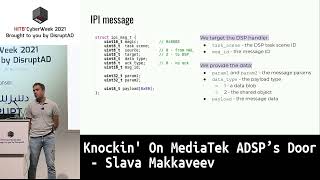
Knockin' On MediaTek ADSP's Door
Reverse engineering MediaTek's audio DSP firmware reveals vulnerabilities in RTOS and Android HAL, potentially enabling local privilege escalation and eavesdropping on user conversations.
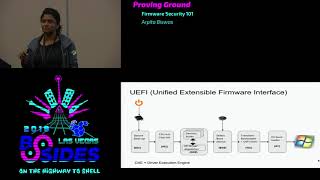
Firmware Security 101
Explore firmware security fundamentals, vulnerabilities, and protection strategies in embedded systems with expert insights and practical examples.
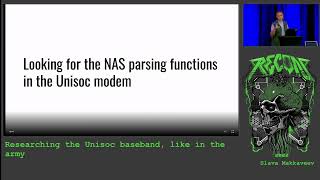
Researching the Unisoc Baseband
Exploring Unisoc baseband security: reverse-engineering and fuzzing LTE protocol stack to uncover vulnerabilities in budget smartphone chipsets, disrupting radio communication.