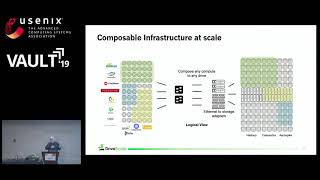
Design of a Composable Infrastructure Platform
Explore composable infrastructure for dynamic creation of secure application clusters, focusing on design challenges, state machine orchestration, Linux subsystem management, and failure recovery mechanisms.
Dapr Workflows - Writing Reliable, Fault-Tolerant Applications with Open Source Technology
Learn to build reliable, fault-tolerant applications using Dapr Workflows. Explore how this open-source technology simplifies microservice development, enhances resiliency, and streamlines business process orchestration.
Problem Solving with Erlang & the BEAM - Robert Virding & Francesco Cesarini - GOTO 2023
Explore Erlang's journey from inception to its pivotal role in mission-critical applications, discussing its unique design, concurrency capabilities, and future in the BEAM ecosystem.
Serverless - The Problem Reactive Was Looking For
Explore how Reactive systems solve challenges in serverless environments, focusing on Lightbend's Kalix platform for building responsive, scalable applications with simplified state management.
Kubernetes Controllers in Rust - Fast, Safe, and Sane
Explore the benefits and challenges of using Rust for Kubernetes controllers, focusing on reliability, efficiency, and fault tolerance. Learn from Linkerd's experience in adopting Rust for their control plane.
Implementing Dapr in an Existing Environment
Discover how Dapr was successfully integrated into an agricultural customer's infrastructure, exploring technical considerations, challenges, architectural decisions, and business impacts.
Accelerating Skewed Workloads with Performance Multipliers in TurboDB Distributed Database
Innovative hybrid database architecture combining distributed and single-machine systems to significantly boost performance for skewed workloads, featuring novel concurrency control and replication techniques.
Deploying Apache Kafka on DC/OS - Best Practices and Challenges
Learn best practices, challenges, and lessons for deploying Apache Kafka on DC/OS. Explore Kafka's role in real-time data pipelines and its integration with microservices in DC/OS environments.

Building a Global Decentralized Storage Network - Lessons Learned from S3 Alternative Platform
Discover how decentralized storage networks operate through real-world examples, focusing on encryption, erasure coding, and fault tolerance in a global network of 13,500+ independent node operators.
Open Quantum Dynamics and Spontaneous Symmetry Breaking
Explore the fundamental principles of open quantum systems and spontaneous symmetry breaking, examining information-theoretic phase transitions and their applications in quantum dynamics.
Force-Multiplying Quantum Hardware with Software
Explore how quantum software design breaks traditional barriers to enhance hardware performance, with insights into compilation methods and contextual machine learning applications for correlated data analysis.
Fault-Tolerant Coding for Quantum Communication - Threshold Theorems and Error Rates
Delve into quantum communication theory, exploring fault-tolerant coding methods, threshold theorems, and practical implementations for reliable message transmission across noisy channels.
Efficient Soft-Output Decoders for the Surface Code
Explore advanced quantum error correction through efficient soft-output decoders for surface codes, focusing on improved fault-tolerant quantum memory and computation techniques.
Toward a 2D Local Implementation of Quantum LDPC Codes
Explore innovative approaches to implementing quantum LDPC codes in 2D architectures, focusing on bilayer designs and quasi-cyclic codes to achieve efficient error correction with reduced physical qubit requirements.
Single-shot Decoding of Good Quantum LDPC Codes
Explore quantum Tanner codes and their role in single-shot quantum error correction, focusing on constant-weight parity checks and reliable error suppression in both adversarial and stochastic noise scenarios.
Hierarchical Memories - Simulating Quantum LDPC Codes
Explore groundbreaking research on hierarchical quantum LDPC codes for efficient fault-tolerant quantum memories, featuring innovative bilayer architecture and performance analysis against surface codes.
3D-Local Noisy Shallow Quantum Circuits - A Colossal Advantage Against Classical Computing
Explore groundbreaking research demonstrating quantum computing superiority using 3D-local noisy circuits, showcasing unprecedented advantages over classical computing in fault-tolerant quantum systems.
State Purification with Symmetry Subgroup Projectors
Explore quantum state purification techniques using symmetry subgroup projectors to enhance purity of quantum states with reduced overhead and improved scalability for near-term quantum systems.
Fault-Tolerant Circuits from Twisted Quantum Doubles - Quantum Error Correction Beyond Stabilizer and Clifford
Explore advanced quantum error correction through fault-tolerant circuits and twisted quantum doubles, focusing on geometric locality and abelian non-chiral topological phases implementation.
A Converse for Fault-tolerant Quantum Computation - Fundamentals and Lower Bounds
Delve into quantum computation fundamentals, exploring fault tolerance, redundancy bounds, and noise thresholds in quantum systems through advanced mathematical and theoretical frameworks.

Concatenate Codes and Space Optimization for Fault-Tolerant Quantum Computation
Discover groundbreaking advances in fault-tolerant quantum computation through concatenated codes, achieving 90%+ reduction in space overhead while maintaining high threshold and modularity in quantum architectures.