
Fault-tolerant Coding for Entanglement-Assisted Communication
Delve into fault-tolerant coding methods for quantum channels, exploring entanglement-assisted communication and innovative techniques for reliable information transmission despite noisy quantum gates.

Quantum Error Correction with Erasure Qubits and Noise Bias
Delve into quantum error correction protocols, focusing on converting amplitude damping errors to erasure errors and improving fault-tolerant quantum computing performance through noise bias.
High Performance IoT Data Replication Over Raft
Discover how to implement high-performance IoT data replication using the Raft consensus protocol, focusing on optimization techniques and practical applications in distributed systems.
Unification of RAS Feature Control - Enhancing EDAC
Enhance RAS feature control through unification, focusing on EDAC improvements and advancements in Linux systems.
Propagator Networks for Degenerate Computation - Enhancing Software Robustness
Explore propagator networks as a robust architecture for degenerate computation, enabling software evolution, operational feedback, and language mixing, with bioinformatics examples.
A Haskell Auto-Parallelizer for Distributed Computing
Explore a Haskell auto-parallelizer for distributed computing, leveraging function purity to create scalable and performant applications on large clusters.
How to Describe Robust NIFs - ElixirConf EU 2023
Learn to create robust NIFs in Elixir with tips on error handling, conditional branching, and assertions. Improve performance while maintaining fault tolerance across platforms.

seL4 and BEAM: Running Erlang Without an OS
Explore running BEAM without an OS, focusing on security and robustness for embedded applications. Learn about seL4 microkernel, formal verification, and BEAM-seL4 integration.

Freestanding Erlang - Porting BEAM Close to the Metal - Code BEAM America 2022
Explore porting BEAM to freestanding environments without OS services, examining tradeoffs and potential applications for embedded systems prioritizing security and robustness.
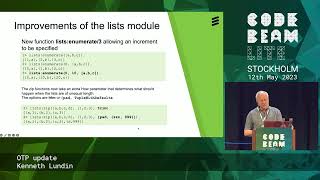
OTP Update - Code BEAM Lite Stockholm 2023
Discover the latest developments from the OTP Team, exploring their recent work and future plans in Erlang/OTP.

Ensuring Message Reliability in RabbitMQ: Clustering, Queues, and Resilience - RabbitMQ Summit 2023
Explore RabbitMQ's technology, clustering, and new features like quorum queues and streams. Learn how to design resilient systems and avoid potential outages in message-driven architectures.

Embracing Resilience in CD Pipelines - Chaos Engineering for Continuous Delivery
Explore strategies for enhancing CD pipeline resilience through chaos engineering. Learn to implement chaos steps, improve deployment success rates, and strengthen system reliability.

Chaos Validation Made Easy with Resilience Probes - Chaos Engineering 2024
Explore chaos engineering best practices and resilience probes to enhance system reliability. Learn implementation strategies and see a practical demonstration for effective chaos validation.
Implementing Chaos Engineering in a Risk-Averse Culture - Conf42 Chaos Engineering 2024
Learn strategies to implement chaos engineering in risk-averse environments. Explore principles, overcome conservative mindsets, and gain buy-in through a real-world case study.

Explaining Distributed Systems Like I'm Five
Discover simple explanations of distributed systems through easy-to-understand examples, exploring how they can scale infinitely.
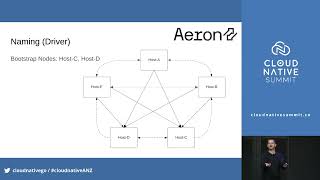
High Performance Messaging in the Cloud with Aeron
Explore Aeron's features for optimal cloud performance: multi-node distribution, DNS, fault tolerance, and performance extensions.
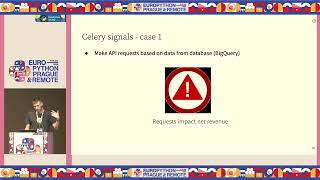
Data Pipelines with Celery: Modular, Signal-Driven and Manageable
Explore efficient data pipeline design using Celery, Redis, and signal-based triggering. Learn to segment workflows, manage API limits, and optimize data processing for improved throughput and maintainability.

Rembus.jl: A Pub/Sub and Remote Procedure Call Middleware for Microservices
Explore Rembus.jl, a middleware for distributed systems. Learn to implement pub/sub and RPC architectures, exchange data between languages, and leverage fault-tolerance features.
5 Quick Tips to Make Your Java Apps More Awesome
Discover 5 essential tips to enhance Java app resilience, performance, and cloud-readiness through practical demonstrations and code evolution.
OpenSergo and Dubbo Microservice Governance Best Practices
Explore microservice governance best practices using OpenSergo and Sentinel for Apache Dubbo, covering stability, fault tolerance, and traffic management.

Deciphering Cassandra's Prophecy - Preventing the Fall of Your Application
Learn from Bloomberg's Cassandra mistakes and solutions to prevent application failures. Discover key insights for running Cassandra at scale and avoiding common pitfalls.