
Explainable Program Synthesis by Localizing Specifications
Explore explainable program synthesis through subspecifications, enhancing implementation understanding with logical formulas. Learn algorithms for constructing and verifying subspecifications, their properties, and impact on code comprehension.

WheaCha: An Explanation Method for Models of Code
Explore WheaCha, a novel method for explaining code model predictions by separating input programs into 'wheat' and 'chaff', demonstrating its efficiency and usefulness in identifying defective models.
FOLD-SE: An Efficient Rule-based Machine Learning Algorithm with Scalable Explainability
Explore FOLD-SE, an efficient rule-based ML algorithm for classification tasks, offering scalable explainability and competitive performance with state-of-the-art methods.

Introduction to Explainable AI
Explore Explainable AI, interpretable ML methods, and Integrated Gradients in this comprehensive talk. Gain insights into attribution baselines and future research directions.
What is Interpretable Machine Learning - ML Explainability - with Python LIME Shap Tutorial
Explore interpretable machine learning with Python, covering LIME and SHAP techniques for explainable AI. Learn why ML explainability matters and how to implement it in your projects.
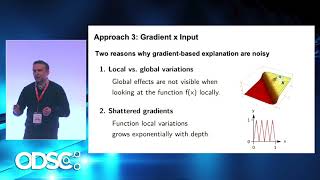
Explainable AI - Methods, Applications & Recent Developments
Explore Explainable AI methods, applications, and developments with Dr. Samek. Learn about Layer-wise Relevance Propagation for various data types and neural architectures, and discuss challenges in the field.
Human-Centric AI for Computer Vision and Machine Autonomy - ICCV'21 Tutorial
Explore human-centric AI in computer vision, covering explainable models, interpretable neural networks, and interactive machine learning for improved AI systems and autonomous machines.

Modeling Conceptual Understanding in Image Reference Games - CVPR 2020 Tutorial
Explore image reference games, conceptual understanding modeling, and machine theory of mind in this tutorial on interpretable vision and multi-agent communication.
Partial Dependence Plots in Machine Learning Explainability - Day 17 of Kaggle's 30 Days of ML
Explore Partial Dependence Plots for interpretable machine learning. Learn to visualize, build, and interpret PDPs, including 2D plots, to enhance model explainability and insights.
AI Explainability 360 - First Half of the Tutorial
Explore AI Explainability 360 toolkit: understand machine learning models, enhance transparency, and gain insights into AI decision-making processes for more responsible and ethical AI applications.

Turing Lecture - Algorithmic Accountability - Professor Ben Shneiderman, University of Maryland
Exploring algorithmic accountability and human-centered oversight for safer AI systems. Emphasizes comprehensible, predictable, and controllable designs to prevent failures and improve safety in critical services.
This AI Recognises Moods in Songs and Explains How It Does It
Explore a deep learning architecture for recognizing and explaining moods in songs, focusing on mid-level features, datasets, and potential applications in music emotion analysis.

Explainable Structured Machine Learning in Similarity, Graph and Transformer Models
Explores techniques for explaining complex machine learning models, focusing on similarity, graph, and transformer structures. Discusses applications in knowledge evolution, gender bias, and task-solving.

Towards Higher-Order and Disentangled Explainable AI
Explore advanced techniques in Explainable AI, including higher-order explanations and disentangled components, to enhance the interpretability of complex machine learning models.
AI for the Sciences - Recent Developments for XAI - IPAM at UCLA
Explore recent advancements in Explainable AI for scientific applications, focusing on novel insights and developments presented by Klaus-Robert Müller at IPAM's workshop.
The Missing Link- How AI Can Help Create a Safer Society and Better Businesses
Explore how AI and NLP can enhance crime-solving, improve business efficiency, and create safer societies by automating information linking and reducing investigative time.
Automated and Explainable Deep Learning for Clinical Language Understanding
Explore advanced deep learning techniques for clinical NLP, including automated model training, explainable AI, and scalable architectures to extract critical healthcare insights from unstructured medical notes.

Avoiding Loss of Quality in Tiny Models - Neuton.ai Partner Session
Explore compact AI models without sacrificing quality. Learn to assess model quality, understand decision-making logic, evaluate training data, and interpret model outputs for tinyML applications.
Explainable AI for the Geosciences
Explore machine learning interpretation techniques in geoscience, focusing on climate science applications and their potential for scientific discovery and increased trust in AI outputs.
Trusted and Responsible AI - Explainability, Adversarial Attacks, Bias, and Fairness
Explore key aspects of responsible AI: explainability, adversarial challenges, bias mitigation, and fairness. Learn strategies for building trustworthy and ethical AI systems in real-world applications.
Fostering Trust via Explainable ML Inferences
Explore the role of explainable ML inferences in building trust between service providers and consumers, with a practical framework for implementation and quantification.