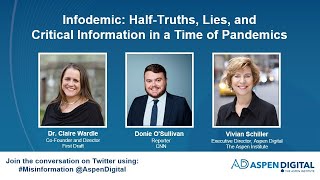
Infodemic: Half-Truths, Lies, and Critical Information in a Time of Pandemic
Explore misinformation trends during COVID-19, their impact, and strategies to combat false information. Learn from experts about verification, online disinformation, and media's role in addressing this critical issue.

COVID-19 Impact on School Sports - Project Play Summit 2020
Experts and young athletes discuss COVID-19's impact on school sports, including budget cuts, mental health issues, and decreased opportunities, while exploring challenges and potential solutions.

The War on Misinformation: Combating Viral Falsehoods in Public Health
Explore strategies to combat viral misinformation, focusing on vaccine skepticism and its impact on public health. Learn how data and technology can track and counter the spread of falsehoods.
When Life Challenges You to Redefine Your Identity
Inspiring journey of resilience and identity redefinition, from misdiagnosis to empowerment. Ziba's story showcases adaptability, courage, and the transformative power of embracing life's challenges with a learning mindset.

The Ethics of Breaking Barriers
Explore the concept of barriers, distinguishing between those that must be broken and those that should remain intact, while considering ethical implications and societal change.

Unconscious Bias in Medicine: Understanding Health Disparities
Explore unconscious bias in healthcare, its impact on health disparities, and strategies for promoting equitable patient care.
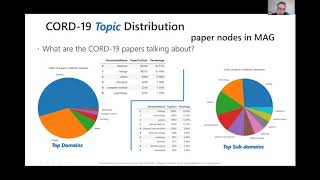
Knowledge Graph Recommendation Systems for COVID-19
Explore knowledge graph recommendation systems for COVID-19, leveraging Python skills to enhance understanding of pandemic-related data and insights.
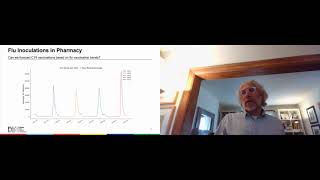
COVID-19 Vaccination Demand Forecasting in Canadian Pharmacies
Develop an analytic forecasting framework for COVID-19 vaccination demand in Canadian pharmacies using historical data, geospatial demographics, and digital surveys.

Machine Learning in One Health
Explore machine learning applications in One Health, integrating human, animal, and environmental health for holistic disease prevention and management.
The Maths of Contagion: Why Things Spread and Why They Stop - With Adam Kucharski
Explore mathematical models for disease spread, misinformation, and internet memes. Learn how outbreaks occur, why some are predictable, and strategies for controlling epidemics and viral content.
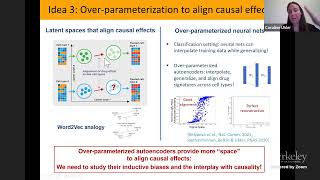
Causality and Autoencoders in Light of Drug Repurposing for COVID-19
Explore causal inference and autoencoders in drug repurposing for COVID-19, covering observational data, causality hierarchy, and predicting interventions with Caroline Uhler from MIT.
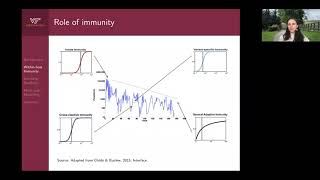
Modelling Immunity to Malaria
Explore mathematical models of malaria immunity, examining within-host dynamics, antigenic variation, and population-level impacts to enhance understanding and control strategies.
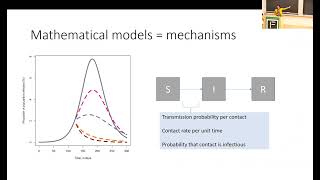
Mathematical Modeling of Epidemics - Are We Confronting or Amplifying Health Inequities?
Explores how mathematical models of epidemics impact public health decisions and their potential to address or exacerbate health inequities, using examples from HIV, COVID-19, and mpox.
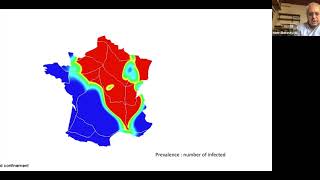
Mathematics for Public Health - Inaugural Lecture by Henri Berestycki
Exploring diffusion in epidemiology models, including SIR equations and reaction-diffusion systems, with applications to COVID-19 spread and the impact of individual behaviors on epidemic dynamics.
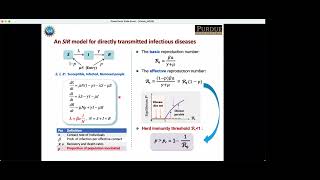
Mathematical Models of Infectious Diseases - Consequences of Underlying Assumption
Explore the impact of underlying assumptions in mathematical models of infectious diseases, examining their consequences for disease dynamics and control strategies.

Modelling of Disease Spread Through Heterogeneous Population
Explore spatial variability in disease spread using PDEs with state-dependent diffusion. Examine density-dependent infection rates and super-diffusive propagation, with a case study on coronavirus in Nova Scotia.
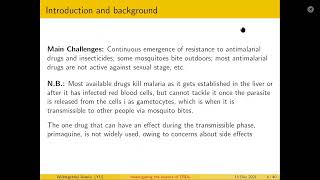
Investigating Transmission-Blocking Anti-malarial Drugs: A Mathematical Modelling Approach
Explore mathematical models assessing transmission-blocking antimalarial drugs' impact on disease control, focusing on treatment coverage, drug efficacy, and protective effects in malaria hotspots.
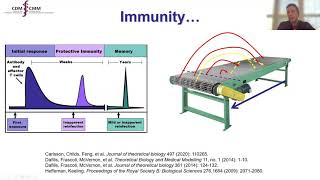
Modelling Immunity
Explore mathematical models of immunity generation and waning, fitted to data for estimating seroprevalence in Canadian jurisdictions, with applications to COVID-19 vaccination programs.
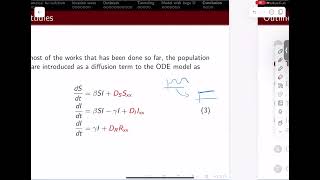
Modelling of Spatial Infection Spread Through Heterogeneous Population
Explore spatial infection spread modeling in heterogeneous populations, examining key factors and methodologies for understanding disease transmission dynamics.

Oxford Mathematician Explains SIR Travelling Wave Disease Model for COVID-19
Explore the SIR Travelling Wave model for disease spread, focusing on COVID-19. Learn how population movement affects epidemic dynamics, including spread speed and severity, and the importance of social distancing measures.

Oxford Mathematician Explains SIR Disease Model for COVID-19
Explore the SIR disease model's application to COVID-19, covering its derivation, spread prediction, peak infection, and total cases. Learn how social distancing impacts these factors.