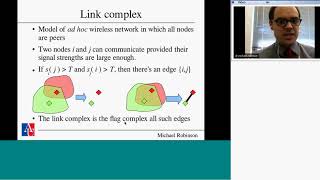
Sheaf Based Modeling of Wireless Communications
Explore sheaf-based modeling for wireless communications, covering topology, simplicial complexes, interference, and network activation. Learn about persistence, homological invariants, and simulation examples.
Michael Baake - A Cocycle Approach to the Fourier Transform of Rauzy Fractals
Explore Fourier transforms of Rauzy fractals and their role in analyzing spectra of Pisot inflation tilings, with applications to diffraction theory and dynamical systems.
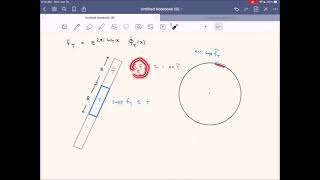
The Restriction Problem and the Polynomial Method - Lecture I
Explore Stein's restriction conjecture, the Kakeya conjecture, and the polynomial method in harmonic analysis. Learn about wave packet decomposition and its applications in studying hypersurface-supported functions.
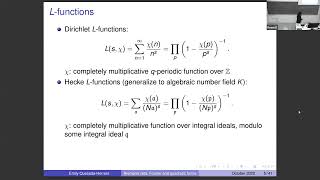
On the Riemann Zeta-Function, Fourier Optimization and Quadratic Forms
Explore the Riemann zeta-function, Fourier analysis, and quadratic forms in number theory. Delve into Selberg's theorem, Berry's conjecture, and representation of integers by quadratic forms.
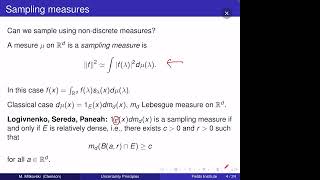
Sampling, Interpolation, and Uncertainty
Explore sampling theory, interpolation techniques, and uncertainty principles in function spaces, with applications in signal processing and control theory.
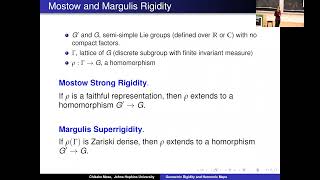
Harmonic Maps and Rigidity
Explore harmonic maps, rigidity theorems, and their applications in geometry. Delve into existence theory, Mostow's strong rigidity, and approaches to rigidity using harmonic maps and the Bochner method.
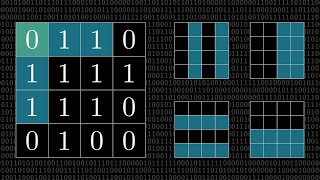
How to Send a Self-Correcting Message - Hamming Codes
Discover error correction codes through an engaging exploration of Hamming codes, learning how to create self-correcting messages for reliable data transmission.
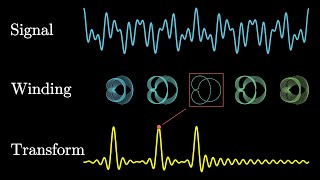
What is the Fourier Transform? A Visual Introduction
Animated exploration of the Fourier Transform, offering a visual and intuitive understanding of this complex mathematical concept. Ideal for those seeking a clear, engaging introduction to signal processing fundamentals.
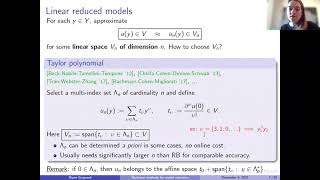
Nonlinear Reduced Models for Parametric/Random PDEs
Explore efficient techniques for constructing reduced models of parametric/random PDEs, focusing on error estimation, library construction, and practical applications in thermal systems and state estimation.

Data-Driven Discovery of Linear Dynamical Systems Over Graphs via Dynamical Sampling
Explore linear dynamical systems on graphs through data-driven discovery, focusing on efficient recovery of missing information and optimal sampling strategies for graph signal processing.
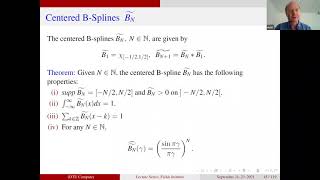
Introduction to Frames and Riesz Bases - Part 2
Explore Fourier transforms, wavelet theory, and Gabor frames in this advanced mathematics lecture, focusing on recent developments in frame theory and Riesz bases.
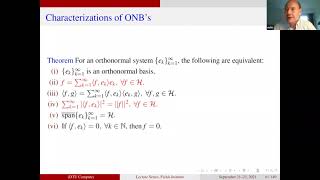
Introduction to Frames and Riesz Bases - Part 1
Explore key concepts of frames and Riesz bases in functional analysis, including characterizations, properties, and applications like Sigma-Delta quantization.
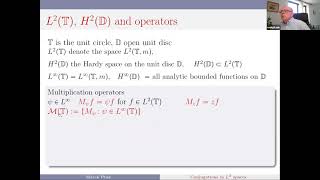
Conjugations in L2 Spaces on the Unit Circle and the Real Line
Explore conjugations in L2 spaces, examining various types and their applications on the unit circle and real line. Includes examples and connections to Fourier transforms.
Topological Complexity of Fibrations and Covering Maps
Explore topological complexity of fibrations and covering maps, examining their homotopy invariance and applications in robotics and mechanical device manipulation.
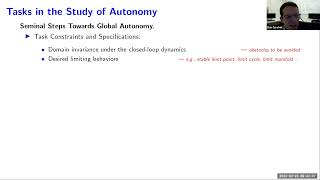
Wanted- Topologists for Autonomous Robots Community
Exploring topological complexity in robotics: from path planning to task spaces. Insights into rigorous formulations for robotic autonomy, emphasizing environment topology and combinatorics in cooperative motion.
Recent Advances in Theory and Implementation of Multi-Parameter Persistence
Explores recent developments in multi-parameter persistence, covering stable filtrations and discrete descriptors. Includes interactive clustering software demo and discusses extensions of one-parameter persistence concepts.
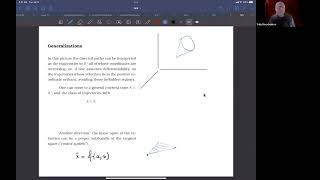
Linear Obstacles in Linear Systems and Ways to Avoid Them
Explore topology in control theory, focusing on obstacle-avoiding paths and cohomology rings using homotopy limits. Gain insights into theoretical computer science applications.
Transportation Engineering for Connected and Automated Vehicles
Explore the impact of connected and automated vehicles on transportation engineering, focusing on mathematical challenges and opportunities in this emerging field.
Functional Inequalities and Improvements: Stability - Part 1
Explore functional inequalities, their applications, and recent developments in stability theory. Learn strategies for optimizing constants and functions in various mathematical fields.
Calculus 3 - TNB (Frenet-Serret) Frames, Curvature, Torsion, Encapsulation
Explore TNB Frames, curvature, and torsion in vector calculus. Learn to compute Frenet-Serret frames, find osculating circles and planes, and perform vector encapsulation for 2D functions.
Stability of Critical Points - Differential Equations
Explore critical points in differential equations to determine solution behavior, enhancing your understanding of stability and general solution characteristics.